

TL;DR:
- Lexical density measures the proportion of content words in a text, indicating how information-rich it is. It guides writers to calibrate their language based on audience and purpose, balancing clarity and detail. Adjusting lexical density through techniques like nominalisation and vocabulary expansion improves the effectiveness of writing.
Lexical density is defined as the proportion of content words to total words in a text, expressed as a percentage. Content words are nouns, main verbs, adjectives, and adverbs. They carry the meaning of a sentence. Function words such as articles, prepositions, and conjunctions hold the grammar together but add no information. Understanding what lexical density in a text actually measures helps writers and students calibrate their writing for any audience, from a university essay to a casual blog post. Grammarly and similar tools flag style issues, but lexical density analysis goes deeper, revealing how information-rich your writing truly is.
What is lexical density in a text?
Lexical density is the ratio of content words to total words in a passage. A text with many nouns, verbs, adjectives, and adverbs packs more information into fewer words. A text full of function words spreads the same information more thinly. Systemic Functional Linguistics, developed by linguist M.A.K. Halliday, uses lexical density to distinguish written language from spoken language. Written texts are lexically denser but grammatically simpler than spoken ones. That distinction matters because it explains why a lecture transcript feels easier to follow than a journal article covering the same topic.

The definition of lexical density is not just academic. Every time you write a sentence, you are making choices about how much meaning to pack in. A sentence like "The rapid deterioration of urban infrastructure demands immediate governmental intervention" is dense. A sentence like "The roads in cities are getting worse and the government needs to do something about it" says the same thing with far fewer content words. Both are grammatically correct. Only one is appropriate for a policy report.
How is lexical density calculated in texts?
The formula for lexical density is straightforward. Lexical density is calculated as the number of lexical words divided by the total number of words, multiplied by 100. Written as a formula: (Number of Lexical Words / Total Number of Words) × 100.
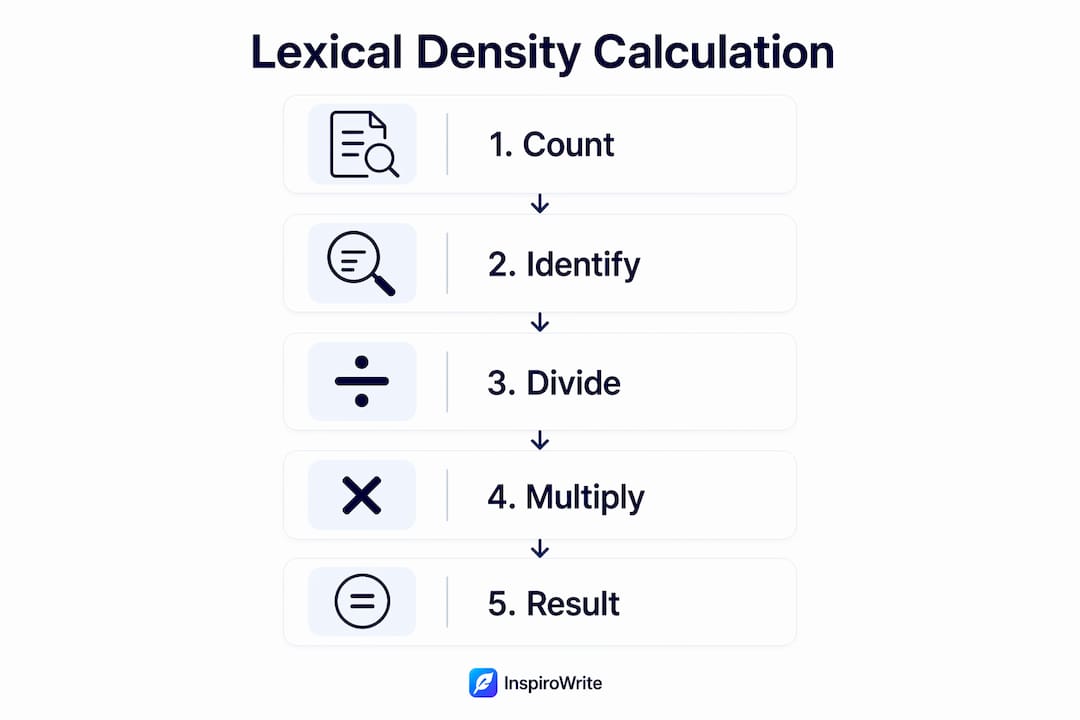
Take this sentence: "The old dog ran quickly across the muddy field." Total words: 9. Content words: old (adjective), dog (noun), ran (verb), quickly (adverb), muddy (adjective), field (noun). That gives 6 content words. The lexical density score is (6 / 9) × 100 = 66.7%. That score places this sentence firmly in the academic or professional range.
Which words count as content words?
Content words carry meaning independently. The four main categories are:
- Nouns: people, places, things, and ideas (teacher, London, justice)
- Main verbs: action or state words, excluding auxiliaries (run, consider, believe)
- Adjectives: words that describe nouns (rapid, complex, written)
- Adverbs: words that modify verbs, adjectives, or other adverbs (quickly, clearly, very)
Function words include articles (a, the), prepositions (in, on, at), conjunctions (and, but, because), pronouns (he, she, it), and auxiliary verbs (is, was, will). These words are excluded from the content word count.
Lexical density benchmarks by text type
Lexical density benchmarks vary significantly across text types. The table below shows typical ranges.
| Text type | Typical lexical density |
|---|---|
| Spoken conversation | Under 40% |
| General-audience writing | 40–50% |
| Academic and professional texts | 50–70% |
| Legal documents | 65–75%+ |
These ranges show that the appropriate score depends entirely on context. A legal contract at 35% would read as vague. A casual blog post at 72% would feel exhausting.
Pro Tip: When counting content words, watch out for phrasal verbs. "Give up" is one verb, not two words. Count it as a single content word to avoid inflating your score.
What is the importance of lexical density for writers and students?
Lexical density directly shapes how much information a reader receives per sentence. Readability scores measure ease of understanding, while lexical density measures the amount of meaningful content. The two metrics address different problems. A text can score well on readability and still be informationally thin.
Academic writing demands higher lexical density because it must convey complex ideas efficiently. A university essay that scores below 45% will likely feel underdeveloped to a marker. The writing may be grammatically correct but lack the information density expected at degree level. Conversely, web content aimed at a general audience benefits from a lower score, typically in the 40–50% range, because readers skim and need breathing room between ideas.
Writers should adjust lexical density to match their register. Register is the level of formality and the conventions appropriate to a specific context. A job application letter sits at a different register than a text message. Lexical density should be calibrated to register appropriateness rather than maximised. Pushing density above 70% without good reason makes text harder to process, not more impressive.
Practical techniques for adjusting lexical density include:
- Nominalisation: converting verbs into nouns to increase density ("decide" becomes "the decision", "analyse" becomes "the analysis")
- Expanding academic vocabulary: replacing common verbs with precise nouns and adjectives
- Sentence combining: merging two short sentences into one to raise the content word ratio
- Removing filler phrases: cutting "it is the case that" or "due to the fact that" reduces function words and raises density
- Adding descriptive detail: inserting relevant adjectives and adverbs where they add meaning, not decoration
How does lexical density differ from lexical diversity and readability?
Three metrics often get confused: lexical density, lexical diversity, and readability. Each measures something different. Lexical density measures content word proportion while lexical diversity measures vocabulary variety, expressed as the type-token ratio. Readability measures ease of understanding based on sentence length and syllable count.
The type-token ratio compares the number of unique words (types) to total words (tokens). A text that repeats the word "important" fifteen times has low lexical diversity even if its density score is high. A text can be dense with information but repetitive in vocabulary. These are separate problems requiring separate solutions.
Readability scores such as the Flesch-Kincaid Grade Level or the Gunning Fog Index assess how easy a text is to process. They penalise long sentences and polysyllabic words. Lexical density does not factor in sentence length or syllable count at all. A short, dense sentence can score poorly on readability but well on lexical density.
| Metric | What it measures | Key tool or method |
|---|---|---|
| Lexical density | Content word proportion | TextAnalyzer.io, manual formula |
| Lexical diversity | Vocabulary variety | Type-token ratio |
| Readability | Ease of understanding | Flesch-Kincaid, Gunning Fog Index |
Lexical density alone does not measure writing quality. A text with 68% density is not automatically better than one at 45%. Quality depends on whether the density matches the purpose and audience. Using all three metrics together gives a far more complete picture of a text's strengths and weaknesses.
Pro Tip: Run your draft through a readability checker like the Hemingway Editor alongside a lexical density tool like TextAnalyzer.io. If readability is low and density is high, try breaking long sentences into shorter ones without reducing your content word count.
How to apply lexical density knowledge to improve your writing
Applying lexical density analysis to your own writing is a practical, repeatable process. The steps below work for essays, reports, and professional documents alike.
- Paste your text into TextAnalyzer.io to get an instant lexical density score. Note whether it falls within the appropriate range for your text type.
- Identify your function word clusters. Phrases like "in order to", "it is the case that", and "due to the fact that" inflate your function word count without adding meaning. Cut them.
- Apply nominalisation where appropriate. Academic writing benefits from noun-heavy constructions. "The committee decided" becomes "the committee's decision". This raises density without adding jargon.
- Expand your content vocabulary. Replace weak verbs with precise nouns and adjectives. "Things got worse" becomes "conditions deteriorated". The role of collocations in English writing matters here. Choosing the right word pair raises both density and clarity.
- Reassess after editing. Recalculate your score after each revision pass. Aim for the benchmark range that matches your text type, not the highest possible score.
Writing teachers use lexical density diagnostically. Techniques like nominalisation, vocabulary expansion, and sentence combining are standard tools for lifting low-density writing to the appropriate register. These are not tricks. They are the mechanics of mature writing.
Tailoring density to your audience is the most important application. A blog post for secondary school students needs a density of around 40–45%. A dissertation introduction should sit closer to 55–65%. Web content for a general audience benefits from shorter sentences and more function words, which naturally lower density and improve scannability. Understanding English writing conventions for your specific genre is the fastest way to calibrate your density instinctively.
Advanced writers can also consider clause-based calculation. Some approaches calculate lexical density based on ranking clauses rather than total words, which better captures the relationship between grammatical intricacy and lexical complexity. For most students, the word-based formula remains the standard and most accessible method.
Key takeaways
Lexical density measures the proportion of content words in a text, and matching that proportion to your audience and purpose is the defining skill of effective writing.
| Point | Details |
|---|---|
| Core definition | Lexical density is content words divided by total words, multiplied by 100. |
| Benchmark ranges | Spoken language sits below 40%; academic texts typically reach 50–70%. |
| Not a quality metric | High density does not mean better writing; register match determines quality. |
| Three distinct metrics | Lexical density, lexical diversity, and readability each measure different things. |
| Practical revision | Use nominalisation, sentence combining, and vocabulary expansion to adjust density. |
Why lexical density changed how I think about editing
Most writers I have worked with over the years treat editing as a grammar exercise. They fix commas, tighten sentences, and call it done. Lexical density analysis revealed a different layer entirely. A text can be grammatically flawless and still fail its reader by being informationally wrong for the context.
The most common mistake I see is students writing academic essays at a density more suited to a conversation. The sentences are clear, the grammar is fine, but the information load is too light. The fix is not to write more. It is to write more densely. Nominalisation alone, converting verbs and adjectives into nouns, can lift a score by several percentage points without adding a single extra sentence.
The counterintuitive lesson is that density above 70% hinders comprehension. Writers who discover lexical density sometimes overcorrect, cramming content words into every sentence until the text becomes unreadable. The goal is calibration, not maximisation. Think of lexical density as a dial, not a scoreboard. Turn it up for a dissertation, turn it down for a newsletter, and always check whether your reader can still follow you comfortably.
My advice to any writer starting out with this concept: calculate your density on a piece you have already written and liked. That score becomes your baseline for that genre. Work outward from there. You will develop an instinct for density far faster than any formula can teach you.
— Mike
How Inspirowrite helps you write with greater clarity
Writers who want to improve their writing clarity need more than a grammar checker. Inspirowrite provides AI-powered proofreading that delivers feedback within seconds, covering style, vocabulary, and register alongside standard grammar checks.
Inspirowrite's tools are built for students and writers who need immediate, reliable feedback without compromising their privacy. Content submitted to Inspirowrite is never used to train AI models, which matters when you are working on original academic or professional material. Whether you are adjusting lexical density in a dissertation or polishing a business report, Inspirowrite gives you the writing quality support you need to produce a polished final draft quickly and confidently.
FAQ
What is lexical density in simple terms?
Lexical density is the percentage of content words (nouns, main verbs, adjectives, adverbs) in a text compared to all words. A higher percentage means the text carries more information per word.
How do I calculate lexical density?
Divide the number of content words by the total number of words, then multiply by 100. For example, 30 content words in a 60-word passage gives a lexical density of 50%.
What is a good lexical density score for an essay?
Academic essays typically fall in the 50–70% range. Scores below 45% suggest the writing may lack sufficient information density for a university-level audience.
Is lexical density the same as readability?
No. Readability measures how easy a text is to process based on sentence length and syllable count. Lexical density measures how much meaningful content the text contains. The two metrics address different aspects of writing quality.
What tools measure lexical density?
TextAnalyzer.io calculates lexical density automatically from pasted text. The Hemingway Editor assesses readability. Using both together gives a more complete picture of your writing's strengths.