

TL;DR:
- Writing confidence often depends on taking small, immediate actions that separate creation from judgment. Using timers and sharing minimally can help overcome evaluative interference, making it easier to start writing. Building a habit through consistent, low-pressure routines creates evidence that gradually boosts confidence over time.
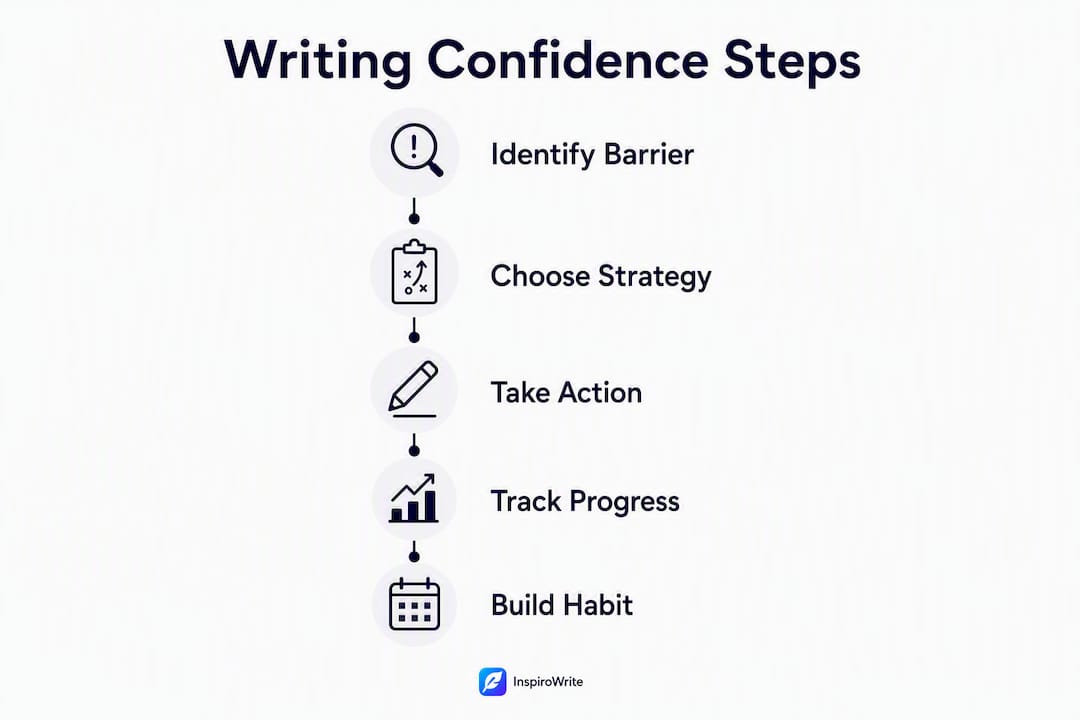
Begin now: write one imperfect sentence, set a 10-minute timer, and tell one person you are doing it. Those three moves are not warm-up exercises. They are the mechanism. The first sentence lowers the stakes from "produce something good" to "produce something." The timer separates drafting from judging. The social step creates the lightest possible accountability before doubt has time to negotiate.
Why does that sequence work? Because most writing confidence problems are not skill problems. They are interference problems: the part of your brain that evaluates your work fires at the same time as the part that generates it, and the two cancel each other out. Separating those phases, even crudely, breaks the loop. The National Centre for Writing recommends treating a first draft as a rough assembly rather than a finished product, which reframes the entire task from performance to construction.
A 146-writer survey found no significant difference between professionals and novices in the type of writing block they experienced or in which solutions worked for them. The barrier you are hitting today is the same one experienced writers hit. The difference is that experienced writers have a toolkit.
Pro Tip: Write your first sentence by hand if you are stuck. The slower pace of handwriting tends to quiet the internal critic long enough to get one idea onto the page.
Table of Contents
- What psychological barriers are actually stopping you?
- Strategies matched to each barrier
- How to build a writing habit that actually sticks
- Warm-up exercises and prompts you can use right now
- Where to find feedback and accountability in the UK
- Why these tactics work: the evidence behind them
- When writing anxiety needs more than a tactic
- Key takeaways
- The thing most writers get backwards
- Private, instant feedback for writers who are not ready to share
- Useful sources and further reading
- FAQ
What psychological barriers are actually stopping you?
Naming the barrier matters because the fix differs by type. Trying a freewriting sprint when your real problem is not knowing what comes next will waste 20 minutes and leave you feeling worse.
Perfectionism and evaluative interference
This is the most common barrier. You write a sentence, immediately decide it is inadequate, delete it, and start again. The internal critic is not waiting until you finish; it is sitting next to you while you type. It affects novices and published authors alike, and it tends to intensify around work that feels personally significant.
How to tell it from a skill gap: if you can talk fluently about your topic but cannot write it down, the barrier is evaluative, not technical.

Fear of judgement and exposure
This one feels like perfectionism but has a social dimension. The worry is not just that the writing is bad; it is that someone will read it and think less of you. Writers working on memoir, personal essays, or anything autobiographical feel this acutely. So do writers in professional contexts where their competence is visible.
Structural uncertainty
You sit down, you want to write, and you genuinely do not know what comes next. This is a different problem from the internal critic. It is a planning or knowledge gap, not a confidence gap, though it produces the same paralysis.
Procrastination and time scarcity
Sometimes the barrier is not psychological in the clinical sense; it is logistical. Writing keeps getting displaced by tasks with clearer deadlines. The result is that writing never happens, and the longer it does not happen, the more intimidating it becomes.
Imposter feelings
The sense that you have no right to be writing this, that someone more qualified should be doing it, or that your previous work was a fluke. This is particularly common among writers moving into a new genre, a higher-stakes format, or a public platform for the first time.
- Perfectionism: internal critic fires during generation, not after
- Fear of judgement: social stakes feel higher than the writing itself
- Structural uncertainty: genuine planning gap, not a confidence problem
- Procrastination: logistical displacement that compounds over time
- Imposter feelings: identity mismatch between self-image and the writing task
Strategies matched to each barrier
The diagnostic question before you pick a tactic: is the problem that your critic is too loud, or that you genuinely do not know what to write next? Practitioners recommend making that distinction first, because freewriting helps one but not the other.
For evaluative interference: the writer's cap session
Put on your "writer's cap" and make one rule: no editing during the draft. Not a word. Close the thesaurus tab. Turn off spell-check if it distracts you. Set a timer for 10, 15, or 30 minutes and write until it goes off. The only permitted action is forward motion.
A simple freewriting template: write the phrase "What I am trying to say is..." and then finish the sentence without stopping. Keep going for the full timebox. The phrase gives your brain a low-stakes entry point that bypasses the performance register entirely.
Separating drafting and editing into distinct cognitive phases is one of the most consistently supported interventions in writing research. Professionals often use separate files or even separate devices to enforce the split physically.
For structural uncertainty: the 10-minute decision checklist
Before you open a blank document, spend 10 minutes answering three questions in bullet form:
- What is the one thing I want this piece to say?
- What does the reader need to know first for that to land?
- What is the single next scene, argument, or section I need to write today?
That is your mini-outline. It does not need to be complete. It needs to be specific enough that you know what the first sentence is about.
For procrastination: implementation intentions
An implementation intention is a simple "when X, then Y" statement written in advance. "When I sit down with my coffee at 7:30 AM, I will open my draft and write for 15 minutes before checking email." Research on habit formation consistently shows that specifying the when and where of a behaviour dramatically increases follow-through compared to a general intention to write more.

Timebox options can vary, with shorter durations serving as lower barriers and longer durations allowing for more substantial writing blocks.
For fear of judgement: staged exposure
Start with the lowest-stakes version of sharing. Write one paragraph and read it aloud to yourself. Then share one sentence with a trusted peer, not for feedback, just for the act of sharing. Then try a low-stakes publication: a private blog, a locked social media post, a writing group with an agreed feedback contract.
Pro Tip: Before sharing a draft, write a brief feedback contract: specify what you want the reader to focus on (structure, tone, clarity) and what you do not want (line edits on a first draft). This keeps critique useful rather than destabilising.
How to build a writing habit that actually sticks
Confidence is a lagging indicator. It does not arrive before you write well; it arrives after you have written consistently for long enough to accumulate evidence. That distinction matters because it means waiting to feel confident before you start is the wrong order of operations.
The mechanics of a sustainable writing habit rest on three things: a specific trigger, a tiny routine, and a record of completion.
The habit template
Fill in each line before your next session:
- When: [specific time or event, e.g. "after breakfast on weekdays"]
- Where: [specific location, e.g. "at the kitchen table with headphones on"]
- Cue: [one physical action that signals writing time, e.g. "open the notebook, write today's date"]
- Tiny routine: [the minimum viable session, e.g. "write 300 words or 10 minutes, whichever comes first"]
- Reward: [something immediate, e.g. "make a second coffee, tick the box in my habit tracker"]
The micro-goal of 300 words or 10 minutes is not a ceiling. It is a floor. On good days you will exceed it. On bad days it is enough to maintain the streak, and the streak is what builds confidence over weeks.
The brag file
Keep a running document, a simple text file or a notes app, where you record every writing problem you solved. Finished a difficult paragraph? Log it. Found the right word for something you had been circling for days? Log it. Practitioners find that a solved-problem journal provides tangible evidence during low-confidence periods when the internal critic insists you are not making progress.
A four-week habit plan
A suggested four-week habit plan starts with brief daily writing sessions and gradually increases effort and social sharing, with adaptation based on actual progress made.
Warm-up exercises and prompts you can use right now
A two-minute warm-up before a writing session shortens the transition from distraction to flow. The ritual does not need to be elaborate: open your document, write today's date, and copy one of the prompts below as your first line. That is it.
Idea generation prompts
- "The thing nobody mentions about [your topic] is..."
- "If I had to explain this to a ten-year-old, I would start by saying..."
- "The question I keep avoiding is..."
Voice and character prompts
- "My narrator would describe this room as..."
- "The character who disagrees with my protagonist would say..."
- "Write the scene from the perspective of the least important person in it."
Argumentative clarity prompts
- "My central claim is X, and the strongest objection to it is..."
- "The evidence I am most confident about is... The evidence I am least sure of is..."
- "If this argument is wrong, it is wrong because..."
Scene continuation prompts
- "The next thing that happens is... and the reason it matters is..."
- "What the character does not say in this scene is..."
- "Fast-forward three hours. Where are they and what has changed?"
Timed exercise instructions
For a 10-minute sprint: pick any prompt above, write without stopping, do not re-read until the timer ends. For a 15-minute session: use the prompt for the first five minutes, then switch to your actual project for the remaining ten. For a 30-minute block: spend the first five on a warm-up prompt, the next twenty on your draft, and the final five on a single note about what comes next (not editing, just a signpost).
Where to find feedback and accountability in the UK
Harvard GSAS writing practitioners emphasise that community reduces the isolating quality of doubt. Finding a small, regular group lowers the perceived risk of sharing early drafts because the stakes feel shared rather than individual.
UK-relevant options
- National Centre for Writing (Norwich): Runs workshops, mentoring, and online events for writers at all stages. Based in Norwich but accessible nationally via online programming.
- University writing centres: Most UK universities offer writing support to enrolled students; many also run public-facing events. The University of East Anglia's creative writing programme, for instance, has a long history of community-building around craft.
- Local writing groups: The Society of Authors maintains a directory of regional groups. Many local libraries host free monthly writing groups.
- Online accountability partners: A single writing partner with a shared weekly check-in is often more effective than a large group. Agree on a word-count target and a brief message confirming completion.
- Structured challenges: Events like NaNoWriMo shift the emphasis from quality to completion, which is exactly the right frame for building momentum. External accountability of this kind consistently helps writers overcome perfectionism and procrastination.
A simple feedback contract
Before sharing a draft, agree on four things with your reader:
- Scope: which section or draft stage you are sharing
- Tone: whether you want encouragement, honest critique, or both
- Focus areas: structure, voice, clarity, or argument (pick one or two, not all)
- Turnaround: a specific date by which you need the response
Understanding how feedback drives essay improvement is worth reading before you set up your first feedback exchange. The short version: specific, scoped feedback builds confidence; vague or comprehensive feedback tends to undermine it.
Why these tactics work: the evidence behind them
The distinction between evaluative interference and structural uncertainty is not just a useful frame; it is the diagnostic that determines which intervention will actually help. Research confirms that applying the wrong fix wastes time and can deepen avoidance. Freewriting is highly effective for evaluative interference and largely useless for structural uncertainty, where a planning tool is needed instead.
| Barrier type | Supported intervention | Mechanism |
|---|---|---|
| Evaluative interference | Freewriting, timed sprints, writer's cap sessions | Separates generation from evaluation; reduces self-monitoring |
| Structural uncertainty | Mini-outlines, argument maps, 10-minute decision checklists | Provides a concrete next step; removes ambiguity |
| Procrastination | Implementation intentions, timeboxing, external challenges | Specifies when/where; shifts focus from quality to completion |
| Fear of judgement | Staged exposure, feedback contracts, low-stakes publication | Gradually raises the stakes; keeps critique constructive |
| Imposter feelings | Brag file, solved-problem journal, community | Builds an evidence base against the internal critic |
The survey finding that professionals and novices experience the same block types at similar rates is worth sitting with. It means the barrier is not a sign of inadequacy. It is a feature of the writing process itself, one that every writer manages rather than eliminates.
When writing anxiety needs more than a tactic
Most writing confidence problems respond to the strategies above. Some do not, and it is worth knowing the difference.
Signs that personal support or professional advice may be needed:
- Persistent anxiety about writing that extends into other areas of life
- Avoidance that has lasted months and is affecting your work, studies, or relationships
- Severe concentration difficulties that make sustained reading or writing impossible regardless of the strategy you try
- Physical symptoms (racing heart, nausea, sleep disruption) triggered by writing tasks
UK signposting
The NHS offers mental health support via your GP; if writing anxiety is part of a broader anxiety pattern, a referral to talking therapies through IAPT (Improving Access to Psychological Therapies) is a reasonable starting point. The Society of Authors provides mentoring for professional writers experiencing career-related stress. Many further and higher education institutions offer counselling services that can address writing-specific anxiety alongside general support.
When contacting a GP or counsellor, describe the functional impact rather than the abstract feeling: "I have not been able to complete any written work for three months, which is affecting my studies and my income" gives a clinician more to work with than "I feel anxious about writing."
Key takeaways
Confidence in writing is not a prerequisite for starting; it is the result of starting repeatedly, recording what works, and gradually raising the stakes.
| Point | Details |
|---|---|
| Three immediate micro-actions | Write one imperfect sentence, set a 10-minute timer, tell one person you are doing it. |
| Diagnose before you fix | Identify whether your barrier is evaluative interference or structural uncertainty before choosing a tactic. |
| Confidence lags behind action | Keep a brag file of solved problems; it provides evidence when the internal critic is loudest. |
| Habit over heroics | A daily 10-minute session beats an occasional two-hour block for building lasting confidence. |
| Inspirowrite for instant feedback | Use Inspirowrite to get private, immediate corrections on early drafts without public exposure. |
The thing most writers get backwards
The conventional advice is to build confidence first, then share your work. In practice, that sequence never closes. Confidence does not accumulate in private; it accumulates through the act of finishing something, sending it, and surviving the response.
What actually shifts confidence is not praise. It is evidence. The brag file works not because it is motivational but because it is factual: here is a list of things you wrote, problems you solved, drafts you completed. When the internal critic says you cannot do this, the file says you already did. That is a different kind of argument.
The other thing worth saying: the gap between a writer who produces work and one who does not is rarely talent. It is almost always the presence or absence of a system that makes starting easier than not starting. The tactics in this article are that system. None of them require inspiration. They require a timer and a willingness to write badly for ten minutes.
Understanding the real role of proofreading in the revision stage is worth reading once you have a draft worth polishing. The confidence that comes from a clean, well-edited piece is different from the confidence that comes from finishing a draft, and both are worth having.
Private, instant feedback for writers who are not ready to share
Inspirowrite gives you the one thing that is hardest to get when you are rebuilding confidence: honest, immediate feedback on a draft that nobody else has to see. Paste in your text and within seconds you have grammar corrections, tone suggestions, and rephrasing options, all processed privately, with your content never used to train AI models.
That privacy matters more than it sounds. The fear of exposure is one of the most common writing confidence barriers, and most feedback routes require you to share your work before it feels ready. Inspirowrite removes that condition entirely. You can iterate on a draft ten times before anyone reads it, and each iteration builds the kind of craft confidence that comes from seeing your own writing improve in real time.
The free plan lets you start without a subscription. If you want to understand exactly how your data is handled before you begin, the privacy policy sets it out plainly. Start with a paragraph you have been avoiding, paste it in, and see what comes back.
Useful sources and further reading
These resources are worth bookmarking. Use them selectively; reading about writing is not a substitute for writing.
- National Centre for Writing — Practical guidance on the psychological barriers to beginning, including the rough-assembly framing of first drafts. UK-based and free to access.
- Harvard GSAS: Overcoming Writing Obstacles — Concise practitioner advice on community, isolation, and the mechanics of getting unstuck. Short and direct.
- Writing Challenges: Obstacles, Fixes and Exercises — Covers the evaluative vs structural distinction in detail, with exercises mapped to each barrier type.
- Happy Writer Hub: How to Overcome Self-Doubt as a Writer — Practical advice on the brag file and confidence as a lagging indicator.
- Lindenwood University: Overcoming Writer's Block — A readable overview of block types and strategies, useful as a secondary reference.
- Writer's Life: Building Writing Confidence One Draft at a Time — Accessible, draft-focused advice for writers at any stage.
- University of East Anglia — Home to one of the UK's most respected creative writing programmes; the website lists public events and resources.
- Society of Authors — UK membership organisation with mentoring, regional groups, and professional support for writers at all career stages.
Keep action first. Read one source, apply one tactic, and return to the reading only when you need a new tool.
FAQ
How do you overcome barriers to writing skills?
Diagnose whether the barrier is evaluative (your internal critic is too loud) or structural (you do not know what comes next), then apply the matched fix: freewriting for the first, a mini-outline for the second. A 146-writer survey found the same interventions work for novices and professionals alike.
How do you regain confidence in your writing?
Start with the smallest possible action: one sentence, a 10-minute timer, and a record of completion. Confidence functions as a lagging indicator, meaning it follows consistent action rather than preceding it, so the goal is to accumulate evidence through repetition, not to wait until you feel ready.
Why do some writers struggle so much with getting started?
The most common cause is evaluative interference: the part of the brain that judges writing fires at the same time as the part that generates it. Separating drafting from editing, even with a simple timer, breaks that loop and restores forward motion.
What is a practical first step for writing anxiety?
Write one imperfect sentence right now, without editing it. The act of producing something, however rough, shifts the task from abstract to concrete and lowers the stakes enough to continue. Inspirowrite can then give you private, instant feedback on that draft before you share it with anyone.