

Passive voice pairs a form of "to be" with a past participle, so the subject receives the action instead of doing it: "The results were recorded" rather than "We recorded the results." Three rules cover most essay situations:
- Avoid it when it hides who did what or buries your argument in vague phrasing.
- Keep it when the action or the result matters more than the actor, when the actor is unknown, or when you're writing up a scientific method.
- Revise it whenever naming a clearer subject would sharpen your point.
One quick example: "Mistakes were made during the analysis" (passive, evasive) becomes "The researchers misread the calibration data" (active, accountable).
Key Takeaways
Passive voice is correct English, not an error, and the difference between strong and weak essay writing lies in choosing it on purpose rather than by default.
| Point | Details |
|---|---|
| Know the formula | Passive voice pairs a form of "to be" with a past participle, moving the recipient into the subject slot. |
| Check for the "by" clue | Look for a trailing "by" phrase, but remember the agent can be dropped entirely. |
| Keep passive for methods and unknown agents | Scientific procedures, unclear actors, and hedged claims are legitimate uses of passive voice. |
| Revise when agency matters | Naming the actor usually shortens the sentence and sharpens your argument. |
| Use a tool for the final pass | Inspirowrite flags passive constructions and suggests active rewrites during pre-submission checks. |
Table of Contents
- What is passive voice in essay writing?
- How to identify passive voice in your essay
- When passive voice works in academic essays
- Myths about passive voice, and what's actually true
- Passive voice examples in essays with active rewrites
- How to revise passive sentences step by step
- Practice: find and fix these six sentences
- A note on using voice on purpose
- Get a second pair of eyes before you submit
- Sources
- FAQ
What is passive voice in essay writing?
Passive voice follows a fixed grammatical pattern: a conjugated form of "to be" plus a past participle. The University of Toronto's writing advice service defines it as the construction where the person or thing acted upon becomes the sentence's subject, displacing the "doer." The doer, or agent, either disappears entirely or gets tucked into a "by" phrase at the end.
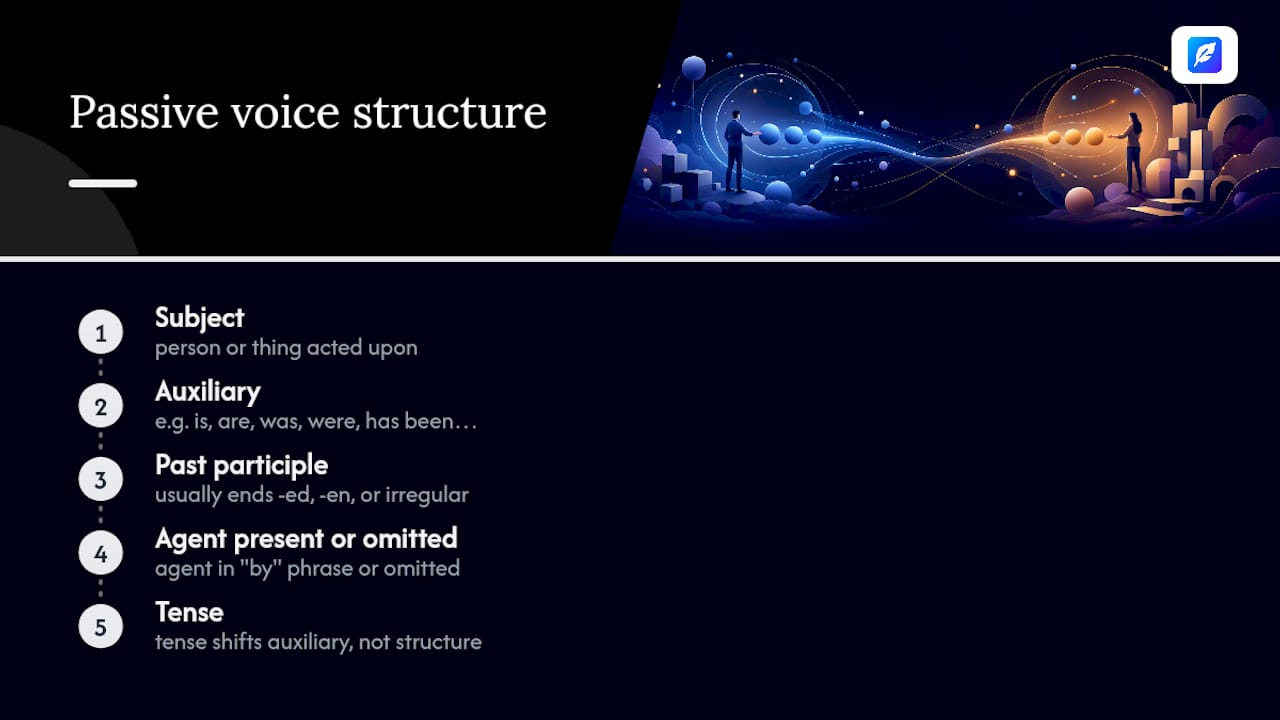
Common auxiliary forms include is, are, was, were, has been, is being, and will be. Each combines with a past participle, usually ending in ed, en, or an irregular form like written or shown.
Two examples show the range:
The first names the agent explicitly. The second drops it, which is common when the actor is obvious, unimportant, or deliberately vague. Both follow the same formula: was (a form of "to be") plus submitted (past participle). Tense shifts the auxiliary, not the underlying structure, whether you're writing "is submitted," "was submitted," or "will be submitted."
How to identify passive voice in your essay
Spotting passive constructions gets easier once you know what to scan for. Watch for these signals:
- A form of "to be" sitting directly before a past participle.
- A sentence that ends with a "by" phrase naming the actor.
- No actor at all, just the action and its recipient.
- Wordier phrasing than an active version would need.
- A subject that receives rather than performs the verb.
To apply this while editing, read each sentence and ask: who or what is doing the action, and is that word the grammatical subject? If the subject is being acted upon instead, you've found a passive construction. The Naval Postgraduate School's Graduate Writing Centre recommends scanning for the auxiliary verbs first, then checking whether a past participle follows.
Pro Tip: Use your word processor's find function to search for "was," "were," "is," and "been" one at a time. Highlight every hit, then check each for a following past participle. It turns a vague sense of "this paragraph feels clunky" into a concrete, fixable list.

Example: "The hypothesis was tested by the team" flags on was, confirms with tested, and reveals the agent in the "by" phrase, so you can decide whether to keep or cut it.
When passive voice works in academic essays
Passive voice earns its place in specific situations rather than functioning as a default. According to Virginia Commonwealth University's writing resources, it fits best when the action matters more than the actor, when the actor is unknown, or when disciplinary convention expects it.
- Scientific methods: "The samples were heated to 80°C" keeps focus on procedure, not the technician.
- Emphasis on result: "The theory was later disproved" foregrounds the outcome over who disproved it.
- Unknown agent: "The manuscript was damaged in transit" works when nobody knows who caused the damage.
- Formal general truths: "It is widely believed that..." signals a claim without pinning it to one source.
- Cautious hedging: "It could be argued that the policy failed" softens a claim that needs qualification.
Passive voice is often appropriate in materials, methods, and results sections of scientific writing, where the procedure or finding matters more than the researcher performing it.
Disciplinary norms vary sharply here. Lab reports and methods sections in the sciences lean passive far more than a history essay or a literature analysis would, according to the University of Hull's library guides. Check your department's style guide before assuming either voice is the safe default.
Myths about passive voice, and what's actually true
Myth: "Passive voice is always grammatically wrong." Fact: it's a legitimate structure, not an error. Style guides flag overuse, not existence.
Myth: "Good writers never use passive voice." Fact: skilled academic writers vary voice deliberately, matching the choice to genre and emphasis rather than avoiding passive on principle.
Myth: "Grammar checkers that flag passive voice are always right to suggest a change." Fact: those flags are prompts for review, not commands. Some passive constructions serve the sentence perfectly well.
Many authoritative writing centres explicitly caution against blanket rules like "never use passive" and instead recommend judging each case on context.
The real risk isn't passive voice itself. It's overuse that buries who did what, leaving your argument sounding hedged and unaccountable when it shouldn't.
Passive voice examples in essays with active rewrites
Ten pairs, drawn from the kinds of sentences that show up across humanities and STEM essays. Each passive version is followed by an active rewrite and a one-line note.
- Passive: "The novel's themes are explored by the author through symbolism." Active: "The author explores the novel's themes through symbolism." Shorter, and the agent finally does something.
- Passive: "It was found that the reaction rate increased with temperature." Active: "The reaction rate increased with temperature." No agent needed here; the passive was just adding words.
- Passive: "Mistakes were made in the interpretation of the data." Active: "The team misread the trend in the data." Names who erred, restoring accountability the original sentence dodged.
- Passive: "The argument is undermined by a lack of evidence." Active: "A lack of evidence undermines the argument." Puts the real cause front and centre.
- Passive: "The samples were collected over a six-week period." Active: "Researchers collected the samples over a six weeks." Fine to keep passive here; the method matters more than who gathered the samples.
- Passive: "It is believed that the policy failed due to poor implementation." Active: "Critics believe the policy failed due to poor implementation." Active version, once you name who believes it, is more precise.
- Passive: "The character is portrayed as isolated throughout the play." Active: "The playwright portrays the character as isolated throughout the play." Gives credit to the writer's craft rather than leaving it floating.
- Passive: "Several limitations were noted in the study's design." Active: "The authors noted several limitations in the study's design." Subtle case: 'noted' reads like plain description until you check for the missing agent.
- Passive: "The proposal was rejected without explanation." Active: "The committee rejected the proposal without explanation." Reveals a hidden actor the passive version conveniently omitted.
- Passive: "A solution was reached after prolonged deliberation." Active: "The panel reached a solution after prolonged deliberation." Another instance where past-participle-as-adjective ('reached') hides in plain sight.
Numbers 5 and 6 illustrate the judgement call at the heart of using passive voice in essays: sometimes the passive genuinely fits, and forcing an active rewrite would distort the emphasis your sentence needs.
How to revise passive sentences step by step
Correcting passive voice in writing follows a repeatable sequence, not guesswork.
- Identify the agent. Read the sentence and ask who or what performed the action, even if it's missing from the sentence.
- Decide whether the agent matters. If naming it adds clarity or accountability, keep it. If it's obvious or irrelevant, the passive may already work.
- Choose your rewrite. Move the agent into the subject position for an active sentence, or retain the passive with an explicit "by" phrase if the agent must appear but the emphasis should stay on the result.
- Tighten the wording. Active rewrites almost always trim a few words; cut anything the new structure makes redundant.
Micro-edits show the pattern clearly:
- Before: "The report was written by the committee." After: "The committee wrote the report." Four words shorter, same meaning.
- Before: "It was decided that the meeting would be postponed." After: "The board postponed the meeting." Removes the vague 'it was decided' entirely.
- Before: "The window was left open by someone." After: "Someone left the window open." Restores natural word order without losing information.
A quick checklist for the final pass: Is the sentence concise? Is the agent clear where it needs to be? Does the voice match the emphasis you intend? Have you avoided evasive phrasing that dodges responsibility? Running through this list against your essay proofreading checklist catches most stragglers before submission.
Practice: find and fix these six sentences
Try revising each sentence before checking the answer key.
- "The experiment was conducted over three days."
- "The essay was criticised for lacking a clear thesis."
- "Errors were introduced during data entry."
- "The results are shown in Table 2."
- "A decision was reached by the panel after much debate."
- "The window had been left open all night."
Answer key:
- Keep as passive. The duration matters more than who ran the experiment.
- Revise: "The tutor criticised the essay for lacking a clear thesis." Names the actor, restores accountability.
- Revise: "The data entry clerk introduced errors." Reveals a hidden, relevant agent.
- Keep as passive. Standard convention in reporting results, per Purdue OWL.
- Revise: "The panel reached a decision after much debate." Shorter, active, no loss of meaning.
- Subtle case, keep as passive. No agent is implied or needed; the state of the window is the point.
A note on using voice on purpose
Voice is a choice, not a verdict on your grammar. I'd rather see a student keep one deliberate passive sentence than strip every single one out and flatten the argument in the process. InspiroWrite's own guide to common essay grammar mistakes covers similar judgement calls students face when tidying a draft. Always check what your department actually wants before rewriting wholesale.
Get a second pair of eyes before you submit
Spotting every passive sentence by hand takes patience, and after the fourth read-through, your eyes start skimming past the ones that matter. Inspirowrite's proofreading tool flags passive constructions instantly and suggests active rewrites, without storing your essay or feeding it into any training data.
It's built for the pre-submission pass: upload your draft, let it mark up passive sentences alongside grammar and tone issues, then decide case by case which ones to keep. Pair it with a manual check using the find-and-fix method above, and you'll catch both the obvious passives and the subtle ones hiding as past-participle adjectives. Run your next draft through Inspirowrite before you hit submit.
Sources
For deeper guidance beyond this article, these resources cover the same ground with more institutional depth.
Writing centres consistently frame passive voice as a stylistic tool to deploy with intent, not a fault to eliminate on sight.
- Passive voice: revising passive voice | Writing Advice (University of Toronto)
- Active voice vs passive voice | Virginia Commonwealth University writing resources
- Revising passive voice into active voice | Graduate Writing Centre (Naval Postgraduate School)
- Active and passive voice | University of Hull library guides
- Passive voice | The Writing Center (UNC Chapel Hill)
Always cross-check with your own department's style guide when the advice above conflicts with a specific assignment brief.
FAQ
What are some examples of passive voice in essays?
"The results were analysed," "the theory was proposed," and "mistakes were made" are typical examples, each using a form of "to be" plus a past participle with the actor removed or tucked into a "by" phrase.
What is passive voice in essay writing?
It's a sentence structure where the subject receives the action rather than performing it, formed with "to be" plus a past participle, and it's appropriate when the result or process matters more than the actor.
How do I write in passive voice correctly?
Choose a form of "to be" that matches your tense, add the past participle of your main verb, and either drop the agent or add it with a "by" phrase if it needs stating.
Does using passive voice lower my essay grade?
Not by itself. Overusing it to hide vague arguments can cost you clarity marks, but deliberate, well-placed passive sentences, especially in scientific methods sections, are standard and expected.
How can I quickly check a draft for passive voice?
Search for common "to be" forms like "was," "were," and "is," then check each one for a following past participle. A tool like Inspirowrite automates this flagging alongside broader grammar checks.