

Tone determines how readers interpret your intent, and it largely shapes whether they trust what you're telling them. Get it wrong, and a perfectly accurate email can read as cold, evasive, or even rude. Get it right, and the same information lands as clear, respectful, and credible.
What correct formal tone achieves is practical, not decorative:
- Clarity — the reader knows exactly what you mean and what you want them to do.
- Respect — the phrasing acknowledges the reader's time and position without stiffness.
- Persuasive authority — the message sounds like it comes from someone worth listening to.
The immediate fix, if you're staring at a draft right now, is simple: switch passive constructions to active ones, replace inflated vocabulary with plain words, and read the whole thing aloud before you send it. That single pass catches most tone problems.
Key Takeaways
Tone works because it substitutes for the non-verbal cues missing from written text, and plain, active language delivers formality without losing clarity.
| Point | Details |
|---|---|
| Tone signals attitude | Word choice, sentence structure and punctuation together tell the reader how to interpret your intent. |
| Plain language beats complexity | Simple, direct phrasing inside a formal register improves comprehension and speeds up decisions. |
| Match tone to context | Base formality on audience, purpose, relationship stage and channel rather than a fixed formal or casual rule. |
| Edit with paired rewrites | Convert passive sentences, jargon and long phrasing into active, plain alternatives before sending. |
| Govern tone with a style guide | Internal style guides and a proofreading checklist keep tone consistent across an entire team. |
Table of Contents
- What is the role of tone in formal business writing?
- Why does tone matter in formal business writing?
- Principles for choosing the right formal tone
- How do you edit for a more formal, professional tone?
- How does tone change across emails, reports, and proposals?
- How do you keep tone consistent across a team?
- What tools and habits actually support a consistent formal tone?
- Useful resources for formal tone and plain language
- What most advice on formal tone gets wrong
- Sources
- FAQ
What is the role of tone in formal business writing?
Tone is the attitude your writing conveys, built from word choice, sentence structure, and even punctuation. It's the difference between "Please advise at your earliest convenience" and "Let me know when you can." Same request, entirely different relationship implied.
Tone gets confused with two neighbouring concepts constantly, so it helps to separate them properly, as Purdue OWL's guidance on business tone sets out:
- Tone is the attitude conveyed in a specific piece of writing. It can shift from email to email depending on the situation.
- Voice is the underlying personality or persona of the writer or brand. It stays relatively stable across everything you write.
- Style is the sentence-level toolkit: word length, punctuation habits, paragraph rhythm.
Think of voice as who you are on the page, and tone as the mood you're in for this particular message. A company might have a consistently warm, direct voice, yet still write a firm tone into a payment reminder and a celebratory tone into a product launch. Style is what makes both of those recognisably the same writer.
Why does tone matter in formal business writing?
Written communication carries none of the non-verbal cues that soften or sharpen spoken words. No raised eyebrow, no warm smile, no pause before a difficult sentence. Tone has to do that work on the page.
The old claim that only 7% of meaning comes from words themselves has been thoroughly debunked as a misapplication of research on emotional expression, but the underlying point survives: written tone must intentionally stand in for the vocal inflection and body language a reader would otherwise use to interpret you, according to UTPB's breakdown of the nonverbal communication myth. Every comma, every word choice, every sentence length decision becomes a substitute signal.
Get the substitute wrong and the risks are concrete, not abstract:
- Confusion — an ambiguous tone leaves the reader guessing whether a request is urgent, optional, or a veiled complaint.
- Offence — an overly blunt or overly casual tone in the wrong context reads as disrespect, even when none was intended.
- Weakened persuasion — a tone that feels defensive or apologetic undercuts an otherwise solid argument.
Organisations that keep tone consistent across teams tend to anchor it in something written down rather than instinct, as recommended by Technology & digital learning — ESG Training Institute. That's where internal style guides and plain-language principles earn their keep: they turn "what feels right" into a shared standard that survives staff turnover and different writing habits across departments.
Principles for choosing the right formal tone
Formal doesn't mean complicated. That's the single most common misunderstanding in business writing, and it's worth correcting early: overcomplicated phrasing reduces comprehension and slows down decisions, according to Digital. The best formal writing is authoritative and accessible at the same time, not one at the expense of the other.
Five plain-language rules do most of the work:
- Use active voice. "The team completed the audit" beats "The audit was completed by the team" almost every time.
- Choose common words over inflated ones. "Use" instead of "utilise," "help" instead of "facilitate."
- Keep the tone positive where possible. Say what can be done, not just what can't.
- Centre the reader, not the process. Explain what this means for them before explaining your internal workflow.
- Cut anything that doesn't earn its place. If a sentence survives deletion without losing meaning, delete it.
That fourth rule has a name: the you-attitude. Instead of "We require your signature on the attached form," try "Your signature on the attached form confirms the agreement." Same instruction, but the sentence is built around the reader's action rather than the organisation's requirement. It stays formal. It just stops sounding like a demand.
Judging the right level of formality for a specific document comes down to four quick questions:
- Who is the audience, and how much do they already know?
- What's the purpose: to inform, request, persuade, or apologise?
- Where does this sit in the relationship: first contact, ongoing partnership, or damage control?
- What channel are you using: email invites more warmth than a formal report ever should.
Pro Tip: Draft the message the way you'd actually say it to the person, then go back and tighten the loose phrasing. Starting formal and loosening up is harder than starting natural and tightening.
How do you edit for a more formal, professional tone?
The gap between a stiff draft and a clear one is usually three or four small edits, not a full rewrite. Paired examples make the pattern obvious fast, which is why writing centres lean on them so heavily when teaching tone.
Passive to active: ✗ "It was decided that the contract would be extended." ✓ "The board decided to extend the contract."
Jargon to plain terms: ✗ "We will leverage synergies to optimise deliverables going forward." ✓ "We'll combine our teams' strengths to finish the project faster."
Long sentence to concise version: ✗ "In light of the fact that the deadline has been moved up, it is necessary for us to reconsider our current approach to the project timeline." ✓ "Since the deadline moved up, we need to revisit the timeline."
Beyond full rewrites, a handful of smaller decisions shift tone just as much:
- Contractions ("we'll," "don't") soften formal writing without making it casual. Most modern business style guides now permit them outside legal or highly ceremonial documents.
- Hedging words ("might," "could," "it seems") signal appropriate caution in a report but read as weak or evasive in a direct request. Use them where genuine uncertainty exists, not as a reflex.
- Titles and salutations still matter more than people assume. "Dear Dr Aksoy" versus "Hi Elif" sets the register before the reader reaches your first sentence.
Punctuation carries tone too, often more than writers realise:
A single exclamation mark can turn a neutral update into something that sounds either enthusiastic or slightly manic, depending on context. Ellipses suggest hesitation or trailing thought, which rarely belongs in a formal document. An em dash inserted mid-sentence can read as an abrupt interruption rather than an added thought. Commas that create short, clipped clauses tend to sound clinical; longer, well-joined clauses tend to sound considered.
One editorial habit worth stealing: wait before sending anything sensitive. A short cooling-off period, even ten minutes, tends to catch tone problems that felt invisible the moment you finished typing. Experienced writers rely on this far more than any single rule.
How does tone change across emails, reports, and proposals?
The core principles hold everywhere, but each document type has its own shortcuts and its own tolerance for warmth.
- Emails live or die on the subject line and opening sentence. State the purpose immediately, keep the call to action unambiguous, and reserve extended pleasantries for first contact only. Repeated formality with someone you email weekly reads as distance, not respect.
- Reports and proposals need evidence-based authority. Precise language matters more than confident-sounding language: "revenue increased by 12%" outperforms "revenue increased significantly." Calibrate confidence to what the data actually supports, because overclaiming in a proposal is the fastest way to lose credibility once someone checks your numbers.
- Internal memos can relax slightly, particularly among established teams, but formality should tighten again the moment the memo touches policy, compliance, or anything that might be forwarded outside the immediate team.
The channel is a formality shortcut in itself. A Slack message and a signed letter can carry the same instruction and require entirely different tone treatment.
How do you keep tone consistent across a team?
Consistency rarely happens by accident. It comes from a written reference everyone actually uses, backed by a proofreading habit that catches drift before it reaches a client.
- Adopt or build an internal style guide. Reference established plain-language principles where you don't have bespoke rules, and lean on external references such as the U.S. National Archives' plain writing standards or structured public frameworks like the Australian Style Manual's guidance on voice and tone as a starting point.
- Run a short proofreading checklist before sending anything client-facing. Check for passive voice overload, inconsistent formality within the same document, and language that could read as exclusionary to any part of your audience. Inspirowrite's own proofreading habits guide covers the mechanics of building this into a routine.
- Loop in a subject-matter expert or legal counsel for anything touching contracts, compliance, or public statements, where a tone misstep carries real legal or reputational weight.
What tools and habits actually support a consistent formal tone?
A proofreading tool earns its place in the workflow when it checks the right things, not just spelling and grammar. Look for whether it flags:
- Formality mismatches — casual phrasing sitting inside an otherwise formal document.
- Excessive hedging — too many "maybe," "perhaps," and "I think" constructions undermining an authoritative point.
- Inclusive language gaps — phrasing that unintentionally excludes or assumes about the reader.
Inspirowrite's tone adjustment feature is built around exactly this kind of check, alongside grammar and style corrections, so a writer can see formality flags in seconds rather than guessing. It also keeps drafts private and never uses submitted text to train its models, which matters when the document under review is a client contract or an unpublished proposal.
None of that replaces human judgement. A tool can flag a passive sentence or an inconsistent register; it can't tell you whether your client prefers directness or diplomacy. Treat automated checks as a fast first pass, then read the message once more as the person receiving it would.
Useful resources for formal tone and plain language
- The U.S. National Archives' plain writing principles for foundational rules on clarity.
- Purdue OWL's guide to tone in business writing for audience-based tone selection.
- UTK Writing Center's lesson on finding the right tone for worked examples across registers.
- The Australian Style Manual as a model for organisation-wide tone standards.
What most advice on formal tone gets wrong
Most guidance on formal writing still treats formality as a vocabulary problem: swap in longer words, add "please find attached," pile on hedges, and call it professional. That's backwards. The research on plain language is consistent on this point, and it matches what any experienced editor sees daily: complexity and formality are not the same thing, and readers make faster, more confident decisions when the two are separated.
Where the conventional advice really falls down is punctuation. Most style guidance treats punctuation as mechanical correctness rather than a tone signal, yet a stray exclamation mark or a clipped, comma-heavy sentence changes how a message reads more than half the vocabulary choices around it. Teach that, and the vocabulary fixes mostly take care of themselves.
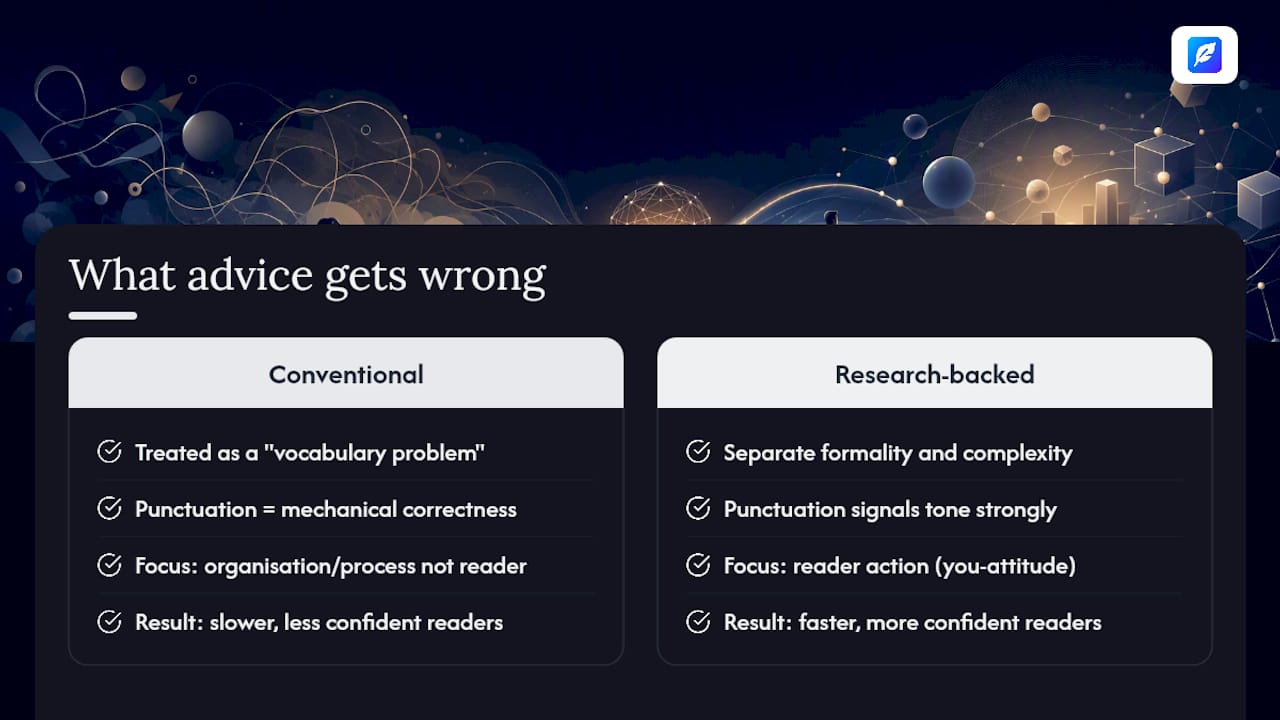
If you take one thing from this: prioritise the you-attitude before you touch word choice. A formal document centred on the reader's action rather than the organisation's process reads as respectful even when the vocabulary stays simple. That's the order most training gets backwards, and it's the fastest single fix available at the drafting stage.
Sources
- Plain Writing: Ten Principles (U.S. National Archives)
- How much of communication is nonverbal? (UTPB article)
- Digital
- Tone in business writing (Purdue OWL)
FAQ
What is the role of tone in writing?
Tone shapes how a reader interprets the writer's intent, standing in for the non-verbal cues that spoken conversation carries naturally. It affects whether a message reads as respectful, credible, and clear, or as confusing and off-putting.
What is the tone in business writing?
Business writing tone is typically formal to semi-formal, built on plain language, active voice, and a reader-centred you-attitude, calibrated to audience, purpose, and relationship. It varies by document type and channel rather than following one fixed register.
What is the tone of writing in formal writing?
Formal writing generally uses a measured, respectful tone with precise vocabulary, minimal contractions in highly formal contexts, and a structure that avoids ambiguity. Modern best practice favours plain, clear phrasing within that formal register rather than dense or ornate language.
How is tone used in informal writing?
Informal writing allows contractions, conversational phrasing, and looser sentence structure because the relationship and context tolerate more warmth and less caution. The same underlying principle applies, though: word choice and structure still signal attitude, just with a wider range of acceptable options.