

Tone of voice in writing is the writer's attitude expressed through word choice and style, and it shapes how the reader feels about the message before they've consciously registered a single argument. Get it wrong and even accurate, useful content gets ignored or misread. This article gives you a simple four-part model for mapping tone, a step-by-step method for applying it, a working vocabulary of tone words, and a quick way to test whether readers actually perceive the tone you intended.
TL;DR:
- Most content benefits from precise tone settings, with formal, respectful, and matter-of-fact tone ideal for troubleshooting or instructional contexts.
- Using the four sliders to score tone dimensions helps ensure consistency across different content channels and avoids register mixing.
- Setting clear sentence-level rules and selecting specific tone words enhances message clarity and prevents unintentional shifts in perception.
- Conducting quick product-reaction tests with real readers reveals perception gaps that self-assessments often miss, improving tone accuracy before publication.
- Automated tools can enforce tone consistency, identify register slips, and save time when revising large batches of content or translated materials.
Table of Contents
- What's the difference between tone, voice and style?
- The four-dimension framework for mapping tone
- How do you define and apply a tone for a piece of content?
- Tone examples and a working vocabulary list
- How do you test whether your tone actually lands?
- Who's behind this guide and how InspiroWrite fits in
- Three tone mistakes writers keep making
- Test your tone before you publish it
- Sources
- FAQ
What's the difference between tone, voice and style?
Tone is the attitude a piece of writing takes towards its subject and reader, and it shifts depending on the situation. Voice is the underlying personality that stays constant across everything you write, the thing that makes an email or an essay recognisably yours. Style covers the mechanical choices, sentence length, vocabulary, punctuation, that produce both. Mood is different again: it's the feeling the reader is left with, not the attitude the writer took.
Tone gets signalled through several concrete levers:
- Word choice (diction): formal versus colloquial, technical versus plain
- Sentence structure (syntax): short and punchy versus long and layered
- Formality level: contractions, second person, slang
- Point of view: first person warmth versus third person distance
Wheaton College's writing centre puts it plainly: tone has to match audience and purpose, because an inappropriate tone distracts readers from whatever argument or information you're actually trying to deliver. Treat voice as the fixed personality and tone as the situational adjustment layered on top of it.
The four-dimension framework for mapping tone
Vague tone words like "friendly" or "professional" mean different things to different people on a team, which is exactly the problem. The Nielsen Norman Group's four-dimension model fixes that by forcing you to place your writing on four separate sliders:
- Funny versus serious, how much humour the content can carry
- Formal versus casual, how much distance or intimacy the language creates
- Respectful versus irreverent, how much you're willing to challenge convention
- Enthusiastic versus matter-of-fact, how much energy the copy projects
A help article troubleshooting a login error might sit close to serious, moderately formal, fully respectful, and matter-of-fact, because a frustrated reader wants clarity, not jokes. A marketing headline for the same product might swing towards funny, casual, and enthusiastic, because it's competing for attention rather than solving a problem. Four sliders give you operational vocabulary that a single adjective never can, because they force a decision on axes that don't automatically move together.
Pro Tip: Score each slider from 1 to 5 and write the number down in your style guide. "Formal, 2 out of 5" settles arguments that "keep it friendly but professional" never will.
How do you define and apply a tone for a piece of content?
Turning a tone decision into consistent writing takes four steps, and you can run through all of them in under 40 minutes.
- Decide audience and purpose first. A tax notice and a birthday email exist for different reasons and reach different readers; tone follows from that, not the other way round.
- Set your four slider positions. Write down a number for each dimension rather than a fuzzy adjective, and get a second person to agree with your score before you move on.
- Pick three to five tone words with matching do/don't examples. "Warm, not gushing" is usable. "Warm" on its own is not.
- Translate those words into sentence-level rules. This is where most tone guides fall apart, because they stop at adjectives instead of reaching syntax.
Concrete rules worth setting include:
- Contractions allowed in emails, banned in legal notices
- Second person ("you") throughout, never third person ("the user")
- Maximum sentence length for help content, no ceiling for narrative marketing
- No exclamation marks outside social copy
- A short banned-words list per channel (email, help centre, social)
Style manuals like Australia's government style guide back this up: small mechanical choices, contractions, pronoun use, sentence structure, do more to shift perceived tone than any adjective in a brief. Keep a one-page variant sheet per channel so an email doesn't accidentally sound like a contract, and a help article doesn't sound like a tweet.
Tone examples and a working vocabulary list
The same sentence can carry three entirely different tones without changing its factual content. Take a delayed order:
- Formal, matter-of-fact: "Your order has been delayed due to a supplier issue and will now arrive on Thursday."
- Warm, apologetic: "We're sorry, your order's running a bit late. It'll land Thursday instead."
- Playful, casual: "Bit of a hiccup on our end. Your parcel's now landing Thursday, sorry about that."
Nielsen Norman Group's paired tone samples confirm that changing tone alone, while holding the actual content constant, measurably shifts how trustworthy or personable a brand feels to readers.
A working vocabulary, sorted by channel, gives you a faster starting point than staring at a blank slider:
- Help centre: clear, patient, direct, reassuring, precise
- Marketing: bold, playful, confident, energetic, punchy
- Academic: measured, objective, analytical, precise, restrained
Mixing registers within one piece, dropping slang into a legal notice, or academic hedging into a sales page, is the fastest way to make writing feel untrustworthy. Pick one register per document and hold it.
How do you test whether your tone actually lands?
Writers routinely misjudge their own tone, because intention and perception are two different things. The fix is a product-reaction test: show a handful of readers a content sample and ask them to pick adjectives from a list that describe how it comes across, then compare their answers to what you intended.
Running it takes ten minutes with classmates, colleagues, or a small peer group:
- Show three or four samples, including at least one you're unsure about
- Give readers a fixed adjective list rather than an open question, so answers are comparable
- Note where their choices cluster away from your target slider position
- If most readers pick "cold" when you were aiming for "efficient", tighten sentence length or add second person address to shift the perception
Nielsen Norman Group's guidance on the product-reaction test treats disagreement between readers as useful data, not noise, because it reveals a perception gap you'd rarely spot by rereading your own draft. Even a sample of five or six peers tends to surface a mismatch the original author missed entirely.
Who's behind this guide and how InspiroWrite fits in
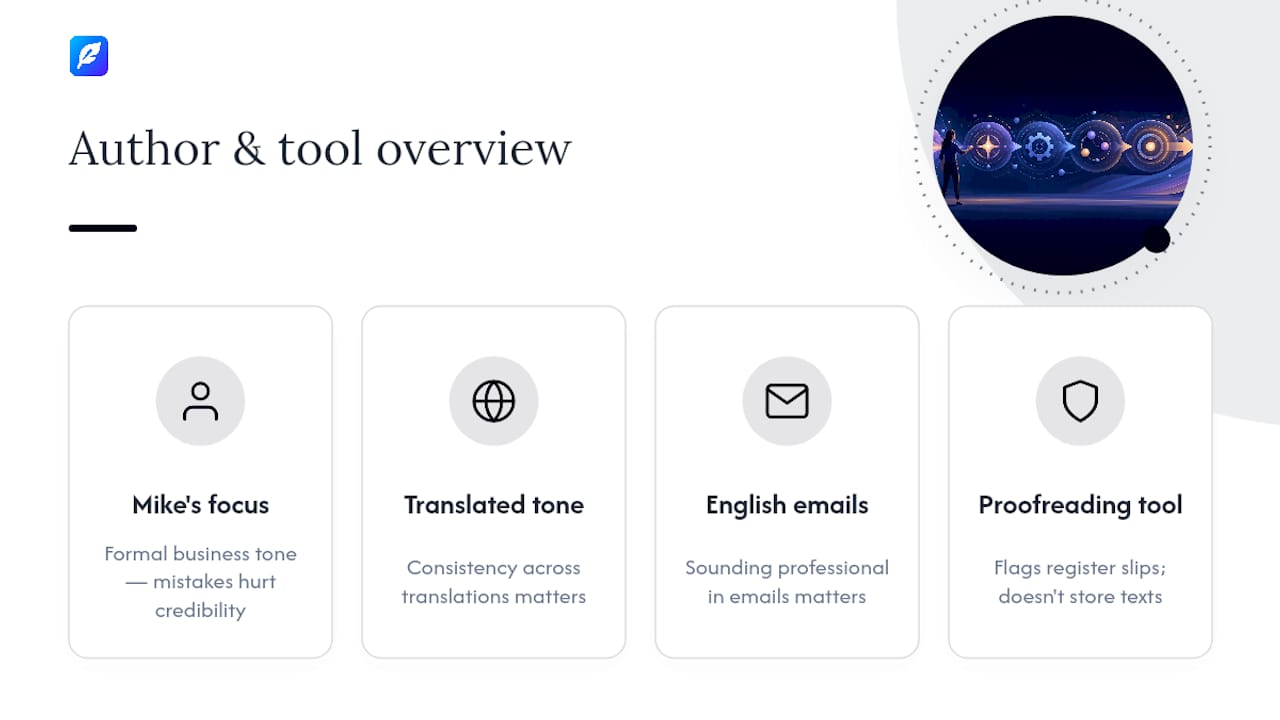
This piece draws on Mike's writing on tone in formal business writing, tone consistency across translated content, and sounding professional in English emails, three areas where tone mistakes cost writers the most credibility.
A proofreading tool can apply directly to the workflow above: it flags register slips, tightens sentence structure to match a formality target, and does it without storing or training on your text. For a batch of help articles or a translated email chain, that means checking tone consistency across dozens of documents in the time it would take to reread one by hand.
Three tone mistakes writers keep making
Mixing registers across channels tops the list, an email that reads like a legal notice, a help article that reads like a tweet. Fix it with a short micro-guide per channel. Vague tone words rank second; "friendly but professional" means nothing until it's a slider score. Skipping user testing is the third, and the costliest, since a ten-minute adjective test with peers catches gaps a solo reread never will.
— Mike
Test your tone before you publish it
Guessing at tone is the slow way to get it wrong. There are private, fast ways to check whether your draft's formality, warmth, and energy actually match what you intended, without sending your text anywhere it gets used to train someone else's model.
Run a batch of help articles or client emails through it and you'll spot register slips, a stray contraction in a formal notice, a flat sentence where you meant enthusiasm, in seconds rather than after a slow manual reread. It also enforces a banned-words list automatically, so a whole team stays inside the same tone boundaries without everyone memorising the style guide by heart. If you're translating content and worried tone will flatten in the process, the same tone-preserving approach applies across languages. A consistent tone also supports how your content performs in search, since content marketing and SEO both reward writing that reads coherently across a whole site. Head to Inspirowrite and run your next draft through it before you send or publish.
Sources
For deeper study, Nielsen Norman Group's four-dimension pieces cover the slider framework in full, Wheaton College's writing centre resources explain tone's academic function, and general style manuals set out formality tiers you can adapt to any organisation's voice.
- Tone-of-Voice Words
- Style, diction, tone and voice — Wheaton College writing centre
- Voice and tone | Style manual
FAQ
What is an example of tone of voice?
A single sentence like "your order is delayed" can be written formally ("has been delayed due to a supplier issue"), warmly ("running a bit late, sorry about that"), or playfully ("bit of a hiccup on our end"), each carrying identical information in a different tone.
What are the four dimensions used to describe tone of voice?
Nielsen Norman Group's model maps tone across four sliders: funny versus serious, formal versus casual, respectful versus irreverent, and enthusiastic versus matter-of-fact.
What are examples of tone in writing?
Tone shows up through diction, sentence length, formality, and point of view, a short, contraction-heavy sentence in second person reads casual and warm, while a long, formal sentence in third person reads distant and objective.
What is tone of voice in writing?
Tone of voice is the attitude a piece of writing expresses towards its subject and reader, shaped by word choice, sentence structure, and formality, and it's what determines whether a reader feels respected, patronised, entertained, or ignored.
How do you check if your tone of voice is working?
Run a product-reaction test: show readers a sample and ask them to pick adjectives describing its tone, then compare their answers to what you intended; tools like some AI proofreading services can also flag register slips before you publish.