

Find the main agent and action first. Cut every word that doesn't earn its place. Then split or reorder the rest into subject, verb, object. That's the whole method, and you can run it on a sentence in under a minute.
Paste this checklist wherever you edit:
- Spot the real subject and the real verb, and put them near the front.
- Delete qualifiers, redundant pairs, and throat clearing ("in order to" becomes "to").
- Break one overloaded sentence into two clean ones, or reorder into subject, verb, object.
Before: "The decision that was made by the committee, after several weeks of deliberation regarding budget constraints, was to postpone the project." After: "The committee postponed the project after weeks of budget talks."
Pro Tip: Read your edit aloud. If you run out of breath before the full stop, the sentence still needs work.
Key Takeaways
Simplifying a complex sentence means finding the subject and verb, cutting what doesn't earn its place, and reordering into subject, verb, object.
| Point | Details |
|---|---|
| Start with agent and action | Find the real subject and verb before touching anything else in the sentence. |
| Target 15 to 20 words | Sentences past 25 words usually need splitting or pruning to stay readable. |
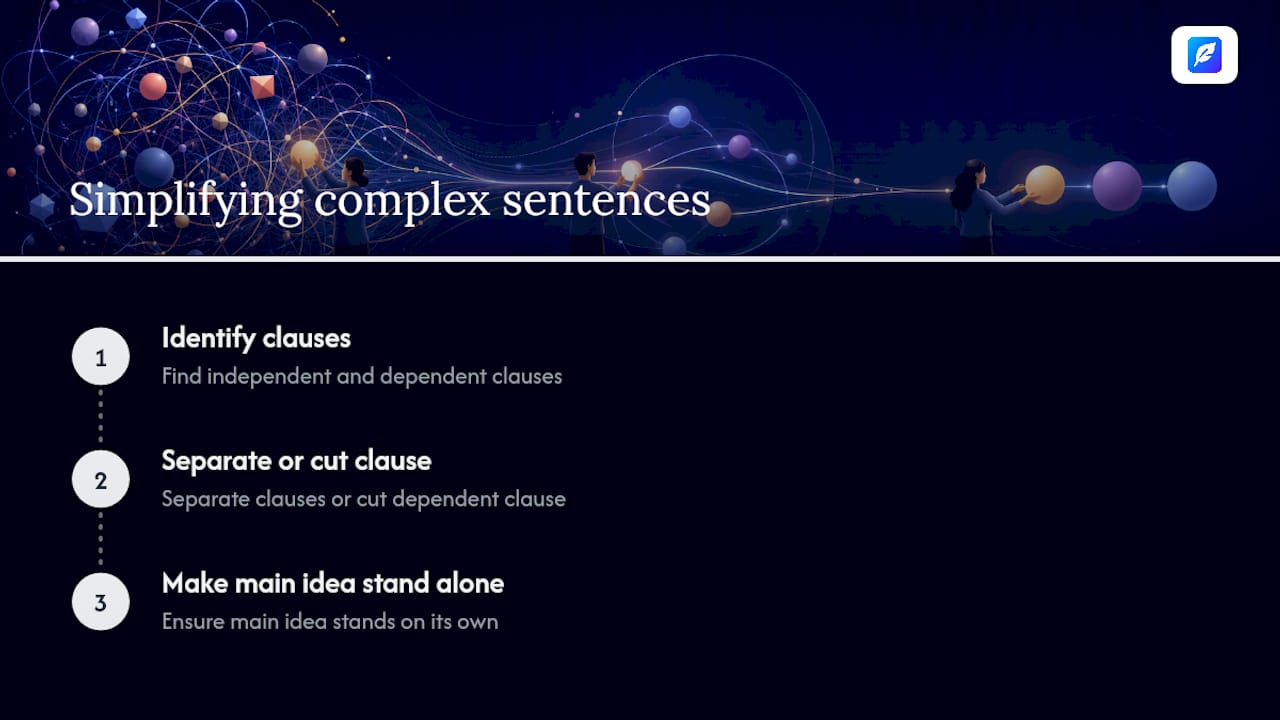
| Split at clause boundaries | Identify independent and dependent clauses first, then decide what stands alone. |
| Keep complexity when deliberate | Long sentences earn their place when they carry rhythm or nuance on purpose. |
| Check AI edits for meaning | Tools like Inspirowrite speed up rewrites while keeping drafts private from model training. |
Table of Contents
- What makes a sentence complex?
- Why simplify sentences in the first place?
- Concrete editing techniques (with before and after examples)
- How to use AI to simplify sentences
- A five-step SVO workflow you can practise
- When to keep a complex sentence
- Inspirowrite for writers who want fast, private edits
- Sources
- FAQ
What makes a sentence complex?
Length alone isn't the problem. A sentence gets hard to follow when it stacks subordinate clauses, buries the subject under prepositional phrases, or separates the verb from its subject by a dozen words. Nominalisations (turning verbs into noun phrases, so "decide" becomes "the decision-making process") add weight without adding meaning.
Watch for these signals:
- Multiple "which", "that", or "who" clauses chained together
- Three or more prepositional phrases in a row ("in the context of the review of the policy for the department")
- A verb that arrives ten or more words after its subject
- Passive constructions that hide who did what
- Jargon doing the work a plain word could do
The subject and verb are the skeleton of a sentence. Bury them under enough qualifiers and clauses, and the reader has to reconstruct that skeleton themselves before they can even start on meaning.
Most bloated sentences trace back to the same three habits: technical jargon carried over from a source document, a passive voice that dodges naming the actor, and a pile of hedging words ("it could be argued that", "in some respects") that add caution but no content.
Why simplify sentences in the first place?
Shorter, plainer sentences get processed faster and remembered longer. That matters whether you're writing a report your manager will skim in ninety seconds or an essay a marker will read alongside thirty others.
- Readers extract meaning on the first pass instead of rereading
- Persuasive writing lands harder when the point isn't buried in a subordinate clause
- Non-native speakers and screen-reader users depend on plain sentence structure to follow along at all
A practical readability target is roughly 15 to 20 words per sentence, with anything past 25 words usually forcing a second read. That's not a hard rule for every sentence, but it's a useful trip wire while editing.
Complexity isn't always the enemy. A long sentence built deliberately, to mirror a rush of thought or hold a piece of imagery together, can be the right call. The failure is complexity you didn't choose.
Concrete editing techniques (with before and after examples)
Work through these in order. Each one targets a different kind of bloat, and together they cover most of what makes a sentence hard to parse.
-
Remove jargon. Swap specialist terms for plain words unless the audience needs the precision. Before: "We need to leverage synergies to optimise our operational bandwidth." After: "We need to work together more efficiently." Keep the jargon only when a technical reader expects it, and translating it would blur meaning.
-
Break long clauses apart. Identify the independent clause first, then decide whether each dependent clause deserves its own sentence. Splitting reliably starts with telling independent and dependent clauses apart. Before: "The report, which was compiled over three months by a team that included two analysts and a consultant, revealed several problems with the supply chain." After: "A team of two analysts and a consultant spent three months compiling the report. It revealed several problems with the supply chain."
-
Eliminate redundancy. Cut redundant pairs ("each and every", "basic and fundamental") and unnecessary qualifiers. Standard conciseness advice lists exactly this kind of trim as the fastest way to tighten a draft. Before: "This is a completely new and unique approach that is truly innovative in nature." After: "This is a new approach."
-
Use active voice. Name the actor and put them before the verb. Before: "Mistakes were made during the rollout that affected customer accounts." After: "The team made mistakes during the rollout that affected customer accounts." Passive voice still has a place when the actor is unknown or irrelevant ("the building was damaged in the storm").
-
Simplify word choice. Replace a long word or phrase with the plain equivalent: "utilise" to "use", "prior to" to "before", "in the event that" to "if".
-
Rephrase for directness. Some sentences don't need trimming so much as reordering. Try reducing a subordinate clause into a compact phrase, which is the approach Magoosh's guide to simplifying complex sentences recommends for GRE-style sentence rewrites. Before: "Because the client had not responded by the deadline, which was originally set for Friday, the team decided to proceed without final approval." After: "The client missed Friday's deadline, so the team proceeded without final approval."
Simplifying doesn't mean stripping content out. It means removing whatever stands between the reader and the meaning, while keeping the logic that connects one idea to the next.
Pro Tip: If a sentence carries deliberate rhythm or emotional weight, don't flatten it by default. Ask whether the length is doing a job. If it is, leave it.
How to use AI to simplify sentences
The standard AI workflow is simple: paste the sentence, ask for a plain-English version, then check the result against the original for dropped meaning or a shifted tone; consider using AI Visibility Services to optimize your content's clarity and performance. AI tools handle this well for a quick first pass, but they can flatten technical terms that actually need to stay, so always reread the output against your source.
Three prompts worth keeping on hand:
- "Simplify this sentence for a general reader without losing any technical terms: [sentence]"
- "Rewrite this in plain English, keeping the same tone: [sentence]"
- "Break this into two shorter sentences without changing the meaning: [sentence]"
Feed a sentence like "The implementation of the new policy necessitated a comprehensive review of existing procedures" into a tool with the second prompt, and expect something close to "The new policy meant we had to review our existing procedures thoroughly."
Privacy matters here too. If you're pasting client work or unpublished drafts into a tool, check that it doesn't use your text to train its models. Inspirowrite processes text without feeding it back into training data, which matters more than most people realise until they've pasted a confidential draft somewhere they shouldn't have.
Pro Tip: Never accept an AI rewrite on trust. Read it against the original sentence line by line, especially for numbers, names, and any word that carries legal or technical weight.
A five-step SVO workflow you can practise
This is the repeatable version of everything above, built around getting subject, verb, and object next to each other early. Keeping the verb close to its subject and object cuts reader processing time, which is the whole point of the exercise.
- Find the real subject and the real verb.
- Prune fillers, hedges, and nominalisations.
- Move the verb next to the subject.
- Split off any clause that can stand alone.
- Reread for meaning against the original.
Worked example: "The proposal that was submitted by the marketing team, following extensive consultation with stakeholders across departments, was ultimately rejected by senior management due to budget concerns." Strip it down step by step and you land on: "Senior management rejected the marketing team's proposal over budget concerns, despite extensive stakeholder consultation."
- Try it yourself: pick a sentence over 30 words from your own work and run all five steps.
- Compare your result against the original for anything you lost.
Pro Tip: Do this workflow on paper the first few times. Typing straight into an editor tempts you to patch rather than rebuild.
When to keep a complex sentence
Not every long sentence is a mistake. Some rules of thumb: aim for one main idea per sentence, vary length across a paragraph so the rhythm doesn't flatline, and keep technical terms when precision genuinely depends on them rather than swapping in a vaguer plain-English stand-in.
- Academic and legal writing often needs qualifying clauses that a blog post would cut
- Interface copy and instructions should almost always go short
- A single long sentence can work as a deliberate pace change inside otherwise short prose
Pro Tip: If you keep a long sentence, make that a decision you can defend, not a sentence you never got round to editing.
An editor's take on simplifying sentences
Most writers treat simplifying as damage control. It's not. It's a skill you build the same way you build any other, through repetition on real sentences, not rules memorised once and forgotten. Do the five-step workflow on ten of your own sentences and you'll start seeing the pattern before you even reach for the checklist.
Inspirowrite for writers who want fast, private edits
Everything above works on paper, but running it sentence by sentence through a full draft takes time most students and writers don't have before a deadline. Inspirowrite handles the mechanical part: paste a paragraph, and it flags jargon, redundant phrases, and passive constructions, then suggests a rewrite you can accept, tweak, or reject line by line.
It suits the exact reader this guide is written for: someone juggling an essay, a report, or client copy who needs a second pair of eyes without waiting hours for feedback or handing a private draft to a stranger. Inspirowrite doesn't use your text to train its models, and results land in seconds rather than sitting in a review queue. If jargon is a recurring issue in your field, the guide on translating technical jargon into plain English pairs well with the editing habits covered here. For teams sending documents across languages, Inspirowrite's multilingual workflow covers how to keep technical terms intact while simplifying everything around them.
Try pasting a paragraph you've been putting off editing into Inspirowrite and see what it flags first.
Sources
- Creating Concise Sentences
- Writing concisely – The Writing Center
- Clear communication: simplify your sentences – Writing Tips Plus (Canada.ca)
- Simplifying Complex Sentences
- Khan Academy — independent and dependent clauses
FAQ
What is a complex sentence, simplified?
A complex sentence pairs one independent clause with at least one dependent clause. Simplifying it usually means separating those clauses or cutting the dependent clause down to a phrase, so the main idea stands on its own.
What are some examples of complex sentences and their simplified versions?
"Although the meeting ran late, the team finished the agenda" simplifies to "The meeting ran late. The team still finished the agenda." "The report that the analyst wrote last week contained an error" simplifies to "The analyst's report from last week contained an error."
What are some examples of simple sentences?
Simple sentences carry one independent clause and nothing else: "The team finished the report." "Sales rose in March." "She reviewed the contract." Each one has a single subject and a single verb.
How many words should a sentence have to stay readable?
Roughly 15 to 20 words is a comfortable target for most prose, with sentences over 25 words often needing a second read to follow.
Can AI tools reliably simplify sentences without losing meaning?
AI tools give a solid first pass at simplification, but they can flatten technical terms or shift tone, so always check the rewrite against the original sentence before using it.