

TL;DR:
- Effective topic sentence starters clearly introduce the paragraph's main idea and connect it to the thesis. Using specific, purpose-driven phrases like "One significant factor is…" or "This is evident in…" helps guide the reader through your argument. Avoid vague or filler openings, and always position the topic sentence at the start of the paragraph to maintain clarity.
The most useful topic sentence starters for essays are phrases like "One significant factor is…", "This is evident in…", "In contrast to…", "As a result of…", "A key example of this is…", "Building on this point…", and "Taken together, these findings suggest…". Each one signals a specific rhetorical job, which is exactly what separates a strong paragraph opener from a vague one.
Here is a quick reference by function:
- Main point: "One significant factor is…" / "Central to this argument is…"
- Contrast: "In contrast to…" / "While X suggests Y, the evidence points to…"
- Cause/effect: "As a result of…" / "This led directly to…"
- Example/evidence: "A key example of this is…" / "This is evident in…"
Pro Tip: Every topic sentence should complete this test: does it name the paragraph's single idea AND connect to your thesis? If you can answer yes to both, the sentence is doing its job.
Table of Contents
- What is a topic sentence, and how does it differ from a general sentence starter?
- How do you write a strong topic sentence?
- Topic sentence starters grouped by what they do
- Model topic sentences: weak versions improved
- Common mistakes students make with topic sentences
- Academic versus informal tone: what to use where
- A quick-reference cheat sheet of topic sentence starters
- Key takeaways
- The habit that actually changes your writing
- Inspirowrite helps you sharpen every topic sentence
- Useful sources
- FAQ
What is a topic sentence, and how does it differ from a general sentence starter?
A topic sentence is the controlling sentence of a paragraph. It states one central idea, signals how that idea connects to the essay's thesis, and sets the scope for everything that follows. Think of it as a contract with the reader: the rest of the paragraph must deliver on what the topic sentence promises.
General sentence starters are broader. They can open any sentence in any position, from a hook in an introduction to a mid-paragraph transition. Topic sentence starters are a specific subset: they carry the weight of the paragraph's argument, not just its style.
The distinction matters because choosing the wrong type of opener can mislead a reader about what a paragraph is doing. Sentence starters act as linguistic signposts that open a paragraph and signal its central idea, helping readers navigate complex academic writing. A stylistic opener like "Silence." works brilliantly in a narrative paragraph but tells an academic reader nothing about the argument.
Here is how the three often-confused sentence types differ:
- Topic sentence: States the paragraph's main idea and links it to the thesis. ("The Industrial Revolution fundamentally altered working-class family structures.")
- Transition sentence: Moves the reader from one paragraph to the next without necessarily stating a new idea. ("Having established the economic causes, it is worth examining the social consequences.")
- Thesis restatement: Echoes the essay's overall argument, usually in the conclusion. ("As this essay has shown, economic pressures were the primary driver of social change.")
Using a transition where a topic sentence belongs is one of the most common structural errors in student essays, and it leaves paragraphs feeling purposeless.
How do you write a strong topic sentence?
The single most reliable rule: state the paragraph's main point in the first sentence, then support it. Do not build up to the point through context or background. Academic readers, including markers, look for the claim first.
A practical checklist for every topic sentence you write:
- One idea only. If the sentence contains two distinct claims joined by "and", split it into two paragraphs.
- Specific language. Replace vague nouns ("things", "aspects", "factors") with precise ones ("taxation policy", "narrative perspective", "cell membrane permeability").
- Clear link to the thesis. The topic sentence should feel like a direct answer to one part of your thesis, not a tangential observation.
- Avoid weak openers. Phrases like "In this essay, I will…" or "This paragraph will discuss…" are filler openers that academic readers find shallow; they delay the argument without adding anything.
- Position it first. In academic writing, the topic sentence almost always belongs at the start of the paragraph, not buried in the middle.
The Academic Phrasebank at the University of Manchester recommends matching sentence openers to functional moves: establishing the territory (what the field or topic is), identifying a niche (what gap or problem exists), and occupying the niche (what your argument contributes). Mapping your topic sentence to one of these moves keeps it purposeful rather than decorative.
Pro Tip: If your topic sentence runs longer than 25 words, it is probably carrying two ideas. Cut at the conjunction and make the second idea the opening of the next paragraph.

Topic sentence starters grouped by what they do
Comprehensive collections of topic sentence starters group them by rhetorical function: addition, contrast, cause/effect, example, sequence, emphasis, and conclusion. The groups below follow that logic, with adaptation notes for different essay types.
Stating the main point
Use these to open a paragraph that introduces a new argument or piece of evidence.
- "One significant factor is…"
- "Central to this argument is…"
- "A key aspect of [topic] is…"
- "The most compelling evidence for this is…"
- "At the heart of this issue is…"
- "One important reason is…"
- "A defining characteristic of [X] is…"
- "The primary concern here is…"
- "What stands out most clearly is…"
- "A critical consideration is…"
Adaptation note: In an argumentative essay, lead with the claim ("One significant factor is the government's failure to regulate…"). In a descriptive essay, lead with the feature ("A defining characteristic of the Victorian novel is its use of omniscient narration.").
Contrasting or countering
- "In contrast to…"
- "While X suggests Y, the evidence points to…"
- "Despite this, it is clear that…"
- "On the other hand…"
- "However, this view overlooks…"
- "Whereas [X] argues…, [Y] demonstrates…"
- "This stands in sharp contrast to…"
- "Although [X] is widely accepted, [Y] challenges this by…"
- "Contrary to popular belief…"
- "Yet the data reveals a different picture…"
Adaptation note: Prefer explicit signposting that names the logical shift, such as "While this evidence supports X, it fails to account for Y", rather than empty transitions like "In addition." This keeps the counter-argument visible and the reasoning honest.
Cause and effect
- "As a result of…"
- "This led directly to…"
- "One consequence of [X] is…"
- "The impact of [X] can be seen in…"
- "Because of [X], [Y] became…"
- "This relationship between [X] and [Y] explains…"
- "The effect of [X] on [Y] is…"
- "Consequently, [X] produced…"
- "This pressure resulted in…"
- "A direct outcome of [X] was…"
Adaptation note: Science and social science paragraphs benefit most from this group. Pair the cause-effect starter with quantified evidence in the next sentence to ground the claim.
Giving evidence or examples
- "A key example of this is…"
- "This is evident in…"
- "To illustrate this point…"
- "A case in point is…"
- "This can be seen in [X], where…"
- "For instance, [X] demonstrates…"
- "Evidence for this comes from…"
- "The clearest illustration of this is…"
- "This argument is supported by…"
- "A notable instance of [X] is…"
Adaptation note: In literature essays, replace the placeholder with the text and author: "This is evident in Orwell's use of doublespeak in Nineteen Eighty-Four, where…"
Sequencing
- "Building on this point…"
- "Having established [X], it is now possible to examine…"
- "The next consideration is…"
- "A further dimension of this argument is…"
- "Turning now to…"
- "This brings us to the question of…"
- "Beyond this, [X] also…"
- "The following point develops this idea further…"
- "Alongside this, [X] contributes to…"
- "A second factor is…"
Weighing and evaluating
- "The significance of [X] lies in…"
- "What makes [X] particularly relevant is…"
- "The strength of this argument rests on…"
- "A limitation of this view is…"
- "This interpretation is persuasive because…"
- "The value of [X] becomes clear when…"
- "Critically, [X] reveals…"
- "This evidence is compelling in that…"
- "The weakness of this position is…"
- "Taken as a whole, [X] suggests…"
Concluding or transitioning out
- "Taken together, these findings suggest…"
- "This analysis points to…"
- "The evidence presented here indicates…"
- "These examples demonstrate that…"
- "Collectively, [X] and [Y] show…"
- "This pattern reveals…"
- "The cumulative effect of [X] is…"
- "What emerges from this discussion is…"
- "This supports the broader argument that…"
- "Ultimately, [X] confirms…"
Model topic sentences: weak versions improved
Practice exercises that convert weak openers into strong, thesis-linked sentences are one of the most effective ways to internalise what a good topic sentence actually does. The table below shows six common problems alongside their fixes.
| Weak version | Improved version | What changed |
|---|---|---|
| "This paragraph will talk about Shakespeare's use of language." | "Shakespeare uses imagery of disease in Hamlet to signal the moral corruption of the Danish court." | Removed the meta-announcement; added specificity and a thesis link. |
| "There are many causes of the First World War." | "The alliance system created a chain reaction in which a regional dispute escalated into a continental war." | Replaced the vague claim with a specific causal mechanism. |
| "Climate change is a big problem for the environment." | "Rising sea temperatures directly threaten coral reef ecosystems, reducing biodiversity in ways that affect global food chains." | Narrowed the scope; added a concrete consequence. |
| "In this essay, I will explain how vaccines work." | "Vaccines stimulate the immune system to produce antibodies without exposing the body to a live pathogen." | Dropped the filler opener; stated the mechanism directly. |
| "The French Revolution was very important." | "The French Revolution dismantled the feudal social order and established the legal principle of equal citizenship." | Replaced the vague evaluative adjective with two specific outcomes. |
| "Running through the forest, she felt scared." | "Running through the forest, she registered every snapped twig as a threat, her body already ahead of her mind." | Kept the gerund opener but added sensory specificity and psychological depth. |

The literature, history, and science examples here show the same principle at work across disciplines: replace vague claims with specific mechanisms, consequences, or textual evidence.
Common mistakes students make with topic sentences
Most weak topic sentences share one of five problems, and each has a quick fix.
- "In this essay, I will…" openers. This announces the essay rather than making an argument. Fix: Delete the announcement and state the claim directly.
- Two ideas in one sentence. "The poem uses rhyme and the imagery reflects grief" is two topic sentences. Fix: Split at the conjunction; give each idea its own paragraph.
- Vague language. "There are several interesting aspects to consider." Fix: Name the aspect: "The poem's irregular metre mirrors the speaker's psychological instability."
- No link to the thesis. A topic sentence that could belong to any essay on the same subject is not doing its job. Fix: Add a phrase that ties the paragraph's point back to your central argument.
- Repeating evidence instead of stating a point. "Wilfred Owen describes mud and blood in 'Dulce et Decorum Est'." This is description, not argument. Fix: Lead with the interpretive claim, then cite the evidence.
Pro Tip: After drafting a paragraph, read only its first sentence. Ask: does this sentence tell me what the paragraph argues, and does it connect to my thesis? If the answer to either question is no, revise the opener before touching anything else. This check takes under a minute and catches most structural problems.
For a deeper look at sentence-level clarity, the Inspirowrite guide to paragraph structure walks through how each sentence within a paragraph should relate to the topic sentence above it.
Academic versus informal tone: what to use where
The register of a topic sentence matters as much as its content. Formal academic writing has clear conventions, and breaking them signals inexperience to a marker.
In formal essays, do:
- Use measured, impersonal verbs: "suggests", "demonstrates", "indicates", "reveals."
- Use precise nouns: "taxation policy" not "the tax stuff"; "narrative perspective" not "the way it's told."
- Open with the subject of the argument, not with yourself: "The data suggest…" not "I think the data show…"
In formal essays, avoid first-person opinion markers to maintain clear conventions, and consider using AI-assisted writing workflows that help rephrase or tighten topic sentences, as available through sAImonsays.ai — talk to machines, get the truth.
- First-person opinion markers: "I think", "I believe", "In my opinion."
- Colloquialisms: "a lot of", "kind of", "pretty much."
- Sweeping historical openers: "Throughout history…" or "Since the dawn of time…" These weaken authority by delaying the actual argument.
- The "In this essay" frame in any form.
Informal and creative writing operates by different rules. Gerund openers ("Running through the forest…"), single-word punches ("Silence."), and appositive phrases ("A quiet, methodical man, he never raised his voice.") all work well in narrative and descriptive writing, where atmosphere and pace matter more than logical signposting.
Discipline-specific notes:
- Literature: Prefer interpretive verbs ("suggests", "implies", "constructs") and always name the text and author in or near the topic sentence.
- Sciences: Lead with the phenomenon or finding, not the researcher. "Cell division accelerates under elevated temperatures" beats "Smith (2019) found that…" as a topic sentence.
- History and social sciences: Causal and evaluative starters ("This led directly to…", "The significance of X lies in…") suit the analytical mode these disciplines reward.
For guidance on English writing conventions that apply across academic registers, the Inspirowrite blog covers the most common pitfalls in detail.
A quick-reference cheat sheet of topic sentence starters
Print this or paste it into your notes. Each starter is one line, ready to adapt.
Stating the point:
- "One significant factor is [X]…"
- "Central to this argument is [X]…"
- "A key aspect of [topic] is [X]…"
Contrasting:
- "In contrast to [X], [Y] demonstrates…"
- "While [X] suggests [Y], the evidence points to…"
- "However, this view overlooks…"
Cause and effect:
- "As a result of [X], [Y]…"
- "One consequence of [X] is…"
- "This led directly to [Y]…"
Evidence and examples:
- "A key example of this is [X]…"
- "This is evident in [X], where…"
- "To illustrate this point, [X] shows…"
Sequencing:
- "Building on this point, [X] also…"
- "A further dimension of this argument is…"
- "Having established [X], it is now possible to examine…"
Evaluating:
- "The significance of [X] lies in…"
- "A limitation of this view is…"
- "What makes [X] particularly relevant is…"
Concluding:
- "Taken together, these findings suggest…"
- "This analysis points to [X]…"
- "The evidence presented here indicates…"
Adaptation tip: Replace every bracketed placeholder with the specific concept, text, or argument from your essay. The starter does the signposting; the content you insert does the arguing.
Key takeaways
Strong topic sentences share one quality: they state a specific, thesis-linked claim in the first sentence of the paragraph, then support it with evidence.
| Point | Details |
|---|---|
| State the point first | Open every paragraph with the argument, not background context or a meta-announcement. |
| Link to your thesis | Each topic sentence should answer one part of your thesis directly. |
| Be specific | Replace vague nouns with precise ones; specificity is what separates a strong opener from a weak one. |
| Vary your starters | Students who rely on a handful of openers write less mature-seeming paragraphs; use starters from different functional groups. |
| Avoid filler openers | Drop "In this essay, I will…" and "Throughout history…" entirely; they delay the argument without adding to it. |
| Inspirowrite for revision | Inspirowrite's rewrite and tone-adjustment tools help students sharpen topic sentences and match academic register in seconds. |
The habit that actually changes your writing
Most students revise their essays from the top down: introduction, then body, then conclusion. The problem with that order is that the introduction often looks fine while the body paragraphs are doing the real structural damage. A weak topic sentence buried in paragraph four rarely gets the attention it deserves.
The habit worth building is the reverse: after drafting, go paragraph by paragraph and read only the first sentence of each. If those sentences, read in sequence, do not tell a coherent story of your argument, the essay has a structural problem that no amount of polished prose will fix. This takes about two minutes for a standard essay and surfaces more problems than any other single editing pass.
The other thing students underestimate is how much variety matters. Teaching resources consistently show that writers who rely on a narrow set of openers produce paragraphs that feel repetitive and less sophisticated, regardless of the quality of the underlying ideas. The fix is not complicated: keep a reference list of starters from different functional groups and consciously rotate through them. After a few essays, the variety becomes automatic.
Inspirowrite helps you sharpen every topic sentence
Drafting a topic sentence is one thing; knowing whether it is specific enough, correctly pitched for academic register, and genuinely linked to your thesis is another. Inspirowrite gives students instant feedback on exactly those dimensions.
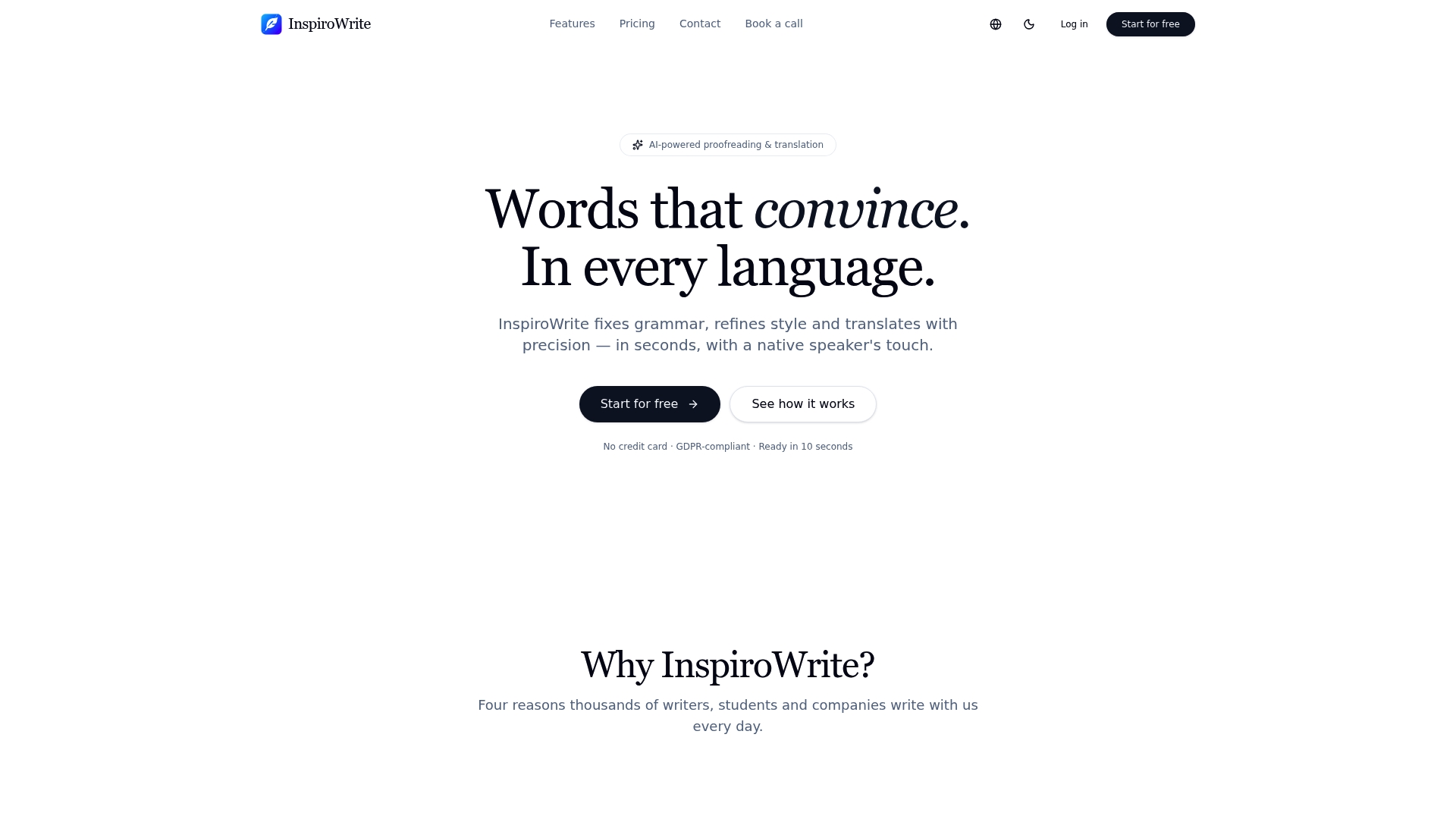
Paste a draft paragraph into Inspirowrite and use the rewrite feature to see an alternative version of your topic sentence with tighter language and a clearer claim. The tone-adjustment tool shifts the register from informal to formal in one click, which is particularly useful when you know a sentence sounds off but cannot pinpoint why. Processing is instant, and your text is never used to train AI models, so your essay stays yours.
The free plan lets you try the core features without a subscription. For students working through multiple assignments, the Pro plan gives unlimited rewrites, history tracking, and the ability to upload full documents. Start with the free plan at Inspirowrite and revise your next topic sentence in under a minute.
Useful sources
- Academic Phrasebank | Introducing work — The University of Manchester's authoritative guide to functional sentence moves; particularly useful for matching starters to rhetorical purpose in academic writing.
- Writing introduction paragraphs — NDLA's practical guidance on essay introductions, including advice on weak openers to avoid and how to move quickly to a thesis.
- How to start a sentence: 25 sentence starters and examples — Covers five broad starting methods (action, scene-setting, character, logic, engagement) with examples; useful for narrative and descriptive writing.
FAQ
What is a good topic sentence starter?
A good topic sentence starter names the paragraph's central idea immediately and signals its connection to the essay's thesis. Phrases like "One significant factor is…", "This is evident in…", and "In contrast to…" each perform a specific rhetorical job rather than simply filling the opening slot.
What are five examples of a topic sentence?
Five model topic sentences: "The alliance system created a chain reaction that escalated a regional dispute into a continental war." / "Shakespeare uses imagery of disease in Hamlet to signal the moral corruption of the Danish court." / "Rising sea temperatures directly threaten coral reef ecosystems, reducing biodiversity in ways that affect global food chains." / "Vaccines stimulate the immune system to produce antibodies without exposing the body to a live pathogen." / "The French Revolution dismantled the feudal social order and established the legal principle of equal citizenship."
How do you begin a topic sentence?
Begin with the paragraph's main claim, not with context, background, or a meta-announcement like "In this essay, I will…". Choose a starter that matches the paragraph's rhetorical function: a contrast starter for a counter-argument paragraph, a cause-effect starter for an analytical one.
What makes a sentence starter "good" in academic writing?
A good academic sentence starter is precise, impersonal, and purposeful. It uses measured verbs ("suggests", "demonstrates", "indicates"), avoids first-person opinion markers, and connects the paragraph's point directly to the essay's argument rather than restating the thesis or announcing what the paragraph will do.
Can Inspirowrite help me improve my topic sentences?
Yes. Inspirowrite's rewrite and tone-adjustment features let you paste a draft topic sentence and receive an alternative version with tighter language and the correct academic register, with results delivered in seconds and your text kept fully private.