

Cohesion in text is the grammatical and lexical "glue" that links sentences and ideas together, forming a unified piece of writing rather than a series of disconnected statements. Linguists Michael Halliday and Ruqaiya Hasan, whose foundational work remains the standard reference in this field, identified five primary categories of cohesive devices):
- Reference: pronouns and demonstratives that point back or forward to other elements ("she," "this," "those")
- Substitution: replacing a word or phrase with a shorter stand-in ("I'll have the same")
- Ellipsis: omitting words that are understood from context ("Can you drive? Yes, I can.")
- Conjunction: linking words and phrases that signal logical relationships ("however," "therefore," "as a result")
- Lexical cohesion: word-choice connections, including repetition, synonyms, and collocations
Together, these devices create what linguists call "texture," the quality that makes a text feel like a whole rather than a list of isolated sentences.
What are the two main types of cohesion in text?
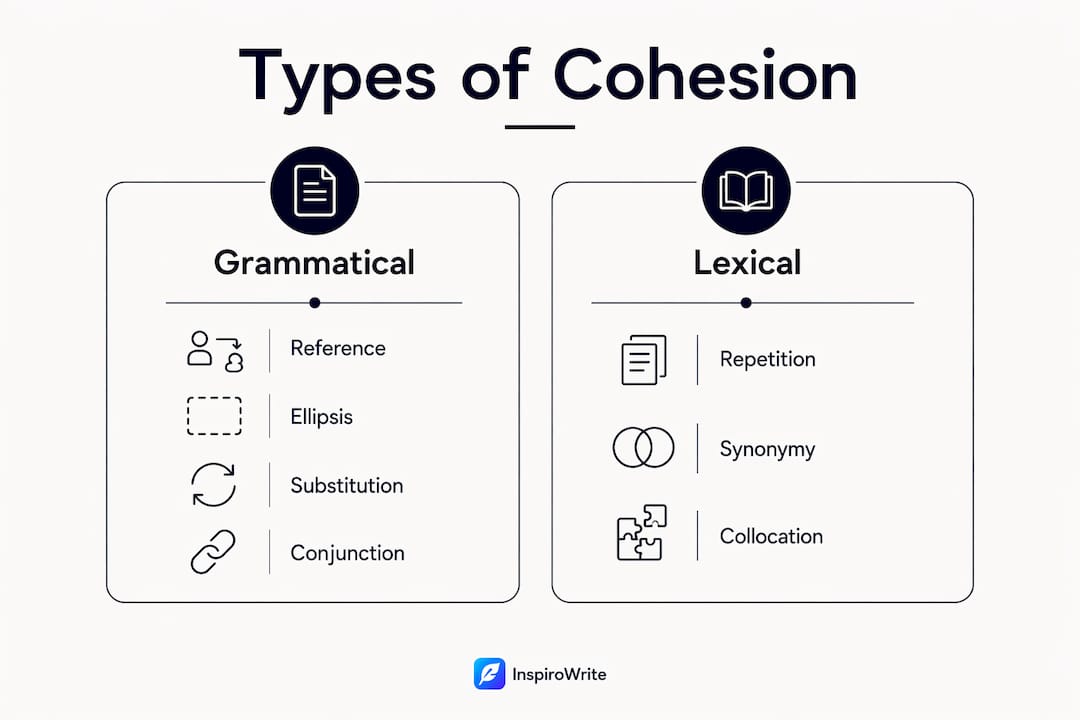
Grammatical and lexical cohesion) are the two broad categories, and understanding the difference between them sharpens your ability to diagnose and fix weak writing.
Grammatical cohesion works through structure:
- Reference: a pronoun or demonstrative ties one sentence to another ("The film was long. It was also dull.")
- Substitution: a replacement word stands in for a longer phrase to avoid repetition
- Ellipsis: words are deliberately left out because context makes them clear
- Conjunction: logical connectors such as "although," "consequently," and "meanwhile" signal how ideas relate
Lexical cohesion works through word choice:
- Repetition: restating a key term to keep the reader anchored to the main idea
- Synonyms: using related words ("dress" followed by "frock") to add variety without losing the thread
- Collocations: words that naturally cluster together, such as "heavy rain" and "pour," reinforcing a shared semantic field
Both types work in tandem. Grammatical cohesion handles the structural wiring; lexical cohesion handles the thematic consistency. Strip either out and the writing starts to feel either mechanical or scattered.
How do cohesive devices actually work? Categories with examples
Each category of cohesive device performs a distinct job. Think of them as different tools in the same kit, each suited to a specific kind of join.
- Reference: "Maria handed in her essay. She had worked on it for a week." The pronouns "she" and "it" create cohesive ties back to "Maria" and "essay," so the second sentence does not need to repeat those nouns.
- Ellipsis: "Tom can play the piano, and so can [his sister]." The bracketed phrase is omitted because the reader fills it in automatically.
- Substitution: "I wanted the red coat, but I bought the blue one." The word "one" replaces "coat" without losing meaning.
- Conjunction: "The data was incomplete. Nevertheless, the team drew conclusions." The connector signals contrast and keeps the argument moving.
- Lexical repetition: "Climate change poses serious risks. Climate change affects food security, water supply, and coastal communities." Repeating the key term anchors the paragraph's focus.
- Synonyms and collocations: Pairing "storm" with "thunder," "lightning," and "downpour" builds a coherent semantic picture without sounding repetitive.
Pro Tip: When you use a pronoun, check that its referent is unambiguous. "John told Mark that he had failed" leaves the reader guessing who failed. Name the subject again when there is any doubt.
Examples of cohesion in writing that connect ideas clearly

Seeing cohesion in action is the fastest way to understand it. Compare these two versions of the same passage:
Without cohesion: "The report was submitted. There were errors. A revision was requested. The team worked overnight. A new version was produced."
With cohesion: "The report was submitted, but it contained several errors. As a result, the editor requested a revision. The team worked overnight and produced a corrected version by morning."
The second version uses a pronoun ("it"), a conjunction ("but"), a causal connector ("as a result"), and lexical repetition ("revision") to pull five facts into a single, readable sequence. The logic is visible; the reader does not have to supply the connections themselves.
Achieving this kind of flow means linking key nouns, maintaining consistent pronoun usage, and ordering sentences so that each one builds on the last. The cognitive load on the reader drops noticeably when the writing does this work.

Pro Tip: Read your paragraph aloud and note where you pause to re-read a sentence. That hesitation usually marks a missing cohesive link.
How does cohesion differ from coherence?
Cohesion and coherence are related but not the same, and conflating them leads to writing that fixes the wrong problem.
Cohesion operates at the micro-level): it is about the sentence-to-sentence links created by pronouns, connectors, and word choice. Coherence operates at the macro-level: it is about whether the overall argument holds together logically, whether each paragraph develops a single idea, and whether the whole text stays on topic.
Key differences at a glance:
- Cohesion: local, linguistic, visible in the words on the page
- Coherence: global, logical, felt as the "flow" or "sense" of the whole piece
- A text can be cohesive but incoherent (sentences link neatly, but the argument wanders)
- A text can be coherent but lack cohesion (the logic is sound, but the sentences feel abrupt and disconnected)
A practical test: ask another reader whether the logical connection between your ideas is clear. Reader feedback reliably surfaces cohesion weaknesses that writers overlook because they already know what they meant to say. For broader guidance on effective communication in writing, the principles of cohesion and coherence apply equally in professional contexts.
Why cohesion matters in effective writing
Cohesion is what allows a reader to follow your thinking without effort. When sentences link clearly, the reader's attention stays on your argument rather than on decoding the structure. The Cornell Writing Institute describes cohesion as operating at both macro and micro levels: thesis sentences and topic sentences unify the whole essay, while sentence-to-sentence links hold each paragraph together.
Poor cohesion forces readers to do extra interpretive work. They must guess at connections, re-read sentences, and piece together a logic the writer left implicit. In academic writing, that friction costs marks. In professional writing, it costs credibility.
Common pitfalls that break textual cohesion
Most cohesion problems fall into a small number of recurring patterns:
- Ambiguous pronouns: "Sarah told Emma that she had misunderstood." Who misunderstood? Name the subject explicitly when a pronoun could refer to more than one person.
- Overusing transition words: Pasting "however" and "therefore" onto every sentence creates a mechanical rhythm without genuine logical connection. Transitions signal relationships; they do not create them.
- Abrupt topic shifts: Jumping to a new idea without a bridging sentence leaves the reader stranded.
- Inconsistent terminology: Calling the same concept "user experience," "UX," and "customer journey" in the same paragraph fragments the thread. Pick one term and stay with it. For a fuller list of structural errors that undermine cohesion, the common grammatical errors guide covers the most frequent offenders.
Practical strategies to improve cohesion in your writing
Improving cohesion is largely a revision task, not a drafting one. Write first, then apply these techniques:
- Use the known-new structure: begin each sentence with information the reader already has, then introduce the new point. This principle anchors new content to familiar ground and keeps the reading experience smooth.
- Repeat key terms deliberately: do not vary a technical term just for stylistic variety. Repetition of a precise term is a cohesive device, not a flaw.
- Check pronoun references: after drafting, underline every pronoun and trace it back to its referent. If the line is unclear, rewrite.
- Vary your connectors: use a mix of conjunctions, lexical repetition, and sentence structure rather than relying on transition words alone.
- Read aloud: your ear catches broken links that your eye skips. A sentence that sounds wrong usually has a missing or misplaced cohesive tie.
Tools such as Inspirowrite can flag ambiguous pronoun references and inconsistent terminology in seconds, giving you a structural edit before a human reader ever sees the draft. Inspirowrite's privacy-first proofreading means your content stays confidential throughout the process.

Key takeaways
Cohesion is the sentence-level linguistic glue, built from reference, ellipsis, substitution, conjunction, and lexical choice, that makes a text read as a unified whole rather than a sequence of disconnected statements.
| Point | Details |
|---|---|
| Two types of cohesion | Grammatical cohesion uses structural devices; lexical cohesion uses word-choice connections such as repetition and synonyms. |
| Five cohesive device categories | Reference, ellipsis, substitution, conjunction, and lexical cohesion each perform a distinct linking function. |
| Cohesion vs coherence | Cohesion is local and sentence-level; coherence is global and concerns the logical unity of the whole text. |
| Most common pitfall | Ambiguous pronouns are the leading cause of broken cohesion; name the subject explicitly when doubt exists. |
| Best revision strategy | Apply the known-new sentence structure to anchor new information to what the reader already holds. |
FAQ
What is cohesion in a text?
Cohesion is the grammatical and lexical linking that holds sentences together as a meaningful unit, as defined by Halliday and Hasan. It is created through devices such as pronouns, conjunctions, and word repetition.
What is cohesion in simple words?
Cohesion is the "glue" between sentences. It is what stops a piece of writing from feeling like a list of unrelated facts.
What does cohesion mean in communication?
In communication, cohesion refers to how clearly ideas connect from one sentence or paragraph to the next, making a message easy to follow without the reader having to guess at the logic.
What is an example of cohesion in writing?
"The experiment failed. It produced no usable data, so the team redesigned the protocol." The pronoun "it" and the conjunction "so" are cohesive devices that link the three clauses into a single, logical sequence.