

TL;DR:
- A pivot language acts as an intermediary for translating between languages lacking a direct connection. Using one reduces the number of required translation pairs from quadratic to linear, enabling scalable multilingual workflows. However, this approach risks semantic drift and cultural distortion, making human revision against the original source essential.
A pivot language is defined as an intermediary language used to translate between a source and a target language when no direct translation path exists. Rather than translating from, say, Swahili directly into Norwegian, a translator routes the text through a shared language both sides can work with, most commonly English. This technique is formally known as indirect translation in translation studies, though "pivot language" is the term widely used in machine translation and computational linguistics. Understanding the pivot language definition matters for anyone working across multilingual workflows, because using a pivot reduces the number of required language pairs from a quadratic number to a linear one, cutting n²/2 pairs down to n-1. That reduction is not a minor efficiency gain. It is the difference between maintaining thousands of translation pipelines and maintaining dozens.
What does pivot language mean in translation processes?
The mechanics of pivot language use follow a two-step process. First, the source text is translated into the pivot language. Second, the pivot text is translated into the target language. Each step is a full translation task, which means errors can compound across both stages.
This two-step method is also called relay translation in professional translation circles. Relay translation has existed for centuries. Medieval scholars translated Greek philosophical texts into Arabic, then from Arabic into Latin, giving European readers access to works that would otherwise have been inaccessible. The same logic applies today in machine translation workflows, where English frequently serves as the relay point between two lower-resource languages.
The scalability argument for pivot languages is compelling. A translation network covering 10 languages without a pivot requires 45 direct language pairs. With a single pivot language, it requires only 9. That compression makes multilingual publishing, software localisation, and international broadcasting economically viable at scale.
Pro Tip: When working with relay translation, always request the original source text alongside the pivot version. Comparing both during revision catches meaning shifts that would otherwise go unnoticed.
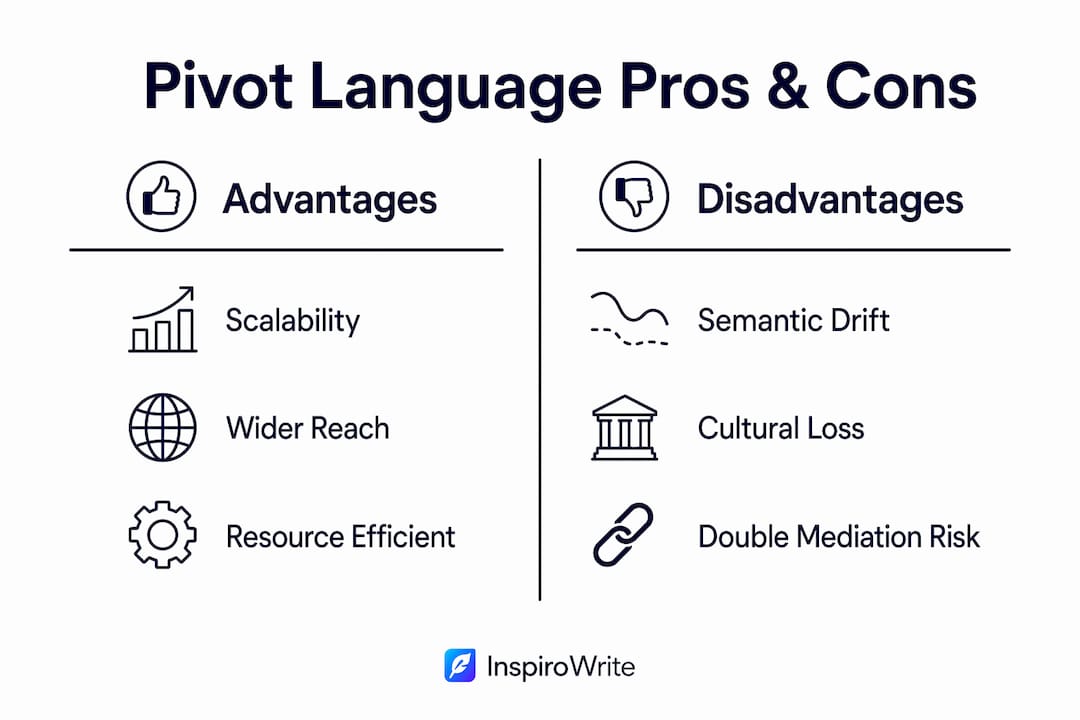
The risks are real, though. Each translation step introduces the possibility of semantic drift. A nuance present in the source may survive the first translation but disappear in the second. Idiomatic expressions are particularly vulnerable, as a phrase that translates cleanly into English may have no equivalent in the target language at all. Translators working in indirect translation workflows need to account for this compounding risk from the outset.
What are the advantages and disadvantages of using pivot languages?
Pivot languages offer genuine practical benefits, particularly for languages with limited translation resources.
Advantages:
- They reduce the total number of language pairs a translation system must support, cutting infrastructure costs significantly.
- They make translation accessible for low-resource languages that lack qualified direct translators into every target language.
- They enable consistent terminology across multiple target languages when a single high-quality pivot translation is produced first.
- They allow smaller translation teams to cover a wider range of language combinations without specialist expertise in every pairing.
Disadvantages:
- Double mediation risk means meaning filters through two cultural and linguistic lenses, doubling the opportunity for distortion.
- Cultural specificity erodes when the pivot language lacks equivalent concepts from the source culture.
- Pivot translations can prioritise sounding correct in the pivot language rather than faithfully conveying the source, a problem well documented in game localisation contexts.
- Errors introduced in the first translation stage are invisible to the second-stage translator unless they have access to the original source.
The choice of pivot language matters enormously for quality. English is the dominant pivot globally, but it is not always the best choice. A translation from Catalan to Romanian routed through English will lose grammatical gender nuances that a Romance language pivot, such as Spanish or Italian, would preserve naturally.
Pro Tip: Always compare the final target text against the original source, not just the pivot version. This dialogic revision process is the most reliable way to catch cultural and linguistic shifts introduced during indirect translation.
The cultural flattening risk deserves particular attention. When a text passes through English as a pivot, it absorbs English-language assumptions about structure, register, and cultural reference. The downstream translator then works from an already anglicised version of the source, which can produce a target text that feels foreign to its intended audience even when grammatically correct.
How are pivot languages applied in modern machine translation and subtitling?
Machine translation has made pivot language use both more common and more technically sophisticated. Large language models (LLMs) now use a technique called pivot prompting, where the model is instructed to reason through a high-resource pivot language before generating the target output. Synthetic pivoting techniques can improve BLEU scores by up to 5.6 points for low-resource language pairs. BLEU scores measure translation quality on a numerical scale, so a 5.6-point gain represents a meaningful improvement in output accuracy.

This improvement is not automatic. The gains depend on choosing a pivot language that is linguistically close to both the source and the target. A structurally mismatched pivot can actively harm translation quality rather than improve it. Researchers have found that linguistically related pivot languages outperform arbitrary high-resource pivots in low-resource settings, which challenges the default assumption that English is always the best relay point.
Pivot subtitling is a distinct and growing application. In audiovisual translation, subtitles are often created first in a major language such as English, then translated into multiple regional languages from that English version rather than from the original audio. This workflow is common in streaming platforms distributing content across dozens of markets simultaneously.
The cultural stakes in pivot subtitling are high. AI-mediated pivot subtitling is vulnerable to meaning loss without skilled human intervention. African cinema distributed to multilingual audiences, for example, often uses English as a gateway language, but the English subtitles may already contain cultural compressions that distort the source meaning before regional translators even begin their work. Skilled translators working on audiovisual projects must treat the pivot text as a working draft, not a finished source.
Human oversight remains the non-negotiable element in any pivot workflow. AI can process pivot translations at speed, but it cannot reliably detect when a culturally specific concept has been flattened into a generic equivalent. That detection requires a translator who understands both the source culture and the target audience.
Which languages are commonly used as pivot languages and why?
English is the dominant pivot language in global translation today, but this has not always been the case. Pivot language selection has shifted across eras and regions. French held that role in 19th-century European diplomacy. Russian served as the relay language across Soviet bloc countries. The choice of pivot reflects economic power, linguistic infrastructure, and the availability of trained translators, not inherent linguistic superiority.
Several factors determine whether a language makes a good pivot:
- Corpus availability: A pivot language needs large, high-quality bilingual corpora to support machine translation systems. English has the largest such corpus by a considerable margin.
- Linguistic proximity: A pivot that shares grammatical features with the source or target language produces fewer structural distortions. Spanish works well as a pivot for Latin American indigenous languages because of shared phonological and syntactic patterns.
- Translator availability: Human relay translation depends on finding translators who work in both the source-to-pivot and pivot-to-target directions. Languages with large translator communities offer more options.
- Standardisation: Languages with well-documented grammar, consistent orthography, and established style guides produce more reliable pivot texts.
Regional pivot languages serve specific translation ecosystems. Hindi functions as a relay language for several South Asian languages, including Marathi and Gujarati, where direct translation resources are limited. Spanish serves a similar function across Latin American markets. Arabic acts as a pivot for several languages across the Middle East and North Africa.
The consequences of a poor pivot choice are concrete. A translation from a tonal language such as Mandarin, routed through English and then into another tonal language such as Vietnamese, will lose tonal information at the English stage that cannot be recovered downstream. The target text may be grammatically acceptable but pragmatically wrong.
Pro Tip: When selecting a pivot language for a professional project, prioritise linguistic proximity over resource availability. A slightly smaller corpus in a structurally closer language will usually produce a better final translation than a massive corpus in a structurally distant one.
Key takeaways
A pivot language reduces translation complexity from quadratic to linear, but it introduces double mediation risk that only skilled human revision can reliably correct.
| Point | Details |
|---|---|
| Core definition | A pivot language is an intermediary used when no direct translation path exists between source and target. |
| Scalability benefit | Using one pivot reduces required language pairs from n²/2 to n-1, making large multilingual networks viable. |
| Double mediation risk | Meaning filters through two cultural lenses, making human revision against the original source essential. |
| Pivot selection matters | Linguistically related pivots outperform arbitrary high-resource ones, especially for low-resource language pairs. |
| AI and subtitling | Synthetic pivoting can improve BLEU scores measurably, but human oversight remains necessary to preserve cultural nuance. |
Why I think we underestimate the cultural cost of pivot translation
The efficiency argument for pivot languages is so strong that it tends to end the conversation before the cultural argument begins. I have seen this repeatedly in multilingual publishing projects where the pivot workflow is chosen for budget reasons, and the cultural review stage is then treated as optional. It is not optional. It is the point where the translation either succeeds or fails for its actual audience.
The technical gains from synthetic pivoting are real and worth pursuing. A 5.6-point BLEU improvement is not trivial. But BLEU scores measure surface-level accuracy against reference translations. They do not measure whether a joke lands, whether a character sounds authentic, or whether a culturally specific concept has been replaced with something that means something entirely different to the target reader.
The most underrated skill in pivot translation is knowing what to look for when comparing the target text against the source. Most translators are trained to check for accuracy in the pivot-to-target direction. Fewer are trained to interrogate the pivot text itself for the distortions it has already introduced. That second layer of critical reading is where quality is actually won or lost.
The future of pivot translation lies in better pivot selection, not just better models. Choosing a linguistically proximate pivot, building in mandatory source comparison at the revision stage, and treating cultural accuracy in translation as a measurable output rather than a soft concern will produce better results than any model improvement alone.
— Mike
Inspirowrite for translators working with multilingual content
Translators managing indirect translation workflows face a specific challenge: maintaining accuracy across multiple language stages while keeping projects moving at pace.

Inspirowrite is built for exactly this kind of work. Its AI-powered proofreading and translation tools deliver fast, accurate feedback on multilingual drafts, helping translators catch the semantic drift and register shifts that pivot workflows introduce. Inspirowrite processes content without storing or using it to train AI models, which matters when you are handling client texts that cannot leave a secure environment. Whether you are reviewing a pivot translation for cultural accuracy or polishing a final target text, Inspirowrite's translation tools give you the speed and precision the work demands.
FAQ
What is a pivot language in translation?
A pivot language is an intermediary language used when translating between two languages that lack a direct translation path. The source text is translated into the pivot first, then from the pivot into the target language.
How does pivot language work in machine translation?
Machine translation systems use a pivot language, typically English, as a relay point between low-resource language pairs. Techniques such as pivot prompting in large language models can improve translation quality measurably for languages with limited direct training data.
What are the risks of using a pivot language?
The main risk is double mediation, where meaning passes through two cultural and linguistic filters, increasing the chance of semantic drift. Human revision comparing the final target text against the original source is the most reliable way to catch these distortions.
Which language is most commonly used as a pivot?
English is the most widely used pivot language globally due to its large bilingual corpora and translator availability. Historically, French and Russian served as regional pivot languages in earlier eras.
Does pivot language choice affect translation quality?
Pivot language choice directly affects quality, particularly for low-resource languages. Linguistically related pivots produce fewer structural distortions than arbitrary high-resource pivots, making proximity a key selection criterion.