

TL;DR:
- Transcreation creatively adapts content to preserve emotional impact and persuasion across cultures. It involves rewriting content based on a creative brief instead of strict translation. Effective transcreation requires bilingual, culturally fluent creatives skilled in both linguistic and artistic reinvention.
Transcreation is defined as the creative adaptation of content from one language and culture to another, preserving its original intent, emotional impact, and persuasive effect rather than translating it word for word. Where standard translation converts meaning, transcreation recreates the experience for a new audience entirely. The process sits at the intersection of linguistic expertise, creative writing, and cultural knowledge. Marketers, advertising agencies, and content creators rely on it when a literal translation would strip the life from a campaign, slogan, or script.
What does transcreation mean, and how is it different from translation?
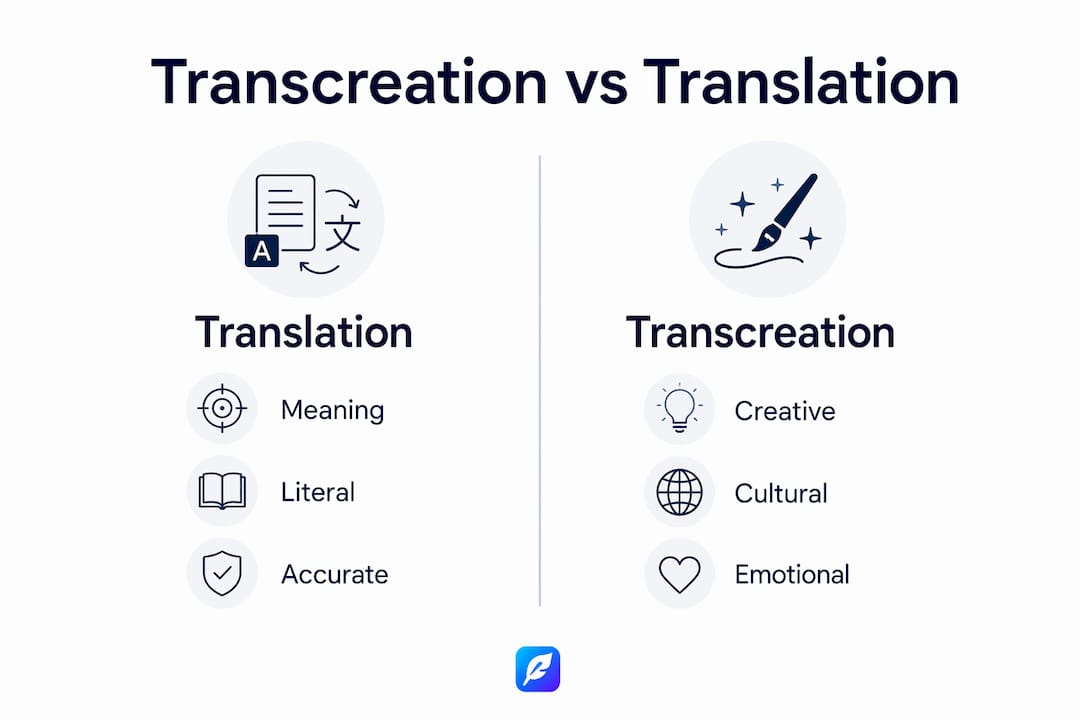
Transcreation and translation are not interchangeable. Translation converts the meaning of a source text into a target language with fidelity to the original words. Transcreation prioritises functional and cultural equivalence over linguistic fidelity, rewriting content so it lands with the same emotional force in the new market.

Localisation sits between the two. It adapts content for a specific locale by adjusting formats, currencies, date styles, and culturally specific references, but it does not typically involve the creative reinvention that transcreation demands. A software interface localised for French users still reads like a translation. A perfume advertisement transcreated for the French market reads like it was written there.
The clearest way to understand the difference is to look at what each process produces. Translation produces an accurate rendering. Localisation produces a culturally appropriate version. Transcreation produces content that feels native to the audience, even when the source text has been substantially rewritten.
| Process | Purpose | Approach | Outcome |
|---|---|---|---|
| Translation | Convert meaning accurately | Word-for-word or close equivalent | Faithful rendering of source text |
| Localisation | Adapt for a specific locale | Adjust formats, references, and conventions | Culturally appropriate version |
| Transcreation | Recreate emotional and persuasive impact | Creative rewriting with cultural reinvention | Content that feels originally written for the audience |
How does the transcreation process work?
A transcreation project begins with a creative brief outlining objectives, audience, brand voice, and emotional goals. This replaces the source text as the primary guide. The transcreator is not asked to follow the original sentence by sentence. They are asked to achieve the same effect in a different cultural context.
The process then moves through several stages:
- Brief review. The transcreator studies the campaign objectives, the target audience's cultural context, and any brand guidelines covering tone, vocabulary, and visual identity.
- Creative brainstorming. Multiple versions of the adapted content are drafted. Unlike translation, this stage involves genuine creative invention, including new metaphors, restructured messaging, and culturally specific references.
- Back-translation and rationale. Transcreators provide back-translations and documented rationale for their choices so clients can verify the intended message and emotional impact are maintained without reading the target language themselves.
- Client review. The adapted content is reviewed against campaign objectives, not against the source text word for word.
- Revision and approval. Feedback is incorporated and the final version is approved before delivery.
Practical constraints shape every stage. Character limits in digital advertising, brand guidelines that restrict certain words, and platform-specific formatting rules all require the transcreator to solve creative problems within tight boundaries.
Pro Tip: Always supply your transcreator with visual assets, audio references, and competitor examples alongside the written brief. Context beyond the text itself dramatically improves the quality of the adapted content.
Where is transcreation used? Real applications and examples
Transcreation is the right choice whenever content depends on persuasion, humour, wordplay, or emotional resonance. The most common content types requiring transcreation include:
- Advertising slogans and taglines. A slogan that rhymes, plays on a cultural idiom, or relies on a double meaning cannot survive literal translation. The adapted version must achieve the same effect through entirely different words.
- Marketing copy and campaign scripts. Emotional appeals in video scripts, radio advertisements, and social media campaigns are built on cultural assumptions. Transcreation rebuilds those appeals for the target culture.
- Brand names and product descriptions. Names that carry positive connotations in one language can carry neutral or negative ones in another. Transcreation addresses this before a product launches.
- Packaging and point-of-sale materials. Retail copy that uses humour or lifestyle references requires creative adaptation to connect with local shoppers.
Marketing content translated literally rather than transcreated typically fails. Clever wordplay becomes awkward and emotional appeals lose their potency. The investment in the original creative work is wasted if the adapted version falls flat.
Standard translation, by contrast, is entirely appropriate for UI strings, system messages, and legal text where clarity and precision matter more than emotional resonance. A terms-and-conditions document does not need to move anyone. A product launch campaign does.
A well-known category of transcreation failure involves fast-food brand names and slogans entering new markets. When KFC's "Finger Lickin' Good" was first introduced in China, a literal translation reportedly produced a phrase closer to "Eat your fingers off." The brand corrected this, but the example illustrates exactly why creative adaptation is not optional for consumer-facing campaigns.
Humour is the hardest content type to transcreate. A joke depends on shared cultural knowledge, timing, and linguistic structure. None of those elements transfer directly. A skilled transcreator does not translate the joke. They write a new one that produces the same reaction.
What skills and challenges define professional transcreation?
Transcreation demands a dual skill set: high-level linguistic expertise and professional-grade creative writing ability. Bilingualism alone is not sufficient. A person who speaks two languages fluently can translate accurately. They cannot necessarily recreate a campaign concept with the same emotional charge in a different cultural register.
The most common pitfall in transcreation projects is treating transcreation like traditional translation by providing a rigid source text rather than a creative brief. When a transcreator is handed a finished advertisement and told to "translate it," the result is usually a compromise between fidelity and creativity that satisfies neither goal. Success is measured against strategic objectives, not source fidelity.
Other frequent challenges include:
- Ignoring cultural fluency. A transcreator who knows the language but not the culture will produce content that is grammatically correct but culturally flat.
- Skipping back-translation. Without a back-translation, clients cannot verify whether the adapted content still carries the intended message. This creates approval problems and risks brand inconsistency.
- Underestimating the time required. Transcreation takes longer than translation because it involves genuine creative work. Budgeting translation timelines for transcreation projects leads to rushed, substandard output.
- Neglecting brand guidelines. Creative freedom does not mean unlimited freedom. The transcreator must work within the brand's established voice, even while reinventing the content.
Effective transcreation requires native speakers with deep cultural fluency and creative writing skills. Translators focused only on accuracy may struggle with the necessary reinvention of content. This is why subject matter expertise and creative background are both selection criteria when commissioning transcreation work.
Pro Tip: When reviewing transcreated content, resist the urge to compare it word for word with the source. Ask instead whether it achieves the same emotional response and serves the same campaign objective.
Industry standards frame transcreation as a structured creative process necessary to preserve persuasion, rhythm, and brand voice. Failure to use transcreation in appropriate contexts often results in a flat or awkward brand perception internationally. The cost of getting it wrong is not just a poor translation. It is a damaged brand reputation in a new market.
Key takeaways
Transcreation is the discipline that separates brands that connect internationally from those that merely communicate across borders.
| Point | Details |
|---|---|
| Core transcreation definition | Transcreation adapts content creatively to preserve emotional impact and persuasive effect, not just meaning. |
| Translation vs. transcreation | Translation converts words; transcreation reinvents content so it resonates equally in the target culture. |
| When to use transcreation | Use it for slogans, campaigns, scripts, and any content where humour or emotion drives the message. |
| The brief is the foundation | A creative brief, not the source text, guides the transcreation process from start to finish. |
| Skill requirements | Effective transcreators combine bilingual fluency with professional creative writing and deep cultural knowledge. |
Why transcreation deserves more respect than it gets
I have spent years watching brands pour significant budgets into creative campaigns and then hand the international adaptation to whoever is cheapest and fastest. The result is almost always the same: a version that is technically correct and emotionally inert. Nobody laughs at the joke. Nobody feels the aspiration. The campaign simply sits there, translated but not felt.
The uncomfortable truth is that transcreation is undervalued because it is misunderstood. Clients often cannot read the target language, so they cannot judge the quality of the adapted content directly. They rely on back-translations and rationale documents, which is exactly why those tools exist. But many agencies skip them to save time, and clients do not know to ask.
What I have found actually works is treating transcreation as a creative commission, not a language service. The brief should be as detailed as the one you would give a copywriter creating the original campaign. The review should focus on whether the content achieves its objective in the new market, not on whether it mirrors the source sentence by sentence.
The demand for transcreation is growing as brands expand into markets where cultural distance from the source material is significant. AI translation tools are improving rapidly, but they do not yet replicate the cultural intuition and creative judgement that transcreation requires. The human element remains the differentiator, and it is worth paying for.
— Mike
How Inspirowrite can support your transcreation projects
Transcreation sits at the point where language skill and creative judgement meet. Getting it right requires the right support from the start. Inspirowrite works with writers, marketers, and businesses who need content that does more than translate accurately. Whether you are adapting a campaign for a new market or refining multilingual copy to carry the right emotional weight, Inspirowrite's content adaptation services are built for that challenge. The platform combines fast, privacy-respecting tools with expert guidance to help you produce polished, culturally resonant content. Reach out to Inspirowrite to discuss your next transcreation project and protect your brand voice across every market.
FAQ
What does transcreation mean in simple terms?
Transcreation means creatively adapting content from one language and culture to another so it carries the same emotional impact and persuasive effect as the original. It goes beyond translation by rewriting content rather than converting it word for word.
What is the difference between translation and transcreation?
Translation converts the meaning of a source text accurately into another language. Transcreation reinvents the content creatively so it resonates with a new audience in their cultural context, even if the words change substantially.
When should you use transcreation instead of translation?
Use transcreation for slogans, advertising campaigns, scripts, and any content where humour, wordplay, or emotional appeal drives the message. Use standard translation for legal documents, system messages, and technical content where precision matters more than resonance.
Who carries out transcreation work?
Transcreation is carried out by bilingual professionals with professional-grade creative writing skills and deep cultural fluency in both the source and target cultures. Bilingualism alone is not sufficient for effective transcreation.
How is transcreation reviewed and approved?
Transcreated content is reviewed against campaign objectives rather than the source text. Transcreators typically provide back-translations and written rationale so clients can verify the adapted content retains the intended message and emotional impact.