

Peer review improves essays because it forces writers to see their work through someone else's eyes, practise self-assessment, and revise at a level that goes far beyond fixing commas. The mechanism is not simply "getting feedback." It is the cognitive shift that happens when a writer must explain their argument to a real reader who can push back.
Three things happen reliably when peer review is structured well:
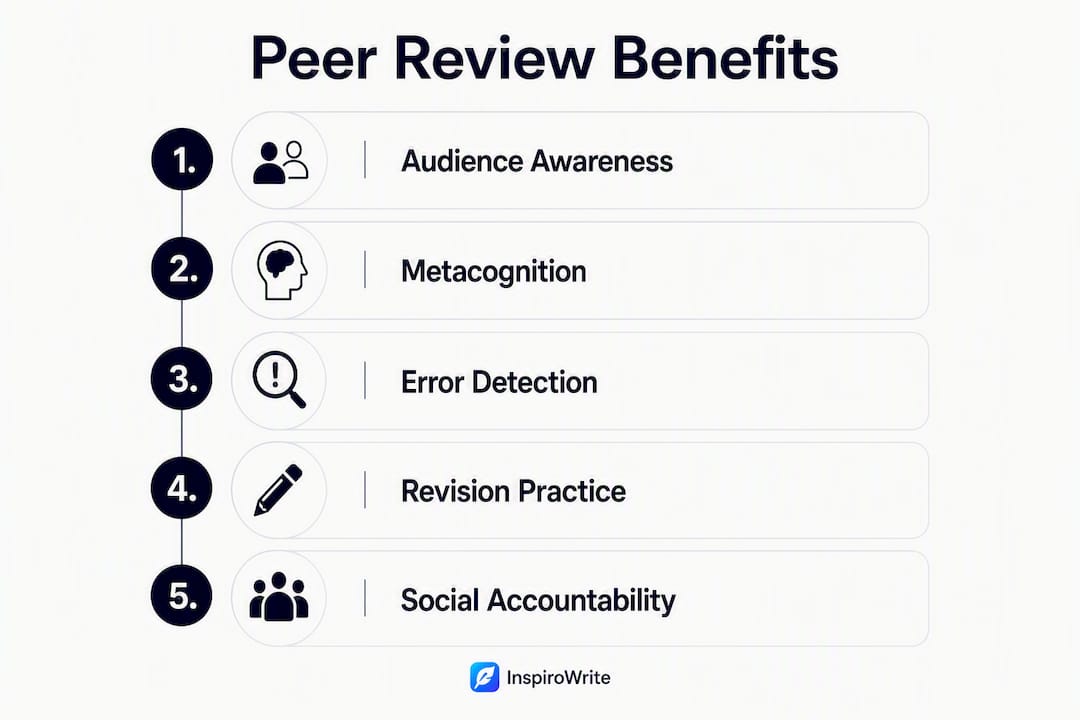
- Audience awareness kicks in: writers discover where their logic breaks down for an actual reader, not just in their own heads.
- Metacognition develops: the act of evaluating a peer's draft trains the same analytical eye students then turn on their own work.
- Substantive revision replaces last-minute proofreading: structured peer review pushes students to submit earlier drafts and make meaning-level changes rather than surface edits.
- Multiple perspectives surface gaps a single reader or the writer alone would miss.
A systematic review found a consistent link between structured peer review and improvements in higher-order writing skills, particularly when rubrics and reviewer training were in place.
Table of Contents
- Why peer review improves essays: the mechanisms behind the gains
- What the research actually shows
- Why giving feedback helps the reviewer's own writing
- How to run peer review so it actually works
- Common pitfalls and how to avoid them
- Key takeaways
- The part most teachers underestimate
- FAQ
- Useful sources
Why peer review improves essays: the mechanisms behind the gains
1. Audience awareness
When a student writes for a teacher, they often assume shared knowledge. Writing for a peer who genuinely does not follow the argument strips that assumption away. The writer has to clarify transitions, define terms, and structure reasoning so it holds for someone without their background. That pressure produces clearer prose, not because the writer was told to be clearer, but because they experienced the consequence of not being.
Classroom example: In an A-level history essay exchange, a student who wrote "the causes were well-documented" receives a peer note: "Which causes? I got lost here." One comment, and the writer rewrites an entire paragraph.
2. Metacognition and self-assessment
Reading a peer's draft with a critical eye is, in effect, a rehearsal for reading your own. Students who evaluate whether a peer's argument is well-supported start asking the same question of their own paragraphs. Peer review engages students with disciplinary content and builds the evaluative judgement that underpins academic success at every level.

3. Error detection transfer
Spotting a structural flaw in someone else's essay is cognitively easier than spotting it in your own, because you have no emotional investment in the other writer's choices. That practice transfers. Students who regularly review peers develop a sharper internal editor, and the transfer is strongest on global aspects such as organisation and cohesion rather than local surface errors.
4. Earlier drafts and substantive revision
Peer review only works if there is a draft to review. That scheduling constraint alone changes student behaviour: writers who know a peer will read their work on Thursday produce a draft by Wednesday rather than the night before submission. The result is time for genuine revision, not just proofreading. Knowing the difference between editing and proofreading matters here: peer review should target editing, not surface correction.

5. Social accountability
There is a subtle motivational effect that rarely appears in research papers but every teacher recognises: students write more carefully when they know a classmate will read the work. The social dimension raises the stakes in a way that a distant submission deadline does not.
Pro Tip: Ask students to write one sentence at the top of their draft stating what they most want feedback on. It focuses the reviewer and gives the writer a sense of agency over the process.
What the research actually shows
The evidence base for peer review in essay writing is stronger than most teachers realise, particularly when the process is scaffolded.
| Study / Source | Context and sample | Headline finding |
|---|---|---|
| Systematic review, 25 studies | Mixed levels, multiple disciplines | Structured peer review consistently improves higher-order writing skills when rubrics and training are in place |
| BYU study on givers vs receivers | Undergraduate writing course | Reviewers made larger gains in global writing aspects than those who only received feedback |
| Hendrix process study | Secondary and undergraduate | 81.5% of peer comments addressed meaning-level concerns; only 10.1% were surface edits |
| Johns Hopkins writing programme | University writing courses | Three or more peer reviewers can approximate instructor feedback at scale |
| Sweetland Center, University of Michigan | Instructor guidance | Modelling helpful feedback with examples measurably raises review quality |
Peer review reframes writing as communication to a real audience, which increases student motivation and ownership of revision. The shift from "writing for marks" to "writing to be understood" is where the quality gains actually originate.
The conditions that reliably boost peer review's impact: a shared grading rubric used during review, at least one session of reviewer training with sample comments, three or more reviewers per essay, and a teacher follow-up that checks review quality.
Why giving feedback helps the reviewer's own writing
The BYU study finding is the one most teachers find counterintuitive: in certain conditions, the students giving feedback improved more than those receiving it. Beginning reviewers showed the largest gains, suggesting the analytical practice is most valuable precisely when students are still developing their writing instincts.
The mechanism is straightforward. Critiquing a peer's argument for coherence, evidence, and structure forces the reviewer to hold those criteria in mind explicitly. That explicit attention transfers directly to their next draft. The transfer is strongest on global aspects: organisation, paragraph cohesion, and argumentative logic. Surface-level grammar is less affected, which is why peer review should not be treated as a substitute for targeted grammar work.
Key gains for reviewers:
- Sharper structural judgement applied to their own outlines and drafts.
- Increased ability to identify where an argument lacks evidence.
- Greater confidence in self-editing, reducing dependence on teacher correction.
Pro Tip: After a peer review session, ask reviewers to write a 100-word note identifying one problem they spotted in a peer's essay that they now want to check in their own draft. This makes the transfer explicit rather than accidental.
How to run peer review so it actually works
Done poorly, peer review produces vague comments and resentful students. Done well, it produces the kind of substantive feedback that drives real essay improvement. The difference is almost entirely in the preparation.
Before the session
- Model good feedback. Show two or three sample comments on a projected draft: one vague ("this paragraph is confusing"), one specific ("your claim in paragraph three needs a source, and the transition from paragraph two is missing"). Let students discuss the difference.
- Supply a rubric. Use the same criteria the essay will be graded against. This aligns reviewer attention with learning outcomes and reduces time spent on irrelevant surface edits.
- Set the review goal. Tell students whether you want them to focus on argument structure, evidence use, or clarity. One focus per session produces better comments than an open-ended "review everything."
- Decide on anonymity. Blind review reduces social pressure and tends to produce more honest feedback, particularly in groups where friendship dynamics are strong.
Session formats
- Written exchange (20–30 minutes): Students swap drafts and write comments using the rubric. Works well for homework essays. Minimum two reviewers per essay.
- Small-group oral + written (40 minutes): Groups of three read one essay aloud, discuss it, then each member writes one written comment. Produces richer feedback and builds spoken academic language.
- Speed peer review (15 minutes): Students rotate drafts every five minutes, each leaving one specific comment. Good for early drafts where broad impressions matter more than detailed notes.
Three or more reviewers per essay is the threshold at which combined peer feedback begins to approximate the range and depth of instructor feedback.
After the session
Require a short revision plan: three bullet points stating which suggestions the student will act on and why. This turns passive receipt of comments into active decision-making. Spot-check a sample of reviews and give brief feedback on the feedback itself. Students who know their comments will be read write better comments.
Common pitfalls and how to avoid them
Even well-intentioned peer review sessions can collapse into polite non-events. These are the patterns to watch for.
Vague praise ("This is really good!"): Happens when students lack criteria. Fix: supply sentence starters ("One place where the argument could be stronger is…", "I wasn't sure what you meant by…") and grade the specificity of comments, not just their presence.
Surface-only focus: Reviewers circle spelling errors and ignore argument gaps. Fix: use a rubric that weights higher-order concerns (argument, structure, evidence) above grammar. Remind students that proofreading is a separate stage from substantive review.
Social reluctance to criticise: Common in close-knit groups or cultures where direct criticism feels rude. Fix: blind review removes the social friction. Framing comments as "questions a confused reader might ask" rather than judgements also helps.
Scepticism about peer competence: Writers dismiss feedback because "they're not the teacher." Fix: require the revision plan described above, where students must engage with each comment and explain their decision. The act of reasoning through a suggestion, even to reject it, is itself productive.
Measuring whether it worked: Compare draft and final versions. Did the writer address higher-order issues or only surface corrections? Student reflections asking "what changed and why?" give you qualitative evidence of genuine revision.
Key takeaways
Peer review improves essays when it is structured with rubrics, reviewer training, and teacher follow-up because it develops audience awareness, metacognition, and the habit of substantive revision.
| Point | Details |
|---|---|
| Reviewers gain too | Students giving feedback improve their own global writing skills, sometimes more than those receiving it. |
| Meaning-level comments dominate | When scaffolded, most peer comments address argument and structure, not just surface errors. |
| Three reviewers is the threshold | Three or more peer reviewers can approximate the range and depth of instructor feedback. |
| Rubrics are non-negotiable | Using the grading rubric during review aligns attention with learning outcomes and reduces surface-only feedback. |
| Require a revision plan | A short written plan of which suggestions to act on turns passive feedback receipt into active revision. |
The part most teachers underestimate
There is a tendency to evaluate peer review by the quality of the comments students write. That is the wrong metric. The more important question is what happens to the reviewer's next essay.
The BYU finding that givers improve more than receivers in certain conditions should change how teachers design writing courses. If the analytical work of critiquing a peer's argument is where the deepest learning happens, then every student needs to be a reviewer, not just a recipient. Rotating roles, requiring multiple review sessions across a term, and making the reviewer's reflection a graded component all shift the exercise from a feedback-delivery mechanism into a genuine writing development practice.
The other underestimated variable is timing. Peer review scheduled two weeks before submission produces substantive revision. Peer review scheduled two days before submission produces proofreading. The calendar matters as much as the rubric.
After peer review, students often have a clearer sense of what their essay needs but still struggle with the final polish; using tools like typing your essay into Google Docs with a real edit history can help track revisions and improve editing. Inspirowrite's AI proofreading tool can handle that last stage quickly and confidentially, checking grammar, style, and clarity without storing your text or using it to train any model. It is a practical complement to the human feedback peer review provides.
FAQ
What are the main benefits of peer review for essay writing?
Peer review develops audience awareness, metacognition, and the habit of substantive revision. Research shows it consistently improves higher-order writing skills, particularly argumentation and structure, when supported by rubrics and reviewer training.
Why is peer review important at GCSE and A-level?
At secondary level, peer review builds the evaluative judgement students need for exam essays, where they must assess the strength of an argument independently. It also gives students low-stakes practice in academic critique before high-stakes assessments.
Does giving feedback improve your own writing?
Yes. A BYU study found that reviewers made larger gains in global writing aspects than those who only received feedback, with beginning reviewers showing the strongest improvements.
What makes peer review more effective?
Structured implementation is the key factor. A systematic review of 25 studies found that rubrics, reviewer training, three or more reviewers per essay, and teacher follow-up consistently produced better outcomes than unstructured exchanges.
How is peer review different from proofreading?
Peer review targets higher-order concerns: argument, structure, evidence, and clarity. Proofreading addresses surface errors such as spelling and punctuation. Conflating the two is one of the most common reasons peer review sessions produce shallow, unhelpful feedback.
Useful sources
| Source | Type | Why it is useful |
|---|---|---|
| Systematic review: peer review and writing performance (JCRELC) | Empirical (systematic review) | Primary evidence base; 25 studies on structured peer review and higher-order writing gains |
| To give is better than to receive (BYU) | Empirical study | Key evidence that reviewers improve more than receivers in certain conditions |
| Peer review as a strategy for improving students' writing (Hendrix) | Practitioner guide with data | Source for the meaning-level comment finding; accessible for classroom practitioners |
| Peer review toolkit (Johns Hopkins Writing Programme) | Practitioner guide | Practical session design advice; source for the three-reviewer threshold |
| Using peer review to improve student writing (Sweetland Center, University of Michigan) | Practitioner guide | Evidence that modelling feedback raises review quality; source for revision reflection guidance |
| Incorporating peer feedback in academic writing: systematic review (PMC) | Empirical (systematic review) | Broad overview of benefits and challenges across learning contexts; useful for literature reviews |
| Peer review as a scholarly practice (PMC) | Empirical / conceptual | Covers the shift from vague criticism to constructive dialogue; strong on reviewer training rationale |
| Using peer review in the classroom (Edutopia) | Practitioner guide | Accessible overview of motivation and ownership gains; good starting point for teachers new to peer review |