

Expository writing explains, informs, or clarifies a topic without trying to persuade the reader or tell a story. A short BBC news report explaining how vaccines work, a GCSE biology textbook passage on photosynthesis, and a step-by-step recipe are all expository writing examples you encounter every day. The form is everywhere, yet students often struggle to produce it cleanly. Resources such as Purdue OWL, the Harvard Writing Center, and Inspirowrite all point to the same fundamentals: a clear thesis, evidence-based body paragraphs, and an objective tone.
- A BBC news explainer on climate change
- A textbook passage on the causes of World War One
- A how-to paragraph on setting up a school email account
Key takeaways
Expository writing explains a topic objectively using a clear thesis, evidence-based body paragraphs, and logical transitions, and mastering its structure is the single most transferable academic writing skill a student can develop.
| Point | Details |
|---|---|
| Definition and purpose | Expository writing informs and clarifies without opinion; it differs from narrative and persuasive writing in both aim and tone. |
| Six core types | Cause-effect, process, compare-contrast, classification, problem-solution, and descriptive expository each suit different tasks and subjects. |
| Non-negotiable structure | Every expository text needs a thesis, topic sentences, at least two pieces of evidence per paragraph, and clear transitions. |
| Top mistakes to fix | Vague thesis, weak topic sentences, opinion language, thin evidence, and nominalisations are the most common errors to catch at revision. |
| Inspirowrite at revision | Inspirowrite's privacy-first proofreading catches tone drift, nominalisations, and grammar errors in seconds without storing your text. |
Table of Contents
- What is expository writing, and how does it differ from other styles?
- What are the key features and structure of expository texts?
- What are the common types of expository writing?
- Model expository examples you can study and imitate
- How do you plan and write an expository essay step by step?
- Common student errors and teacher tips to lift expository writing
- Student checklist: run this before you submit
- A note on UK classroom practice
- Inspirowrite helps you polish expository drafts quickly
- Sources
- FAQ
What is expository writing, and how does it differ from other styles?
Expository writing informs; narrative writing entertains; persuasive writing argues. That single distinction matters more than any other when you are deciding which mode to use. A history essay that explains the causes of the French Revolution is expository. The same essay written to convince the reader that one cause outweighed all others tips into persuasion.
The form turns up constantly across subjects:
- Science reports explaining experimental results
- Textbook passages defining concepts such as osmosis or the water cycle
- News articles summarising an event without editorial comment
- Process instructions walking a reader through a procedure step by step
The core aims are simple: inform, explain, and clarify. Opinion stays out. The writer's job is to make the reader understand something they did not understand before, not to change what they believe.
Twinkl's teaching wiki notes that expository writing is one of the most common forms students encounter in school, which is precisely why learning to produce it confidently pays off across every subject.
What are the key features and structure of expository texts?
Every solid expository text shares the same structural skeleton, regardless of length. Purdue OWL sets out the standard: introduction with a thesis, body paragraphs built on evidence, and a conclusion that restates the main idea without introducing new claims.
Core features to include:
- Thesis statement — one sentence in the introduction that states the topic and the angle of explanation
- Topic sentences — the first sentence of each body paragraph, signalling what that paragraph covers
- Evidence and examples — facts, data, definitions, or examples that support each topic sentence
- Objective tone — no personal opinion, no emotional language
- Logical order — ideas progress in a sequence the reader can follow
- Transitions — linking phrases that connect paragraphs and sentences
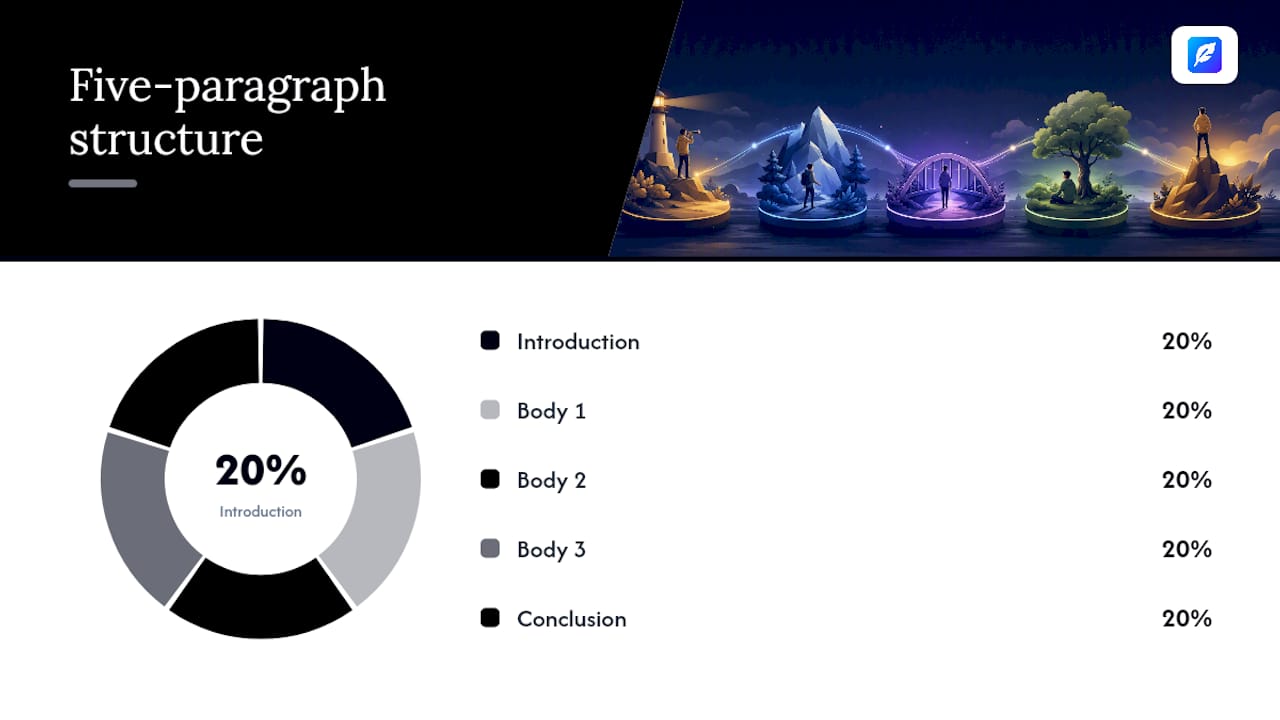
Mini-outline for a five-paragraph expository essay:
- Introduction — hook, background context, thesis statement
- Body paragraph 1 — topic sentence + two or three pieces of evidence + closing sentence
- Body paragraph 2 — topic sentence + evidence + closing sentence
- Body paragraph 3 — topic sentence + evidence + closing sentence
- Conclusion — restate thesis, summarise key points, closing thought
The Harvard Writing Center recommends mapping each argument to a clear paragraph-level topic sentence before drafting, which prevents the common problem of paragraphs that drift between two ideas at once.
Pro Tip: To make evidence feel authoritative without sliding into persuasion, introduce facts with neutral verbs: "Studies show…", "Data from X indicates…", "According to…". Avoid charged verbs such as "proves" or "demonstrates beyond doubt" — they signal opinion, not exposition.
What are the common types of expository writing?
YourDictionary's guide to expository essays identifies six types that cover most classroom tasks. Knowing which type you are writing determines how you organise your evidence.
Cause and effect Explains why something happened and what resulted. Example prompt: "Explain the causes of deforestation in the Amazon and its effects on global temperatures." Common in geography, history, and science.
Process (how-to) Walks the reader through a procedure in sequence. Example prompt: "Describe the steps involved in carrying out a titration experiment." Standard in science and technology subjects.
Compare and contrast Examines similarities and differences between two or more subjects. Example prompt: "Compare the parliamentary systems of the UK and Germany." Appears in politics, history, and English literature.
Classification Groups subjects into categories and explains the criteria. Example prompt: "Classify the main types of renewable energy and explain how each works." Useful in science, economics, and geography.
Problem and solution Identifies a problem, analyses it, and proposes solutions. Example prompt: "Outline the problem of food waste in UK schools and suggest practical solutions." Common in citizenship, PSHE, and business studies.
Descriptive expository Describes a subject in factual detail without narrative or opinion. Example prompt: "Describe the structure and function of the human heart." Frequent in biology and medicine.
Each type uses the same objective tone and evidence-based approach. The difference is in how the paragraphs are ordered and what kind of evidence fits best.
Model expository examples you can study and imitate
Short, annotated model texts are among the most effective classroom tools because they give students a replicable structure alongside visible evidence cues. The two models below are original examples.
Model paragraph
Callouts:
- Topic sentence — states the subject and the explanatory angle immediately
- Evidence — a named source and a specific figure ground the claim
- Objective tone — no personal opinion; the writer reports rather than argues
- Closing sentence — links back to the topic sentence without introducing a new claim
Model mini-essay
Introduction: The internet has changed how people access information more profoundly than any technology since the printing press. Before its widespread adoption, finding reliable data required a visit to a library or a specialist. Today, billions of people can retrieve peer-reviewed research, government statistics, and expert commentary within seconds. Thesis: The internet has democratised access to knowledge, but this shift brings significant challenges around accuracy and information literacy.

Body paragraph 1: One clear benefit of internet access is the speed and breadth of information now available to ordinary people. Medical patients can read clinical guidelines that were once restricted to professionals. Students in remote areas can access the same academic databases as those at well-funded universities. This levelling of access has measurable educational benefits in communities with limited library infrastructure.
Body paragraph 2: The same openness, however, creates serious problems with misinformation. Unlike a published textbook, online content is not subject to mandatory editorial review. Studies of social media sharing patterns consistently show that false headlines spread faster than accurate ones, partly because they are written to provoke an emotional response rather than to inform.
Conclusion: The internet has undeniably expanded access to knowledge, yet that expansion is only valuable when users can distinguish reliable sources from unreliable ones. Information literacy is now as fundamental a skill as reading itself.
Callouts:
- Thesis — appears at the end of the introduction, states the topic and the two-part angle
- Transitions — "One clear benefit…", "The same openness, however…" signal the shift between paragraphs
- Evidence — specific examples (clinical guidelines, academic databases, social media research) replace vague generalities
- Objective tone — the essay reports a tension rather than arguing for one side
How do you plan and write an expository essay step by step?
Oxbridge Essays' step-by-step guide outlines a six-stage process that works for most expository tasks, from a GCSE short answer to a university essay.
- Choose and narrow your topic. A broad topic such as "climate change" produces a vague essay. Narrow it: "the effect of rising sea temperatures on coral reef bleaching in the Great Barrier Reef."
- Research and gather evidence. Collect facts, statistics, definitions, and examples from credible sources. Note where each piece of evidence comes from before you start drafting.
- Write your thesis statement. One sentence that states your topic and the specific angle of explanation. Avoid opinion: "Three factors contribute to coral bleaching: rising water temperature, ocean acidification, and increased UV exposure."
- Plan your outline. Assign one body paragraph to each main point. Write the topic sentence for each paragraph before you write the paragraph itself.
- Draft. Write continuously without stopping to edit. Get the structure down first.
- Revise. Check thesis clarity, topic sentence alignment, evidence quality, tone, and transitions. The Macquarie University guide specifically advises cutting nominalisations and run-on sentences at this stage, since both weaken readability significantly.
Reusable outline template:
- Introduction: Hook → background context → thesis statement
- Body paragraph 1: Topic sentence → evidence 1 → evidence 2 → closing sentence
- Body paragraph 2: Topic sentence → evidence 1 → evidence 2 → closing sentence
- Body paragraph 3: Topic sentence → evidence 1 → evidence 2 → closing sentence
- Conclusion: Restate thesis → summarise key points → closing thought
Transition phrases by function:
- Addition: "In addition," / "Furthermore," / "A further example is…"
- Contrast: "However," / "In contrast," / "On the other hand,"
- Cause and effect: "As a result," / "Consequently," / "This leads to…"
- Sequence: "First," / "Subsequently," / "Finally,"
For guidance on structuring paragraphs in English at the sentence level, that linked resource covers topic sentence placement and coherence in detail.
Common student errors and teacher tips to lift expository writing
Most expository writing problems fall into a short list of recurring patterns. Spotting them early saves significant revision time.
Common errors:
- Vague thesis — "This essay will discuss climate change" tells the reader nothing. A thesis must state the specific angle of explanation.
- Weak topic sentences — opening a paragraph with evidence rather than a claim leaves the reader guessing what the paragraph is about.
- Slipping into persuasion — phrases such as "we must act now" or "it is clear that" signal opinion. Replace with neutral reporting language.
- Thin evidence — one example per paragraph is rarely enough. Aim for two pieces of evidence with a brief explanation of each.
- Missing or repetitive transitions — using "also" for every connection makes the essay feel flat. Vary the linking phrase to match the logical relationship.
- Nominalisations and run-ons — "The implementation of the policy resulted in the reduction of emissions" is weaker than "The policy reduced emissions." The Macquarie University guide flags this as one of the most common sentence-level problems in student expository writing.
Teacher tips:
- Ask students to underline their thesis in one colour and their topic sentences in another. If the colours don't appear consistently, the structure is missing. The Harvard Writing Center recommends this labelling technique as a way to make structural features visible.
- Use peer review with a specific prompt: "Read your partner's essay and write one sentence summarising each paragraph. If you can't, the paragraph needs a clearer topic sentence."
- Give students a model paragraph with the thesis, topic sentence, and transitions removed, then ask them to restore those elements. This is more effective than asking them to write from scratch.
- For students whose first language is not English, common article errors and language transfer issues can obscure otherwise sound expository reasoning. The guide on language transfer in writing offers targeted support for L2 writers.
Peer-review prompt for revision: "Does the first sentence of each paragraph tell you what the paragraph is about? Is there at least one specific fact or example in each paragraph? Does the writer ever express an opinion? If yes, mark it."
Student checklist: run this before you submit
| Check | Pass | Needs work |
|---|---|---|
| Thesis statement is one clear sentence in the introduction | ✓ | Rewrite if vague or missing |
| Every body paragraph opens with a topic sentence | ✓ | Add or sharpen if absent |
| Each paragraph contains at least two pieces of evidence | ✓ | Add a fact, statistic, or example |
| Tone is objective throughout (no personal opinion) | ✓ | Remove "I think", "we must", charged language |
| Paragraphs follow a logical order | ✓ | Reorder if a point appears before its context |
| Transitions connect paragraphs and sentences | ✓ | Add linking phrases where paragraphs feel abrupt |
| Sources are referenced correctly | ✓ | Check your school's referencing style |
If three or more rows land in "needs work", the essay needs a structural rewrite before submission, not just a proofread. Two rows in "needs work" can usually be fixed in a single focused revision pass. One row is a quick edit.
A note on UK classroom practice
UK students face expository writing tasks across nearly every subject, from GCSE science reports to A-level history essays and university-level academic writing. The examples and structure in this guide map directly onto those tasks. A few UK-specific points are worth noting.
Formal tone is non-negotiable in GCSE and A-level written work. Examiners mark down colloquial language and first-person opinion in analytical or explanatory tasks. The objective tone described throughout this guide is exactly what mark schemes reward.
Referencing conventions vary by institution. Secondary schools often use a simplified author-date format; universities typically require Harvard or MHRA referencing. Whatever format your school or institution specifies, apply it consistently. An expository essay with strong structure but inconsistent referencing loses marks it should not.
The model texts in this guide are original and free to use in the classroom. Where you adapt third-party texts, check the licence. Many educational publishers use CC BY-NC-SA 4.0, which permits classroom adaptation with attribution, while CC0 releases material into the public domain with no restrictions at all.
One practical note: Inspirowrite's proofreading tool is particularly useful at the revision stage, where sentence-level clarity and tone consistency matter most. Running a draft through it before submission catches the nominalisations, run-ons, and tone slips that are easy to miss when you have been staring at the same text for an hour.
Inspirowrite helps you polish expository drafts quickly
Getting the structure right is half the battle. The other half is sentence-level clarity: cutting nominalisations, fixing tone drift, and making sure every paragraph opens with a claim rather than a vague scene-setter. That is where a fast, privacy-first proofreading tool earns its place.

Inspirowrite checks grammar, flags tone inconsistencies, and suggests rephrasing for clarity in seconds. Crucially, it does not use your text to train AI models, which matters when you are submitting coursework or handling confidential writing. Paste your draft, review the suggestions for thesis clarity and transition density, and accept the rewrites that genuinely improve the text. You stay in control; the tool does the heavy lifting on the surface errors that cost marks.
Students and teachers can try Inspirowrite on a free plan to see how quickly it catches the sentence-level problems this guide describes.
Sources
The following resources are reliable starting points for further study and model texts.
- Expository essay: Purdue OWL
- Tips on organizing your essay — Harvard College Writing Center
- Expository essay examples for middle and high school — YourDictionary
- What is expository writing? An informational wiki. — Twinkl
- How to write an expository essay: Step-by-step guide — Oxbridge Essays
FAQ
What are some examples of expository writing?
Common examples include textbook explanations, news reports, how-to guides, science reports, and encyclopaedia entries. All share an objective tone and a focus on informing rather than persuading.
What is expository writing?
Expository writing explains or informs a reader about a topic using facts, evidence, and clear structure, without expressing personal opinion. Purdue OWL defines it as writing that sets out to explain, describe, or inform using a clear thesis and evidence-based body paragraphs.
How do you write an expository essay?
Choose a specific topic, research it, write a one-sentence thesis, plan one body paragraph per main point, draft, then revise for clarity and tone. Oxbridge Essays recommends completing the outline before drafting to keep each paragraph focused.
Can you give me an example of an expository text?
A short example: "The water cycle describes the continuous movement of water through the environment. Water evaporates from oceans and lakes, rises as vapour, condenses into clouds, and falls as precipitation before returning to bodies of water." That paragraph has a topic sentence, factual evidence, and no opinion.
How does expository writing differ from persuasive writing?
Expository writing presents facts to inform; persuasive writing uses those facts to argue for a position. The clearest test is tone: if the writer is trying to change the reader's mind, it is persuasive, not expository.