

TL;DR:
- Consistent daily practice across all four language skills is essential for achieving academic English fluency. Regular feedback and structured routines help learners build vocabulary, writing, listening, and speaking confidence in academic contexts. Over months, deliberate, targeted effort yields steady progress toward university proficiency standards.
The fastest route to academic English fluency is a daily short practice block across all four skills, plus one extended synthesis session each week. Start today with three actions: read one short academic text and annotate it, write a timed 150-word paragraph on a topic from your course, and listen to a 10-minute lecture clip while taking structured notes. That combination, done consistently, builds the vocabulary, rhythm, and confidence that academic settings demand.
This week's starting routine:
- Morning (20 min): Read one page of a journal article, underline unfamiliar collocations, add them to a vocabulary notebook.
- Afternoon (15 min): Write a timed paragraph using at least two new phrases from your notebook.
- Evening (10 min): Listen to a short academic podcast or lecture clip; jot three key arguments.
Weekly synthesis session (90 min): Combine all three skills: read a source, summarise it in writing, then speak your summary aloud and record yourself.
University guidance consistently maps active reading, frequent writing, and feedback loops to faster gains in academic English. The key is not intensity on one day but contact with academic language every single day.
Table of Contents
- 1. How to read academic texts more efficiently
- 2. Practical habits that develop academic writing fluency
- 3. How to improve your understanding of academic lectures
- 4. Building spoken fluency for seminars and presentations
- 5. High-impact techniques to accelerate your progress
- 6. How to get useful feedback and measure your progress
- 7. Realistic timelines and CEFR to IELTS mapping
- 8. Which UK resources are worth your time?
- Key takeaways
- The part most guides skip
- Faster revision cycles with Inspirowrite
- Useful sources for further practice
- FAQ
1. How to read academic texts more efficiently
Reading is where most students build their academic vocabulary fastest, but only if they read actively rather than passively scanning pages.
The most effective approach is a three-tier session: spend the first five minutes skimming the abstract, introduction, and conclusion to map the argument's structure. Then scan the body paragraphs for the main claims and any evidence you might cite. Finally, close-read one or two key sections, annotating as you go. Aim for the full cycle in around half an hour on a typical journal article.
Your vocabulary notebook is the engine here. When you encounter an unfamiliar collocation, do not just note the word; write the whole phrase and the sentence it appeared in. The Academic Word List (AWL) covers the most frequent academic terms across disciplines, and learning words with their natural collocations (e.g. conduct research, draw conclusions, pose a question) is far more useful than memorising definitions in isolation.
Pro Tip: Set a 10-minute timer for your annotation pass. If you are still on the first paragraph when it rings, you are reading too slowly — practise skimming the topic sentence of each paragraph first, then return for detail.
BBC Learning English and the British Council both offer levelled reading practice with comprehension tasks, which is useful for calibrating how challenging your chosen texts should be. Once you can read B2-level material comfortably, move to authentic journal articles in your field.
2. Practical habits that develop academic writing fluency
Academic writing fluency is not about writing more; it is about writing with a clear process and revising deliberately.
A compact four-step process works well for most students:
- Plan briefly: Write a one-sentence claim and supporting points before you draft anything.
- Draft: Write without stopping to edit. Use paragraph templates: Topic sentence → Evidence → Explanation → Link.
- Revise for cohesion: Check that each paragraph connects to the next using discourse markers (however, consequently, in contrast, it follows that).
- Proofread carefully: Focus on grammar, article usage, and collocation accuracy — not content.
Short, timed tasks build fluency faster than occasional long essays. Summaries and timed paragraphs force you to paraphrase accurately and use academic register under pressure, training you to structure quickly. Paraphrase drills, where you rewrite a sentence three different ways, sharpen your command of English writing conventions without requiring a full essay.
Common discourse markers worth memorising in clusters:
- Signposting an argument: This paper argues that…, The evidence suggests…, It is contended that…
- Contrast: Nevertheless, Notwithstanding this, Conversely
- Concession: While it is true that…, Although X, it is important to consider…
- Conclusion: In light of the above…, The foregoing analysis indicates…
AI proofreading tools can accelerate the revision stage significantly. Integrating automated feedback into regular revision cycles helps students iterate faster and internalise academic phrasing and tone, rather than waiting days for tutor comments. The key is to use the feedback to understand why a phrase is wrong, not just to accept the correction and move on.
3. How to improve your understanding of academic lectures
Listening to academic English is a skill that transfers directly into better writing and speaking, yet most students practise it least.

Active listening has four stages: predict, listen, restructure, review. Before a lecture or clip begins, spend 60 seconds predicting the main argument from the title or abstract. During the lecture, listen specifically for signposting language (firstly, to summarise, this brings me to) rather than trying to transcribe everything. After it ends, restructure your notes into a simple format: main claim, three supporting points, any terminology you did not recognise. Review within 24 hours by converting those notes into a short written or spoken summary.
A simple note template that works across disciplines:
| Section | What to capture |
|---|---|
| Opening claim | The lecturer's central argument in one sentence |
| Key evidence | Up to three pieces of data or examples cited |
| Signpost phrases | Any discourse markers used to structure the talk |
| New vocabulary | Unfamiliar terms with a brief context note |
For practice material, short TED-Ed talks, BBC Radio 4 academic discussions, and university open-courseware clips are all useful. Replay a 3–5 minute segment twice: once for gist, once for detail. Shadowing, where you repeat the speaker's words immediately after hearing them, trains your ear to the rhythm and stress patterns of academic English. Self-monitoring — listening back to your own attempts and comparing them to the original — is what moves learners beyond passive comprehension to confident production.
Pro Tip: After shadowing a short clip, record yourself giving a 60-second summary of the same content in your own words. The gap between what you understood and what you can produce is where your fluency work lives.
4. Building spoken fluency for seminars and presentations
Most students avoid speaking practice because it feels uncomfortable. That discomfort is the signal to practise more, not less.

The 4-3-2 technique is one of the most evidence-backed drills for spoken fluency. You speak on a topic for four minutes, then repeat the same content to a different listener (or into a recorder) in three minutes, then again in two. The time pressure forces you to drop filler words, tighten your phrasing, and prioritise key arguments. It is particularly effective for seminar preparation because it mimics the real pressure of a timed contribution.
A structured daily speaking routine:
- Minutes 1–5: — Choose a topic from your reading that day. State your position in one sentence.
Shadowing academic speech, rather than casual conversation, is what builds the register you need. Use lecture recordings from your own university or open-courseware platforms, and shadow the presenter's sentence rhythm, not just individual words.
A phrase bank for academic speaking:
Consistent, targeted practice with high-quality academic input is what drives spoken progress. Sporadic conversation practice in informal English will not transfer to seminar performance.
5. High-impact techniques to accelerate your progress
The difference between students who plateau and those who keep improving usually comes down to how they practise, not how long.
Deliberate practice means designing each session around a specific, measurable gap. Instead of "I'll read for 30 minutes," the deliberate version is "I'll read one section of this paper and paraphrase each paragraph without looking back." The feedback loop is immediate: you either can or cannot reproduce the argument accurately. A 2026 pre-experimental study found statistically significant improvements in fluency and writing when learners used regular, targeted AI-assisted practice compared with memorisation-based methods, supporting the case for short, frequent sessions over occasional long ones.
Spaced repetition systems (SRS) are the most efficient way to retain academic vocabulary. Build your flashcard decks around collocations and citation phrases rather than single words. A card might show "___ a conclusion" on one side and "draw" on the other, or a full sentence with a gap for the discourse marker. Review daily for 10 minutes; the algorithm surfaces cards just before you would forget them.
Pro Tip: Build a separate SRS deck for your specific discipline. A politics student's academic vocabulary overlaps with but differs from a biochemistry student's. Generic AWL decks are a starting point, not the destination.
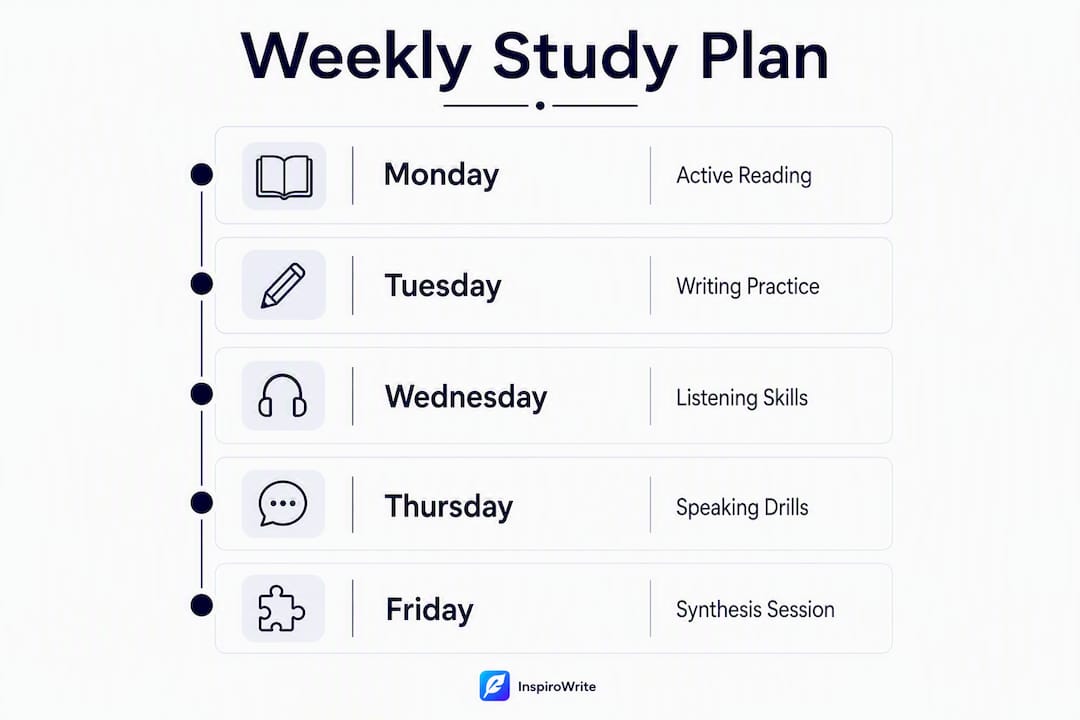
A sample weekly routine
| Day | Task | Duration |
|---|---|---|
| Monday | Active reading + vocabulary notebook | Short session |
| Tuesday | Timed writing paragraph + discourse marker drill | Short session |
| Wednesday | Lecture clip: shadow + note restructure | Short session |
| Thursday | Speaking drill + phrase bank review | Short session |
| Friday | Vocabulary review | Short session |
| Saturday | Extended synthesis: read → summarise in writing → speak summary aloud | Longer session |
| Sunday | Rest or light review of the week's vocabulary notebook | Brief review |
When choosing a feedback or SRS tool, look for one that flags phrase-level issues rather than just spelling errors, processes your text without storing it for third-party use, and gives explanations alongside corrections.
6. How to get useful feedback and measure your progress
Feedback is only useful if it is specific, timely, and acted upon. Most students receive too little of it, too late.
| Feedback source | Cost | Turnaround | Best use case |
|---|---|---|---|
| Peer review | Free | Same day | Catching clarity and structure issues |
| Personal tutor | Included in fees | 3–7 days | Discipline-specific argument and content |
| University writing centre | Free | 1–3 days | Academic register, grammar, citation style |
| AI proofreading | Low/free tier | Seconds | Collocation errors, tone, passive/active voice |
University writing centres are underused. Most UK universities offer one-to-one appointments and drop-in sessions specifically for academic writing, and the feedback tends to be more targeted than a tutor's general comments. Book a session before a major submission, not after.
For scheduling assessment, a monthly writing review works well: take a paragraph you wrote four weeks ago and rewrite it using what you have learnt since. The difference is often striking and motivating. A termly speaking check, where you record a two-minute argument on a topic and compare it to a recording from three months earlier, does the same for spoken fluency.
CEFR self-check items for academic tasks:
- Can I read an academic journal article and identify the main argument without re-reading? (B2+)
- Can I write a structured paragraph with a clear topic sentence, evidence, and a linking phrase? (B2)
- Can I follow a 20-minute lecture and produce accurate notes? (B2–C1)
- Can I contribute a reasoned point in a seminar without significant hesitation? (C1)
- Can I write an essay that uses hedging language and appropriate register throughout? (C1–C2)
Iterative feedback on essays is one of the strongest predictors of writing improvement. A single round of feedback rarely changes habits; three or four revision cycles on the same piece do.
7. Realistic timelines and CEFR to IELTS mapping
Progress in academic English is not linear, but it is predictable if practice is consistent.
The CEFR framework runs from A1 (elementary) to C2 (proficient). Most UK universities require a minimum of B2 for undergraduate entry and C1 for postgraduate programmes, often verified through IELTS Academic. The mapping below is approximate; component scores (reading, writing, listening, speaking) can vary significantly from the overall band.
| CEFR level | Approximate IELTS band | Typical academic context |
|---|---|---|
| B1 | — | Pre-sessional EAP programmes |
| B2 | 5.5–6.5 | Undergraduate entry; most foundation courses |
| C1 | 7.0–8.0 | Postgraduate entry; academic writing at degree level |
| C2 | — | Near-native proficiency; advanced research contexts |
Many UK universities offer preparatory English for Academic Purposes (EAP) programmes, including extended options of 15 weeks or more, for students who need to bridge the gap to required proficiency levels before their main course begins.
Three realistic timeline scenarios:
- Intensive: A few months of daily deliberate practice with regular feedback can yield noticeable proficiency gains.
- Steady: Over half a year to around a year of consistent study commonly results in clear level improvements.
- Long-term: Studying alongside other commitments with moderate weekly hours leads to gradual, cumulative progress, especially in writing skills.
Prior exposure to English-medium education, the amount of academic reading you do outside structured practice, and the quality of feedback you receive all shift these timelines. Deliberate practice with feedback consistently outperforms passive exposure at every level.
8. Which UK resources are worth your time?
Free resources cover most of what you need at B1–C1 level. Paid options add value mainly when you need structured feedback or discipline-specific coaching.
Free resources that deliver:
- BBC Learning English offers grammar explanations, vocabulary lessons, and audio content graded by level. The 6 Minute English series is particularly good for listening practice at B2.
- British Council LearnEnglish provides levelled reading, writing, and grammar exercises with CEFR alignment, plus speaking resources.
- Cambridge English publishes free sample IELTS Academic tasks and grammar reference materials. Their practice tests are the closest available simulation of the real exam.
- University of Reading's self-enrol online courses combine video input with guided tasks covering written communication, source integration, and academic phraseology. Free to access and well-structured for independent learners.
- Your university's own writing centre: free, staffed by specialists, and often the most targeted feedback available.
When paying makes sense:
Structured one-to-one tuition is worth the cost when you have a specific, time-bound goal (an IELTS resit in eight weeks, a dissertation submission) and need personalised feedback on your actual writing. Typical UK rates for private EAP tutors range from £30 to £70 per hour. Group courses through university language centres tend to cost less and offer peer interaction, which is valuable for speaking practice.
A short selection checklist before committing to any resource:
- Does it match your current CEFR level, or is it too easy?
- Does it include feedback, not just content delivery?
- Is the content discipline-relevant, or purely general English?
- If it is a digital tool, does it state clearly how your data is handled?
The fourth point matters more than most students realise. Any tool you use for essay drafts or application statements should have a clear privacy policy that confirms your text is not stored or used to train external models.
Key takeaways
Consistent daily practice across all four skills, combined with structured feedback and CEFR-aligned self-assessment, is the most reliable path to academic English fluency.
| Point | Details |
|---|---|
| Daily micro-practice | Short daily sessions across reading, writing, listening, and speaking build cumulative fluency more effectively than occasional long sessions. |
| CEFR self-assessment | Use CEFR level descriptors to determine your proficiency and select appropriately challenging materials. |
| Feedback frequency | Regular feedback cycles, such as weekly, support faster improvement. |
| Realistic timelines | Level gains depend on consistent, deliberate practice and feedback over several months. |
| Inspirowrite for revision | Inspirowrite offers instant, privacy-focused AI proofreading that helps identify collocation, tone, and register issues quickly, supporting regular revision. |
The part most guides skip
There is a tendency in academic English advice to treat fluency as a purely technical problem: learn more vocabulary, practise more grammar, take more tests. That framing misses something.
The students who improve fastest are not the ones who study hardest in isolation. They are the ones who seek feedback early, act on it specifically, and treat every piece of writing or speaking as a data point rather than a performance. A seminar contribution that falls flat is not a failure; it is a recording of where your phrasing broke down, which you can fix before the next one.
The language journal suggestion that appears in most guides is worth taking seriously, but not as a diary. Use it as a gap log: every time you cannot express an idea in academic English, write the idea in your first language, then find the correct academic phrasing and note it. Over a semester, that log becomes a personalised phrase bank built entirely from your own thinking. No generic AWL deck replicates that.
One more thing: true academic fluency, as the University of Reading's academic English programme frames it, is about expressing complex ideas smoothly, not just speaking quickly or writing without errors. Speed and accuracy are proxies. The real target is clarity of argument, appropriate hedging, and coherent structure. Practise those directly, and the rest follows.
Faster revision cycles with Inspirowrite
Drafting in academic English is one challenge; revising it to the standard your institution expects is another. Inspirowrite gives you instant, phrase-level feedback on grammar, tone, register, and style, without storing your text or using it to train AI models. That privacy guarantee matters when you are working on an essay, a personal statement, or a lab report.
Three student use cases where it fits naturally into the weekly routine above: paste a timed paragraph draft in after your Tuesday writing session and get collocation and register feedback in seconds; upload an essay introduction before a writing centre appointment so you arrive with surface errors already resolved; run an application statement through before submission to catch passive/active voice inconsistencies and tone mismatches. Each of these takes under two minutes and frees your tutor's feedback time for the substantive argument.
Inspirowrite supports multiple languages, file upload and export, and a clear privacy policy that confirms your content stays confidential. Start with the free plan to see how it fits your revision workflow, then upgrade when the usage limit becomes a constraint.
Useful sources for further practice
The resources below are the most reliable starting points for academic English development in the UK context.
- BBC Learning English: Graded audio, video, and grammar content; best for listening practice and vocabulary at A2–C1.
- British Council LearnEnglish: CEFR-aligned reading, writing, grammar, and speaking exercises; free and well-maintained.
- Cambridge English: Free IELTS Academic sample tasks, grammar reference, and exam preparation materials; the closest simulation of real test conditions.
- IELTS Academic: Official practice tests and band descriptors; use these to benchmark your current level against UK university entry requirements.
- University of Reading — online self-enrol courses: Free structured courses covering academic writing, source integration, and phraseology; suitable for independent learners at B2+.
- Your university writing centre: Most UK universities offer free one-to-one appointments and drop-in sessions for academic writing support; check your institution's student services page.
- Open University academic English resources: Video-based activities covering writing conventions and the level of English expected in OU study; useful for distance learners.
For discipline-specific practice, search your university library's open-access journal collections and use them as reading material alongside the resources above. The combination of authentic academic texts and structured feedback from the sources listed here covers most of what you need up to C1 level.
FAQ
How can I improve my academic English quickly?
The fastest gains come from daily 20–30 minute practice sessions combining reading, writing, and listening, with at least one feedback cycle per week. Sporadic long sessions produce far less retention than short, consistent contact with academic language.
What is the 4-3-2 technique?
The 4-3-2 technique is a spoken fluency drill where you speak on a topic for four minutes, then repeat the same content in three minutes, then two. The decreasing time forces you to prioritise key arguments and drop filler, building fluency and confidence for seminars and presentations.
What do the CEFR levels A1 to C2 mean for academic English?
CEFR levels describe language proficiency from A1 (elementary) to C2 (near-native). Most UK universities require B2 for undergraduate entry and C1 for postgraduate study, typically verified through IELTS Academic, where B2 maps to roughly an overall band of 5.5–6.5 and C1 to 7.0–8.0.
How does AI proofreading help with academic English?
AI proofreading tools flag collocation errors, register mismatches, and passive/active voice issues in seconds, giving you a feedback loop between drafts that would otherwise take days. Inspirowrite processes your text without storing it, making it suitable for sensitive academic work such as essays and application statements.
Which free UK resources are best for academic English practice?
BBC Learning English, British Council LearnEnglish, and Cambridge English all offer free, CEFR-aligned materials covering the four core skills. Your university's writing centre provides free, personalised feedback that no online resource can fully replicate.