

TL;DR:
- Maintaining consistency in multilingual documents involves fixed terminology, brand voice, and reference codes. It improves trust, comprehension, and speeds up project workflows by reducing revisions. Proactive tools like glossaries and AI assist in preventing errors during the writing process.
Consistency in multilingual documents is defined as the uniform application of terminology, style, and messaging across every language version of a document. Without it, readers in different markets receive different signals about what a brand means, what a product does, or what a contract requires. The stakes are measurable: 76% of consumers prefer to purchase in their own language, and 40% will refuse to buy from brands that lack proper localisation. The role of consistency in multilingual documents is therefore not a stylistic preference. It is a direct driver of trust, comprehension, and revenue.
What key elements must remain consistent in multilingual documents?
Consistency does not mean every sentence reads identically across languages. It means certain anchors never shift, while other elements adapt naturally to each target language.
The non-negotiable anchors are terminology, proper names, dates, reference codes, and brand voice. A product called "Thermal Control Unit" in English must carry that exact term, or its approved translation, throughout every language version. Stable terminology anchors preserve reader trust across document bundles, even when sentence structures vary by language. A reader who encounters three different translations of the same technical term in one document loses confidence in the source itself.
Brand voice is equally fixed. The tone a company uses in English, whether formal, direct, or conversational, must carry through to French, German, and Japanese versions. Brand voice consistency builds trust and reinforces identity globally. When the English version sounds authoritative and the Spanish version sounds casual, the brand feels fragmented. That fragmentation costs credibility.
What can flex is sentence structure, idiomatic phrasing, and grammatical construction. German requires different word order than English. Japanese uses a different logic for formal address. Forcing identical structures across languages produces unnatural text that reads as translated rather than written. Experts describe this as the "terminological chain" problem: balancing terminology consistency with natural language flow requires analysing conceptual structures in both source and target languages, not just mapping terms literally.
The key elements to lock down across all language versions are:
- Terminology: product names, technical terms, and defined concepts
- Brand voice and tone: the register and personality of all communications
- Reference codes and identifiers: document numbers, version tags, and legal references
- Dates and units: formatted consistently per locale but drawn from the same source data
- Messaging hierarchy: the order and weight given to key claims
Pro Tip: Build a two-column glossary before translation begins. Column one holds the approved source term; column two holds the approved translation. Share it with every translator and reviewer on the project.
How does maintaining consistency improve project efficiency?
Consistency is not only a quality measure. It is an efficiency mechanism with documented results.
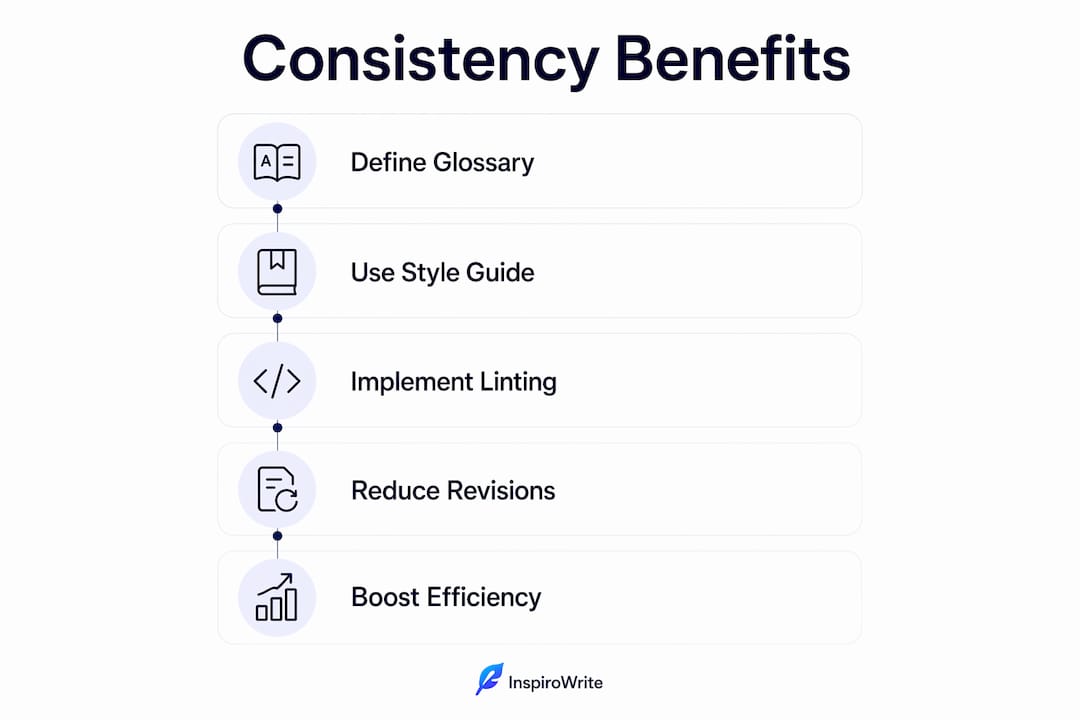
Using structured translation style guides and glossaries reduces revision loops from an average of three rounds to one, improving project turnaround time by 40%. That figure matters because revision is the most expensive phase of any multilingual project. Every round of corrections requires a translator, a reviewer, and often a subject matter expert to re-examine the same content. Cutting that to a single pass frees significant time and budget.
The mechanism behind this improvement is simple. When translators work from a shared glossary and style guide, they make fewer decisions independently. Fewer independent decisions mean fewer inconsistencies. Fewer inconsistencies mean fewer corrections. The whole chain shortens.
Structured glossaries also create what practitioners call operational memory in translation workflows. When a term is approved once and stored centrally, every subsequent document draws from that approval automatically. Writers working on multilingual business documents across legal, technical, and marketing categories benefit from this directly. A legal clause translated consistently in january becomes the reliable template for the same clause in october.
| Consistency tool | Primary benefit | Impact on workflow |
|---|---|---|
| Translation style guide | Defines tone, voice, and formatting rules | Reduces reviewer queries and revision rounds |
| Approved glossary | Locks terminology across languages | Eliminates translator guesswork on key terms |
| Translation memory | Stores approved segment translations | Speeds up repeat content and enforces uniformity |
| Verification pass | Checks for terminology drift before delivery | Catches errors before they reach the reader |
Pro Tip: Treat your glossary as a living document. Assign one person to own it, log every change with a date, and circulate updates to all active translators before the next project phase begins.
What tools and methods enforce consistency across languages?
The most significant shift in multilingual consistency management is the move from reactive correction to proactive prevention. Modern tools catch inconsistencies at the point of writing, not after delivery.
Automated documentation linting tools such as Vale integrate directly into writing workflows. Automated linting improves consistency beyond what human reviewers can achieve at scale, because it checks every sentence against a defined rule set without fatigue. A rule that flags the use of "utilise" when the style guide requires "use" fires every time, on every document, regardless of who wrote it.
AI-powered writing tools take this further by learning organisational style preferences over time. Rather than policing writers after the fact, these tools offer suggestions during drafting. The shift is from style guide as rulebook to style guide as real-time assistant. Inspirowrite operates on this principle, offering AI-driven proofreading and translation that checks grammar, style, and accuracy in seconds while keeping all content private and never using it to train AI models.
Shared-state translation architectures represent the most advanced approach. Shared-state systems allow real-time propagation of approved translations and human corrections across all language versions simultaneously. When a reviewer approves a correction in one language, the system applies the underlying logic to equivalent segments in other languages. This removes the most common source of drift in large multilingual projects: the lag between an approved change and its application across all files.
Integrating automated consistency tools directly into writing workflows represents a shift from reactive editing to proactive content quality assurance. The best systems do not wait for a human to notice an error. They prevent the error from being written in the first place.
The practical integration path for most writers and professionals involves three steps. First, adopt a linting tool or AI writing assistant that checks against a defined style guide. Second, build and maintain a shared glossary that all tools and translators reference. Third, use a translation memory system to store and reuse approved segment translations across projects.
What are the best practices for multilingual document consistency?
Achieving consistency at scale requires treating terminology like engineered infrastructure, not an editorial afterthought.
The foundation is a single source of truth. Every project needs one authoritative style guide, one approved glossary, and one set of formatting rules. When these exist in multiple versions or live in different people's inboxes, inconsistency is guaranteed. Controlled vocabularies and early alignment between teams prevent the terminology drift that causes user confusion and erodes document quality over time.
Early alignment is the most underused practice in multilingual projects. Terminology decisions made after translation begins are expensive. A term changed mid-project requires retroactive correction across every completed language version. Decisions made before the first word is translated cost nothing to implement and save significant rework later.
- Establish a glossary before translation begins. Define every key term, its approved translation, and any terms that must not be used as synonyms.
- Assign a terminology owner. One person tracks changes, approves new terms, and communicates updates to all translators and reviewers.
- Track terminology updates like code changes. Log every revision with a date, a reason, and the name of the person who approved it.
- Run a verification pass before delivery. Check every language version against the current glossary to catch any terms that drifted during translation.
- Audit fragmented files. Inconsistency often hides in documents stored across multiple folders or systems. Centralise source files before a project begins.
Terminology consistency reduces cognitive load for readers and prevents errors in technical documentation. A reader who encounters the same concept described with three different terms must work harder to understand the document. That extra effort creates friction, and friction creates doubt.
Pro Tip: When onboarding a new translator or reviewer, share the glossary and style guide before sharing the source document. Alignment on terminology before reading the content produces far fewer queries during translation.
The role of glossaries in multilingual content is well established as the backbone of any consistency programme. Writers who invest in structured glossary management before a project begins consistently report fewer revision cycles and higher reviewer satisfaction at delivery.
Key takeaways
Consistency in multilingual documents requires stable terminology anchors, a shared style guide, and proactive tools that prevent errors during writing rather than correcting them after delivery.
| Point | Details |
|---|---|
| Lock terminology early | Define and share an approved glossary before translation begins to prevent costly mid-project corrections. |
| Consistency drives efficiency | Structured style guides and glossaries reduce revision rounds from three to one and cut turnaround time by 40%. |
| Stable anchors, flexible structure | Fix terminology, brand voice, and reference codes; allow sentence structure to adapt naturally to each target language. |
| Use proactive tools | Automated linting and AI writing assistants catch inconsistencies during drafting, not after delivery. |
| Treat terminology as infrastructure | Assign ownership, track changes, and run verification passes to maintain consistency across the full document lifecycle. |
Why I think consistency is the most undervalued discipline in multilingual work
Writers and professionals who work across languages tend to focus on translation quality, and rightly so. But in my experience, the projects that fail do not fail because of poor translation. They fail because of inconsistency. A document that uses three different terms for the same concept, or shifts register between sections, signals to the reader that no one was in charge of the whole.
The research backs this up. A 40% improvement in turnaround time from using a style guide and glossary is not a marginal gain. It is the difference between a project that delivers on time and one that runs into a second or third revision cycle. The writers who treat their glossary as seriously as their source document are the ones whose work holds up under scrutiny.
What I find most encouraging about the current state of the field is the shift toward proactive tools. Linting tools and AI writing assistants do not replace editorial judgement. They free it. When a tool handles the mechanical work of checking terminology and style, the writer can focus on meaning, clarity, and the reader's experience. That is where the real quality lives.
The balance between strict terminology control and natural language flow is genuinely difficult to get right. The answer is not to choose one over the other. It is to be deliberate about which elements are fixed and which are free. Fix the anchors. Free the structure. That principle, applied consistently, produces multilingual documents that read as written rather than translated.
— Mike
How Inspirowrite supports multilingual document consistency
Professionals who need to maintain consistency across multiple languages without long revision cycles will find Inspirowrite built for exactly that challenge.
Inspirowrite's AI-powered proofreading and translation checks grammar, style, and accuracy in seconds. It delivers results fast enough to fit into active writing workflows rather than slowing them down. Every document processed stays private and is never used to train AI models, which matters when the content is commercially sensitive or legally significant. Writers working on converting documents to a second language can use Inspirowrite to catch style and terminology inconsistencies before they reach a reviewer. Visit Inspirowrite to see how it fits your multilingual workflow.
FAQ
What is the role of consistency in multilingual documents?
Consistency in multilingual documents ensures that terminology, brand voice, and key messaging remain uniform across all language versions. It prevents fragmented reader experiences and protects brand integrity across markets.
Why does terminology consistency matter in technical documents?
Terminology drift causes user confusion and increases cognitive load for readers. Stable, controlled terminology acts as a control system for meaning, directly improving comprehension and reducing errors.
How do style guides and glossaries improve multilingual project efficiency?
Structured style guides and glossaries reduce revision rounds from three to one and improve project turnaround time by 40%. They give translators a shared reference that removes guesswork and reduces the need for post-delivery corrections.
What tools help enforce consistency during multilingual document creation?
Automated linting tools such as Vale check writing against defined style rules in real time. AI-powered writing assistants and shared-state translation architectures extend this by propagating approved terminology across all language versions automatically.
What is the difference between terminology consistency and translation consistency?
Terminology consistency fixes specific words and phrases across all versions of a document. Translation consistency covers the broader alignment of tone, structure, and messaging. Both are required for a document to read as authoritative and trustworthy in every target language.