

TL;DR:
- A multilingual glossary is a curated list of approved terms and translations that ensures consistency and accuracy across all languages. It reduces mistranslations, enhances brand coherence, and cuts revision time by providing a central source of verified terminology. Updating and integrating glossaries into translation workflows is essential for maintaining quality in both human and AI-assisted translations.
A multilingual glossary is a curated list of approved terms and their translations across two or more languages, serving as the single source of truth for terminology in any content operation. The role of glossaries in multilingual content goes far beyond word lists. Glossaries prevent mistranslations, protect brand voice, and cut revision cycles. They are as relevant to human translators working in CAT tools as they are to content creators feeding prompts into large language models (LLMs). Without one, even experienced translators make inconsistent choices that compound across markets. This guide covers how glossaries work, why they matter, and how to build one that actually holds up.
How do glossaries improve translation quality and brand consistency?

Glossaries reduce mistranslations by removing ambiguity before translation begins. When a translator sees an approved term in a glossary, there is no guesswork. The decision has already been made by subject matter experts, brand managers, and linguists working together. That single act of pre-decision prevents a category of errors that would otherwise require expensive rework.
The risk of skipping a glossary is concrete. Consider a medical device company translating patient instructions into twelve languages. Without a glossary, "catheter tip" might be rendered differently by each translator, creating regulatory risk and patient confusion. In technical content, terminology inconsistency is not a stylistic problem. It is a safety and compliance problem.
Brand consistency follows the same logic. A technology company that uses "dashboard" in English but allows translators to choose between three equivalent terms in German will produce a fragmented user experience. Customers notice when a product feels inconsistent across languages, even if they cannot name the cause. Glossary development is a strategic investment that prevents fragmented user experiences and costly rework.
The benefits of multilingual glossaries extend to customer trust. When terminology is consistent, users feel they are reading authoritative content. When it is inconsistent, doubt creeps in. This effect is amplified in regulated industries such as pharmaceuticals, finance, and legal services, where a single mistranslated term can have serious consequences.
Key areas where glossaries protect quality:
- Brand terminology: Product names, feature names, and slogans translated consistently across all markets.
- Technical terms: Domain-specific vocabulary in fields such as medicine, law, and engineering, where precision is non-negotiable.
- Prohibited terms: Words or phrases the brand has decided never to use, flagged so translators avoid them automatically.
- Preferred register: Formal versus informal address forms, which vary significantly between languages such as French, German, and Japanese.
Pro Tip: Build a "do not translate" list alongside your glossary. Brand names, product codes, and certain technical acronyms should remain in their source form. Translators who do not have this list will make different decisions, and those decisions will conflict.
In what ways do glossaries enhance translation efficiency?
Glossaries cut the time translators spend researching terminology. Glossaries reduce translator research time by 20–40% and lower the number of revisions needed, depending on content complexity. That is a direct reduction in project cost and turnaround time, not a marginal gain.
The efficiency gains compound when glossaries are integrated with translation memory (TM) tools. Translation memory stores previously translated segments and suggests them when similar text appears again. When glossary terms are standardised, TM match rates improve because the same concept is always expressed the same way. Standardised glossary terms improve TM hit rates by 15–25%, boosting pre-translation success especially in technical content. Higher match rates mean less new translation, which means lower cost and faster delivery.
Here is how glossary integration typically works in a professional workflow:
- Glossary creation: Subject matter experts and linguists agree on approved terms before any translation begins.
- CAT tool integration: The glossary is uploaded to a computer-assisted translation (CAT) tool such as SDL Trados, memoQ, or Phrase. The tool highlights glossary terms in the source text and suggests the approved translation automatically.
- Quality assurance check: After translation, an automated QA pass flags any segment where a glossary term was not used correctly.
- Glossary update: When source content changes, the glossary is updated before new translation begins, not after.
| Workflow stage | Without glossary | With glossary |
|---|---|---|
| Terminology research | High per-project cost | Minimal, pre-resolved |
| TM match rate | Lower, due to term variation | Higher, due to consistency |
| Revision cycles | Frequent | Reduced |
| QA pass time | Longer | Shorter, automated |
Pro Tip: Ask your CAT tool vendor whether it supports glossary term highlighting in real time. Tools like memoQ and Phrase do this natively. Translators who see the approved term flagged in context are far less likely to deviate from it.
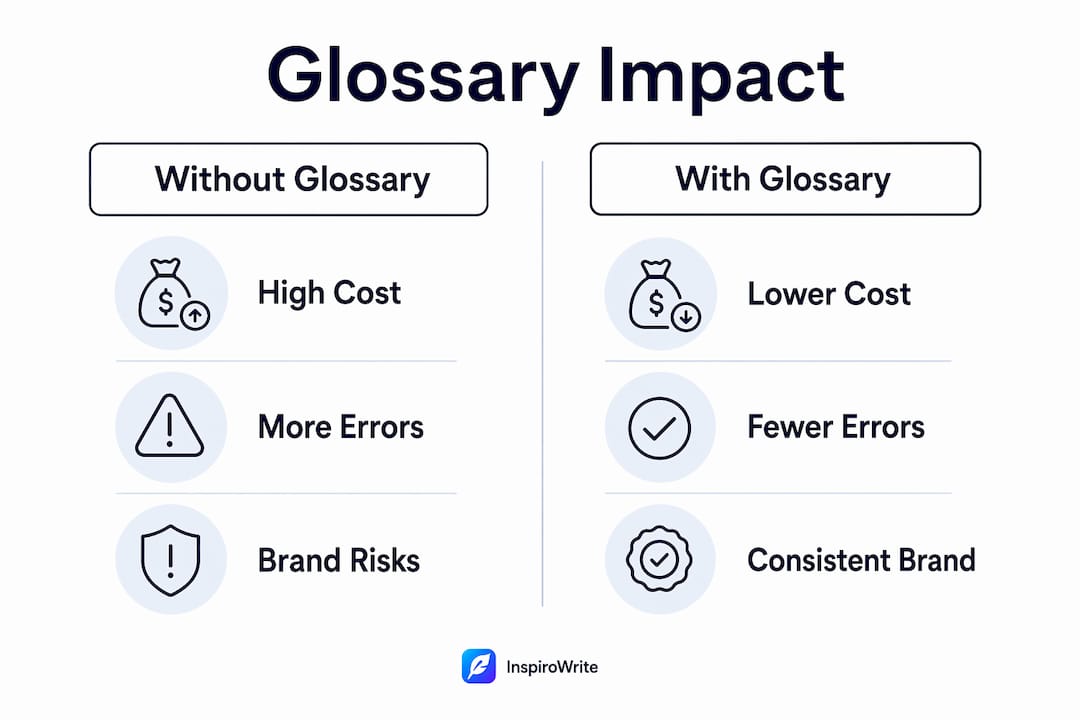
Understanding translation memory basics helps content creators see why glossaries and TM tools work best together, not as separate resources.
What are the best practices for creating a multilingual glossary?
The first decision is whether you need a glossary or a termbase. A glossary is a human-readable list of terms and their translations, often in a spreadsheet or simple document. A termbase is a structured, database-driven resource that supports metadata such as term status, subject domain, usage notes, and CAT tool integration. Moving from glossary to termbase automates quality control and supports metadata management. For small projects, a glossary is sufficient. For organisations translating into five or more languages at scale, a termbase is the right tool.
Regardless of format, these practices determine whether a glossary actually gets used:
- Model terms by concept, not by word form: Enter the concept "user account" once, not separately as "account," "user account," and "account settings." Concept-based entries prevent duplication and contradiction.
- Involve the right people from the start: Glossaries built by translators alone miss brand intent. Glossaries built by marketing teams alone miss linguistic reality. The best glossaries involve subject matter experts, linguists, and brand managers working together.
- Set clear update triggers: Define the conditions that require a glossary update. A product rename, a regulatory change, or a new market entry all qualify. Without triggers, glossaries drift out of sync with source content.
- Integrate directly into your workflow: A glossary that lives in a shared drive and gets consulted occasionally is not a workflow tool. It is a reference document. Glossaries integrated in CAT tools serve as live guides automating terminology enforcement, rather than static lists.
- Audit regularly: Schedule a quarterly review. Check whether any terms have become obsolete, whether new product features need entries, and whether any translations have been flagged by translators as inaccurate.
Outdated glossaries can be more harmful than none due to the risk of factual errors spreading across translations. A glossary that contains a deprecated product name or a superseded regulatory term will actively mislead translators. The update policy matters as much as the initial build.
How do glossaries support AI-assisted translation and localisation?
Glossaries are now essential inputs for AI translation systems, not just human translators. Glossaries not only help human translators but are essential in providing context and brand language for AI translation systems. This ensures both accuracy and brand alignment in hybrid human-AI workflows. As generative AI takes on more translation tasks, the quality of the glossary feeding the model determines the quality of the output.
The mechanism is straightforward. When you feed an approved glossary to an LLM as part of a localised prompt, the model has a reference point for brand-specific terms, preferred register, and prohibited language. Without that reference, the model defaults to its training data, which may reflect general usage rather than your brand's specific choices. Localised prompt engineering using glossaries reduces AI hallucinations and culturally inappropriate outputs by over 50%. That is a significant reduction in the post-editing burden for human reviewers.
Glossaries are the guardrails that keep AI translation on brand. Without them, even the most capable model will produce output that is technically correct but contextually wrong. The model does not know your product. Your glossary does.
The future of multilingual resource management points toward automated glossary extraction. Tools are emerging that analyse existing translated content, identify consistent term pairs, and propose glossary entries for human approval. This reduces the manual effort of glossary creation while maintaining human oversight. For content creators managing large volumes of multilingual material, this kind of automation makes glossary upkeep realistic rather than aspirational.
Subject matter expertise in translation remains critical even in AI-assisted workflows. Glossaries encode that expertise in a form that both humans and machines can use.
Key takeaways
Glossaries are the single most cost-effective tool for maintaining terminology consistency, reducing revision cycles, and aligning both human and AI translation outputs with brand standards.
| Point | Details |
|---|---|
| Glossaries cut research time | Translators spend 20–40% less time on terminology research when a glossary is in place. |
| TM match rates improve | Standardised terms increase translation memory hit rates by 15–25%, reducing cost and time. |
| AI outputs improve significantly | Feeding glossaries to LLMs reduces hallucinations and culturally inappropriate outputs by over 50%. |
| Outdated glossaries cause harm | A glossary with deprecated terms actively misleads translators and spreads errors across markets. |
| Termbases scale better than lists | Structured termbases support metadata and CAT tool integration, making them the right choice at scale. |
Why I think most teams underestimate glossaries
Most content teams treat a glossary as a one-time deliverable. They build it at the start of a project, file it somewhere, and move on. That is the wrong mental model entirely. A glossary is a living document that reflects the current state of your product, your brand, and your market. The moment it stops being updated, it starts working against you.
I have seen this play out repeatedly. A software company renames a core feature. The glossary is not updated. Six months later, translators in four markets are using the old term because that is what the glossary says. The cost of fixing that is not just translation rework. It is updated screenshots, revised help articles, and confused support tickets from users who see two different terms for the same thing.
The other misconception is that glossaries are a translator's concern. They are not. They are a brand asset. The people who should own glossary governance are the same people who own brand guidelines: marketing, product, and legal, working alongside the translation team. When those groups collaborate on terminology, the result is a glossary that actually reflects how the organisation wants to be understood in every market.
Treat your glossary the way you treat your style guide. Review it on a schedule. Assign ownership. Make updates part of your content release process. That discipline is what separates organisations that scale multilingual content successfully from those that spend their budget on rework.
— Mike
How Inspirowrite supports multilingual content consistency
Consistent terminology across languages is a quality problem before it is a translation problem. Inspirowrite addresses it at the source, giving writers and translators fast, privacy-first feedback on grammar, style, and translation accuracy.
Inspirowrite does not store your content or use it to train AI models, which matters when you are working with sensitive brand or product terminology. For content creators managing multilingual business documents across markets, that privacy guarantee is not a minor feature. It is a prerequisite. Visit Inspirowrite to see how it supports consistent, accurate multilingual content at speed.
FAQ
What is the role of a glossary in multilingual content?
A multilingual glossary defines approved terms and their translations, acting as the single source of truth for terminology across all languages. It prevents inconsistent translations, protects brand voice, and reduces revision cycles.
How does a glossary differ from a termbase?
A glossary is a simple, human-readable list of terms and translations. A termbase is a structured database that supports metadata, term statuses, and direct integration with CAT tools, making it better suited for large-scale multilingual operations.
Can glossaries improve AI translation quality?
Yes. Feeding an approved glossary to a large language model as part of a localised prompt reduces AI hallucinations and culturally inappropriate outputs by over 50%, according to research on multilingual marketing strategies.
How often should a multilingual glossary be updated?
A glossary should be updated whenever source content changes significantly, such as a product rename, a new market launch, or a regulatory update. Outdated glossaries spread factual errors across translations and are more harmful than having no glossary at all.
What tools support glossary integration in translation workflows?
CAT tools such as SDL Trados, memoQ, and Phrase support direct glossary integration, highlighting approved terms in real time and flagging deviations during quality assurance checks.