

Run every piece of content through four fixed stages, writer self-check, automated criterion review, targeted human review, then a single named approver signing off before publishing. That single-approver rule is what most teams skip, and it's why work bounces between five inboxes for a week. Put one person's name against final sign-off and the whole pipeline moves faster, with fewer errors slipping through.
TL;DR:
- Clear ownership and specific roles at each stage prevent delays and ensure accountability in the proofreading process.
- Automated tools handle 60 to 80 percent of mechanical checks, freeing human reviewers to focus on judgment-based items like accuracy and voice.
- Setting strict SLAs for each review stage and escalation rules keeps the workflow on schedule and avoids endless review loops.
- Tracking key metrics such as first-pass approval rate and queue times helps identify bottlenecks and improve overall efficiency.
- Separating mechanical checks from judgment, with a single final sign-off, reduces rework and shortens the content review cycle.
Table of Contents
- What does a staged proofreading workflow look like?
- Who owns each stage of the review?
- Which tools support a collaborative editing process?
- What's the practical step-by-step proofreading checklist?
- How do you set SLAs without creating endless review loops?
- Which metrics show whether the workflow is actually working?
- What templates and evidence back this workflow?
- Why staged review beats ad hoc editing
- How InspiroWrite fits into your review pipeline
- Sources
- FAQ
What does a staged proofreading workflow look like?
The workflow runs in four stages, each with a clear owner and a pass or fail gate before work moves on. This mirrors the scalable review model that separates mechanical checks from judgement calls, which is the split most teams get wrong when they route everything to a senior editor.
- Writer self-check: the author runs their own draft against a fixed checklist (grammar, structure, brief alignment) before submitting anything.
- Automated review: a rules engine or AI tool flags spelling, tone, readability, and SEO issues. Fails here bounce straight back to the writer, no human involved yet.
- Human review: an editor checks the things software can't judge, argument logic, factual accuracy, voice fit. This is where a specialist (legal, SEO, technical) joins only if the content is flagged for that risk.
- Final sign-off and publish: one named approver clears the piece and it goes live with quality metadata attached.
Automated pre-checks matter because they absorb the repetitive, rules-based work. Automated gates handle 60 to 80 percent of criterion-based checks, leaving human reviewers free to focus purely on judgement. That's the leverage point: without it, every typo and passive-voice sentence eats a senior editor's time that should go to substance.
Who owns each stage of the review?
Ambiguous ownership is the single biggest cause of stalled drafts. Name a role for every stage, not just "the editor," and give each role a specific job, not a vague mandate to "check it over."
- Writer: owns the first-draft quality bar, runs the self-check list, and fixes anything the automated gate flags before it reaches a human.
- Line editor: checks structure, clarity, and voice. Budget a reasonable amount of time for a standard piece of work.
- Specialist reviewer (SEO, legal, subject-matter expert): reviews only their lane, and only when the content is tagged for that risk. Budget varies by complexity, but cap it at one round unless the piece is genuinely high-risk.
- Final approver: one named person per content type or vertical, with a documented backup for when they're out. This person doesn't re-edit; they check the checklist was completed and make the publish call.
Approval workflows work best when reviewer ownership is explicit and feedback is kept separate from final approval. Merging those two roles into one person is how "just a quick note" turns into a fourth review round. Read more on how feedback should differ from approval if your team currently blurs the two.
Which tools support a collaborative editing process?
Pick tools for what each stage actually needs, not one platform trying to do everything. Drafting and reviewing are different jobs and mixing them causes most of the friction teams complain about.
- Co-authoring tools (Google Docs, Notion, similar) suit the drafting phase, where multiple people build a piece together in real time.
- Tracked-change tools (Microsoft Word, CMS revision history) suit formal review, where you need a clean audit trail of who changed what.
- Automated quality gates: grammar and style checkers, readability scorers, SEO rule engines that catch mechanical issues before a human ever opens the file.
- Routing and notification tools: task assignment and Slack or email alerts that move a draft to the next reviewer automatically once a gate is passed.
Keep the drafting and formal review stages separate. Editing during a formal tracked-change review causes lost changes and reviewer frustration, because two people editing the same locked version at once creates conflicting versions nobody can untangle. Lock the draft before formal review starts, full stop.
Collaborative editing tools with inline comments and version history cut review cycles because reviewers can see exactly what changed since the last pass, rather than re-reading the whole document. That version history also matters for multilingual content workflows, where a translation error introduced in one pass can otherwise vanish into the noise of five subsequent edits.
What's the practical step-by-step proofreading checklist?
Copy this sequence into your team's SOP or project management tool. It works whether you're running a two-person blog or a twelve-person content operation.
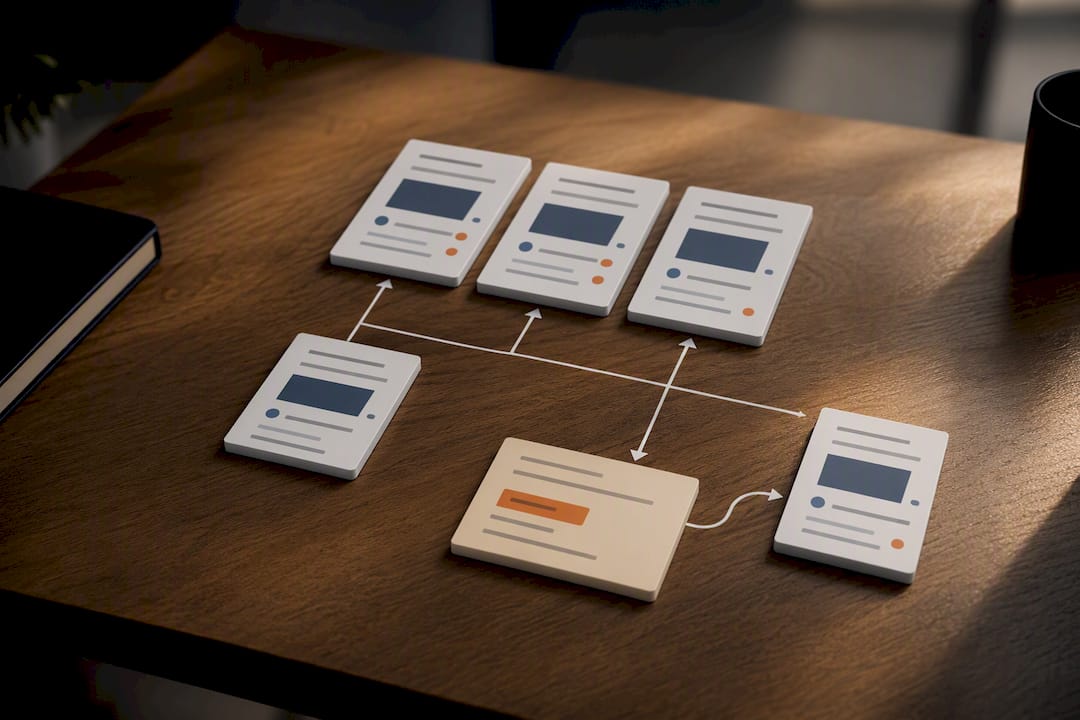
- Lock the brief and tag risk level. Before drafting starts, the brief gets approved and tagged (standard, SEO-sensitive, legal-sensitive). Locking the brief as the first gate prevents most of the rework that happens when scope shifts mid-draft.
- Writer completes self-check. Spelling, brief alignment, structure, and a read-aloud pass. Use an automated tool here so the writer catches mechanical errors before anyone else sees the draft.
- Submit to automated review. The AI gate checks grammar, tone consistency, readability score, and basic SEO criteria. Anything below threshold bounces back to the writer with specific flags, not a vague "needs work."
- Route to human review based on risk tag. Standard content goes to a line editor only. SEO-sensitive or legal-sensitive content also goes to the relevant specialist, in parallel where possible rather than in sequence.
- Editor checks judgement-based items. Logic, factual accuracy, voice, and whether the piece actually answers the brief. This is not a proofreading pass; the automated gate already caught the mechanical issues.
- Consolidate feedback into one round. All reviewer comments get merged before going back to the writer, never sent piecemeal across separate messages.
- Final approver signs off. One person checks the checklist is complete and publishes, attaching quality metadata (who reviewed, when, what was flagged) for future audits.
Pro Tip: Set your automated gate's pass threshold slightly stricter than feels comfortable at first. It's far cheaper to have a writer fix three flagged sentences than to have a human editor discover the same issues twenty minutes into a review.
How do you set SLAs without creating endless review loops?
Give every stage a time limit and a single owner or the pipeline stalls the moment someone's on leave. A reasonable starting point: line editors get 24 hours for standard content, SEO reviewers get 24 hours running in parallel rather than after, and legal reviewers get 48 hours given the higher stakes of getting it wrong.
- Escalation rule: if a reviewer misses their SLA by more than half the window, the piece automatically escalates to their named backup.
- One feedback round, not five: consolidate all comments before sending back to the writer; a second round only happens if the first round wasn't actioned correctly.
- Specialist reviewers join once, not on every pass. Inviting specialists only when their expertise is genuinely required, and assigning them to a specific stage, stops the circular review pattern where five people keep re-reading the same paragraph.
- No informal re-review. Once the final approver signs off, that's the end of the line unless something factually wrong surfaces post-publish.
Which metrics show whether the workflow is actually working?
Four numbers tell you almost everything: first-pass approval rate, human review time per asset, queue time between stages, and post-publish error rate. Track them monthly, not quarterly. By the time a quarterly report flags a problem, you've already shipped three months of it.
- First-pass approval rate: the percentage of drafts that clear automated review without bouncing back. A rising rate means writers are internalising the standard.
- Human review time: minutes spent per piece by editors and specialists. If this creeps up, your automated gate's threshold has probably drifted too loose.
- Queue time: hours a draft sits waiting for a reviewer. This is the number that reveals bottlenecks, not the review time itself.
- Post-publish error rate: errors readers or stakeholders catch after the piece goes live. This should trend towards zero, not just stay flat.
Documenting exact pass/fail criteria for each gate reduces subjective rework and cuts the human review time per asset, because reviewers stop debating what "good" means and start checking against a fixed standard. Sample a small batch of approved content each month against your criteria and recalibrate the automated gate if it's letting through things a human would flag, or catching things that don't actually matter.
What templates and evidence back this workflow?
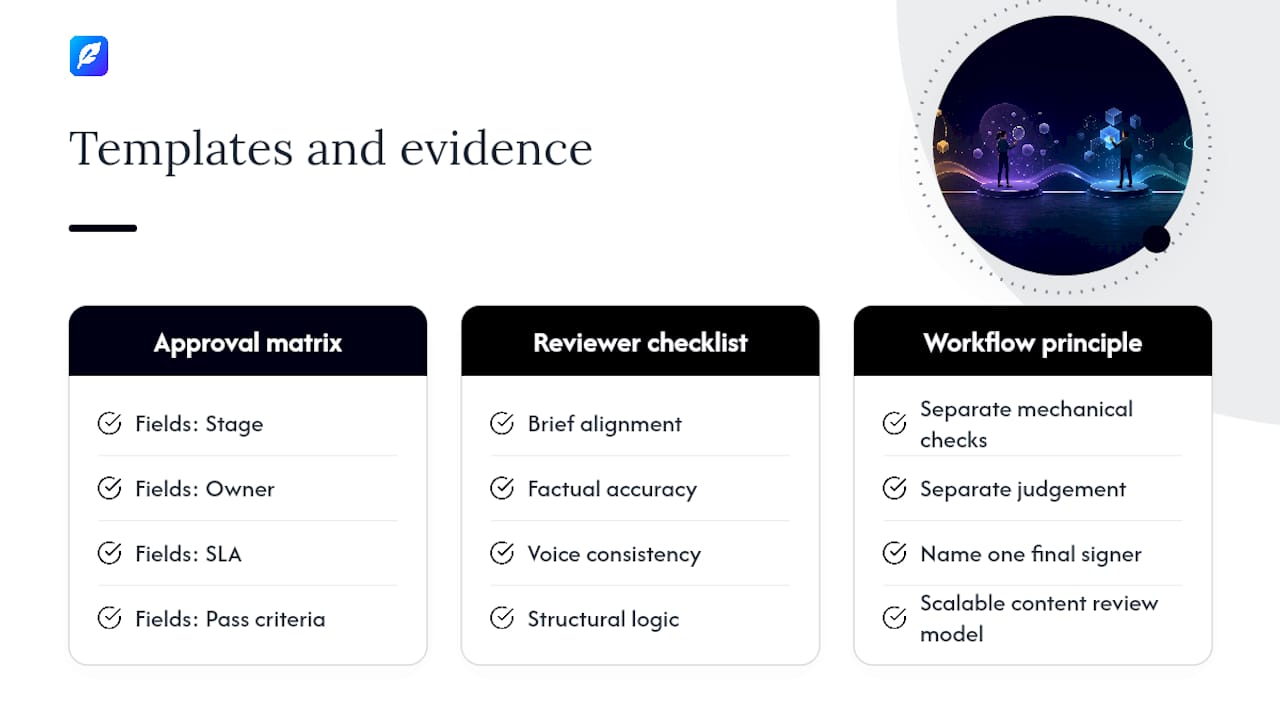
This approach draws on documented models for scalable content review and structured approval workflows, both of which converge on the same principle: separate mechanical checks from judgement, and name one person for final sign-off.
Approval matrix template: Stage | Owner | SLA | Pass criteria. Fill one row per stage, and keep it visible to the whole team, not buried in a wiki nobody opens.
Reviewer checklist template: Brief alignment | Factual accuracy | Voice consistency | Structural logic | Risk tags cleared. Every human reviewer works from this same five-item list, regardless of content type.
InspiroWrite's privacy-first processing and team access features map directly onto the automated review and specialist routing stages, discussed further below. For more on why proofreading discipline compounds over time, see the real role of proofreading in writing quality.
Why staged review beats ad hoc editing
Teams that adopt this structure tend to see fewer review rounds within the first month, mostly because writers start self-correcting once they know exactly what the automated gate checks for. The behaviour change happens faster than the metrics do.
A rough 30-day adoption path: week one, document your stages and name owners; week two, introduce the automated gate; weeks three and four, tighten SLAs and start tracking queue time. Don't try to fix everything on day one.
— Mike
How InspiroWrite fits into your review pipeline
InspiroWrite slots directly into the automated review stage, the stage most teams either skip or overload their editors with. It catches grammar, tone, and clarity issues in seconds, and because it never trains on your content, sensitive drafts, client work, unreleased campaigns, stay confidential rather than feeding some model elsewhere.
Team access means writers and editors work from the same account without passing files back and forth by email, which removes one of the routing headaches this article has spent most of its length solving. A sensible pilot: pick one content stream, run it through InspiroWrite's automated checks for two weeks alongside your existing human review, then compare first-pass approval rates before and after. If the numbers move, roll it out further. Details on how content stays private during processing are on the InspiroWrite privacy page, worth reading before you commit any client-sensitive material to the pilot.
Sources
- How to build a content review process that scales | TeamBench
- Content approval workflows: speed up your editorial process | EditorialGe
- MS Word for legal drafting: track changes guidance | Clio
FAQ
What are the 5 C's of copy editing?
Definitions vary slightly by source, but the version most editors use is clear, correct, concise, complete, and consistent, five checks a human reviewer should run once automated tools have caught the mechanical errors.
Is AI replacing proofreaders?
No. AI tools handle the bulk of criterion-based checks like grammar and readability, but factual accuracy, voice, and argument logic still need a human reviewer's judgement.
What are the steps in the proofreading process?
The core sequence is writer self-check, automated review against a quality gate, targeted human review for judgement calls, then final sign-off and publishing with quality metadata attached.
How much should I charge to proofread 1,000 words?
Rates vary widely by market, industry, and complexity, so there's no single standard figure; freelance proofreaders typically price by project risk and turnaround time rather than a flat per-word rate.
How do you stop reviewers going back and forth endlessly?
Set one feedback round per stage, consolidate all comments before sending them to the writer, and give only one person, the final approver, authority to request a second round.