

TL;DR:
- Register is the language style suited for specific purposes and audiences, characterized by vocabulary and grammar.
- Matching register correctly enhances credibility and clarity, especially for non-native speakers and AI tools.
Register is the variety or style of language chosen for a specific purpose, context, or audience. The Cambridge Dictionary defines it as language that varies because it is used for different purposes, in different contexts, and for different audiences. The Oxford Advanced Learner's Dictionary puts it plainly: the level and style of speech or writing appropriate to the situation.
Three things make up register:
- Vocabulary: specialised or domain-specific words (legal, medical, academic)
- Grammar: sentence length, passive constructions, nominalisations
- Formality and tone: how directly or distantly the writer addresses the reader
Linguists M. A. K. Halliday and R. Hasan add a structural lens, breaking register into three dimensions: field (subject matter), mode (channel), and tenor (social relationship). That framework is the most widely used analytical tool in sociolinguistics and the one this guide applies throughout.
Table of Contents
- What do dictionaries and linguists mean by register?
- How does the field, mode, and tenor framework work?
- Why does register matter for credibility and clarity?
- How do you identify a text's register?
- How do you change or match register in your writing?
- What are the most common register mistakes to avoid?
- Key takeaways
- Why register is the skill most writers underestimate
- FAQ
- Useful sources
What do dictionaries and linguists mean by register?
The Cambridge Dictionary lists legal language, advertising, banking, and weather forecasting as examples of distinct registers, each recognisable by its specialised vocabulary and grammatical patterns. Oxford frames the same idea slightly differently, emphasising appropriateness to situation.
Both definitions point to the same practical truth: register is not just about being formal or informal. A weather forecast and a legal contract can both be formal, yet they belong to entirely different registers because their vocabulary, sentence structures, and purposes diverge sharply.
Consider two quick UK English contrasts. A casual message to a colleague might read: "Just checking — are we still on for Thursday?" The formal equivalent in a business letter becomes: "I am writing to confirm whether our meeting scheduled for Thursday remains convenient." Same information, entirely different register. Similarly, a student might say in conversation: "The experiment didn't work." In an academic paper, that becomes: "The results failed to support the hypothesis."
One important distinction: register and style are not the same thing. Style refers to degrees of formality; register refers to domain-specific language tied to a particular activity or field. A legal document and a medical report are both formal, but they occupy different registers entirely.

How does the field, mode, and tenor framework work?
Halliday and Hasan's framework) gives writers three questions to ask of any text:
- Field: What is the subject matter and purpose? A technical manual about software differs from a news report about the same product.
- Mode: What is the channel? Spoken language, a prepared written report, a live chat message, and a formal letter each pull different grammatical choices even when the topic is identical.
- Tenor: Who are the participants and what is their relationship? A doctor writing to a colleague uses different vocabulary than the same doctor writing to a patient.
| Dimension | What to look for | Short example |
|---|---|---|
| Field | Topic vocabulary, technical terms, jargon density | "myocardial infarction" vs "heart attack" |
| Mode | Sentence length, contractions, punctuation style | Bullet points in a slide vs full paragraphs in a report |
| Tenor | Pronouns, address forms, hedging language | "Dear Sir/Madam" vs "Hi there" |
When you analyse a text, run through all three dimensions. A mismatch in any one of them is usually what makes writing feel "off" even when the grammar is technically correct.
Why does register matter for credibility and clarity?
Getting register wrong costs you the reader's trust before they finish the first paragraph. A cover letter written in conversational English signals carelessness. A customer email written in dense legalese signals indifference. Neither is a grammar error; both are register failures.
For non-native speakers, this is particularly high-stakes. Grammatically correct sentences in the wrong register can read as rude, naive, or unprofessional to a native speaker, even when the writer's intent was perfectly reasonable. Matching register correctly is often what separates writing that sounds fluent from writing that merely sounds correct.
AI tools add a layer of complexity. A tool set to "improve grammar" without register guidance may replace informal phrasing with formal alternatives that feel stiff and out of place in a casual blog post. Conversely, a tool set to "simplify" may strip out technical vocabulary that the audience actually expects.
Corpus research confirms that speakers and writers naturally adjust language to situational characteristics — register adaptation is not a stylistic luxury but a communicative norm.
Biber and Egbert argue that registers are culturally recognised categories, not fixed rule sets. That means good AI tools need to adapt to evolving communicative norms, not just enforce prescriptive grammar rules.
How do you identify a text's register?
Work through this checklist on any paragraph you are reviewing:
- Vocabulary level: Are words technical, neutral, or colloquial? Count how many terms require domain knowledge.
- Sentence length and complexity: Long, subordinated clauses suggest academic or legal register; short declarative sentences suggest journalistic or conversational.
- Contractions: "It's" and "don't" signal informal or conversational register; "it is" and "do not" signal formal.
- Passive voice frequency: Heavy passive use ("it was determined that") is a marker of academic and scientific register.
- Pronoun choice: First-person "I/we" feels personal; third-person throughout suggests formal or institutional writing.
- Nominalisations: "The investigation of results" instead of "investigating results" is a strong academic register signal, as Douglas Biber's corpus research consistently shows.
- Greetings and closings: "Hey" vs "Dear Ms Smith" tells you the tenor immediately.
For domain registers specifically, look for clause types. Legal texts stack conditional clauses ("provided that", "notwithstanding"). Medical texts use Latin-derived terminology alongside hedged claims ("may indicate", "consistent with").
Pro Tip: When using an AI proofreading tool, paste a short sample of your target text alongside your draft and ask the tool to match the vocabulary and sentence patterns of the sample. This anchors the AI to the correct register rather than its default.
How do you change or match register in your writing?
A human-led rewrite process
Start by identifying the target register using the field/mode/tenor framework. Then:
- List vocabulary that belongs to the wrong register and find domain-appropriate substitutes.
- Adjust sentence length to match the mode (shorter for digital/conversational, longer for formal written).
- Change pronoun and address forms to reflect the tenor.
- Read aloud. Anything that sounds unnatural for the intended audience needs another pass.
Using AI tools with explicit register prompts
Vague instructions produce vague results. Specific prompts produce register-accurate rewrites. Here are three you can copy and adapt:
Make more formal: Simplify for a general audience: Make more technical: For practical guidance on professional email register, the principles above apply directly to workplace correspondence. If you work across languages, the same register logic applies: a Spanish email grammar checklist follows identical field/mode/tenor principles.
After any AI rewrite, check for register drift: the tool may have changed meaning subtly while adjusting tone. Re-read the output against your original intent, not just against a grammar standard.
What are the most common register mistakes to avoid?
- Hyper-formality: Using "utilise" when "use" is clearer, or stacking nominalisations until the sentence collapses under its own weight. Formal does not mean maximally complex.
- Jargon in the wrong context: Technical terms borrowed from one domain and dropped into another (e.g. "leverage" in a medical context) confuse rather than impress. Test jargon by asking: would my target reader use this word naturally?
- Mixed register within one text: Opening a report formally, then slipping into conversational asides mid-paragraph. Readers notice the inconsistency even when they cannot name it.
- Literal translation errors: Non-native speakers sometimes carry register conventions from their first language. In many European languages, formal written style uses longer, more complex sentences than English formal register typically does. The result reads as stiff or over-elaborate. Language transfer effects on register are worth understanding directly.
- Over-relying on AI defaults: An AI tool set to "formal" will apply a generic formality filter. Without explicit field and tenor instructions, it cannot distinguish between a legal brief and an academic essay.
The corrective is straightforward: reduce nominalisations, prefer active voice where the register permits it, and keep pronoun and address forms consistent throughout.
Key takeaways
Register is the single most overlooked dimension of writing quality: grammar can be perfect while register remains completely wrong for the audience and purpose.
| Point | Details |
|---|---|
| Define audience and purpose first | Identify field, mode, and tenor before writing or prompting an AI tool. |
| Register is broader than formality | Domain vocabulary and clause types matter as much as formal vs informal tone. |
| Use the identification checklist | Check vocabulary, contractions, passive voice, pronouns, and nominalisations in any paragraph. |
| Write explicit AI prompts | Specify field, audience, and grammatical preferences; vague prompts produce generic results. |
| Inspirowrite supports register-aware edits | Inspirowrite's privacy-focused proofreading lets you adjust tone, rephrase, and rewrite without your text being used to train AI models. |
Why register is the skill most writers underestimate
Most writing advice focuses on grammar and clarity. Register sits underneath both. You can write grammatically flawless sentences that still fail because they belong to the wrong variety of language for the situation.
What strikes me about the field/mode/tenor framework is how rarely it appears in practical writing guides, despite being the most useful diagnostic tool available. When a piece of writing feels wrong but you cannot identify why, the answer is almost always a tenor mismatch: the writer is addressing the reader from the wrong social distance. Fix the tenor, and the vocabulary and grammar choices often follow naturally.
AI tools are genuinely useful for register adjustment, but only when you give them the right instructions. A tool that knows the field, mode, and audience will outperform one set to a generic formality level every time. The prompts in this guide are a starting point; refine them for your own recurring writing contexts and save them.
FAQ
What does register mean in language?
Register is the variety or style of language chosen for a specific purpose, context, or audience, characterised by particular vocabulary and grammatical patterns. Both the Cambridge Dictionary and Oxford Advanced Learner's Dictionary define it in terms of situational appropriateness.
How is register different from tone or style?
Style refers to degrees of formality; tone refers to the writer's attitude. Register is broader: it includes domain-specific vocabulary and grammatical structures tied to a particular field, such as legal or academic language.
What are the main types of language register?
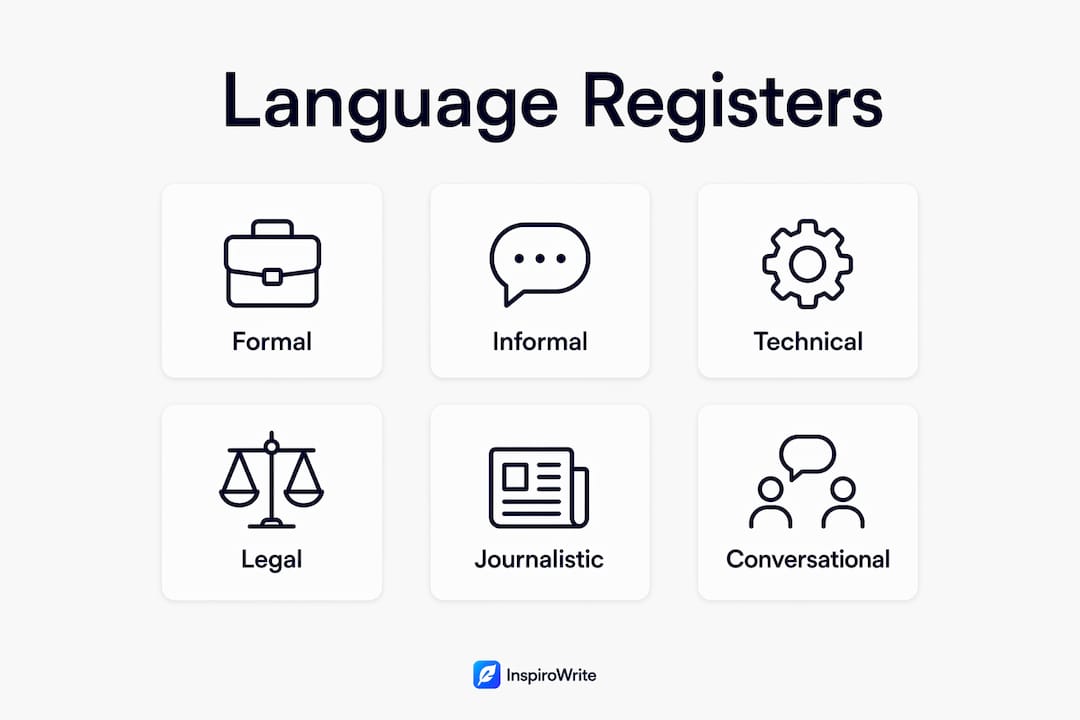
Common registers include formal, informal, academic, technical, legal, journalistic, and conversational. Each is recognisable by its vocabulary choices, sentence structures, and the social relationship it assumes between writer and reader.
How do I use AI tools to match register correctly?
Specify field, mode, and tenor in your prompt rather than asking for a generic formality adjustment. For example, state the subject domain, the intended audience, and whether the output should use active or passive constructions.
Why do non-native speakers struggle with register?
Transfer effects from a first language can carry different register conventions into English writing, producing sentences that are grammatically correct but tonally mismatched. Understanding interlanguage effects helps identify where these mismatches originate.
Useful sources
- Cambridge Dictionary — register (grammar): the primary dictionary definition used throughout this guide, with examples of common registers.
- Oxford Advanced Learner's Dictionary — register: complementary dictionary authority defining register as level and style appropriate to situation.
- Register (sociolinguistics) — Wikipedia): clear summary of Halliday and Hasan's field/mode/tenor framework with quoted definitions.
- Annual Review of Linguistics — register studies: corpus-based overview of how situational characteristics shape language use.
- Biber & Egbert — What is a register?: contemporary argument that registers are culturally recognised categories, not fixed rule sets.
- Douglas Biber — Corpus Research Lab: source for corpus-based findings on nominalisations and grammatical register markers.
- Teaching note — register vs style: pedagogical distinction between register (domain language) and style (formality).
- : short audiovisual overview of the field/mode/tenor approach for readers who prefer that format.
- Inspirowrite — proofreading and translation tool: privacy-focused AI tool supporting register-aware rewrites, tone adjustment, and multilingual editing.