

Writing proficiency levels are a structured way of describing a writer's functional ability across word, sentence, and text levels, from producing isolated words and memorised phrases right through to crafting sophisticated, nuanced prose for any audience or purpose. The four frameworks you will encounter most often are the CEFR (six levels, A1–C2, dominant in Europe and UK academic contexts), ACTFL (five major levels, Novice to Distinguished, widely used in the United States), ILR (an ordinal scale from 0 to 5 used by government and foreign-service agencies), and IELTS/Cambridge band descriptors (used for university admission and visa applications in the UK). This guide maps all four, shows you what writing looks like at each stage, and gives you a practical plan to move up.
Key takeaways
Writing proficiency levels describe a writer's functional ability across word, sentence, and text levels, measured consistently across the FACT criteria by frameworks including CEFR, ACTFL, ILR, and IELTS.
| Point | Details |
|---|---|
| Four major frameworks | CEFR (A1–C2), ACTFL (Novice–Distinguished), ILR (0–5), and IELTS bands each serve different assessment purposes. |
| FACT criteria matter | Raters assess Functions, Accuracy, Context, and Text type together; strong vocabulary alone does not raise a level. |
| Text level drives gains | Research shows text-level organisation produces the largest improvement in overall writing quality. |
| Self-assess first | Use the CEFR checklist or British Council tools to place yourself before committing to a formal test such as IELTS or ACTFL WPT. |
| Inspirowrite accelerates revision | Instant, privacy-first proofreading helps learners apply level-specific feedback between drafts without storing their content. |
Table of Contents
- How the major writing proficiency frameworks compare
- What raters actually look for when measuring writing
- What writing looks like at each level
- Concrete sample tasks and what they reveal about level
- How to assess your own writing level
- Evidence-based ways to improve your writing at every level
- Why levels are tools, not labels
- Inspirowrite supports your level-based improvement plan
- Sources
- FAQ
How the major writing proficiency frameworks compare
Four frameworks dominate how writing skill levels are assessed globally, and each was built for a different audience.
CEFR (Common European Framework of Reference for Languages) defines six levels grouped into Basic (A1–A2), Independent (B1–B2), and Proficient (C1–C2). It is the standard reference for language teaching across Europe and underpins most UK school and university language programmes. Descriptors are written as "can-do" statements tied to real communicative tasks.
ACTFL (American Council on the Teaching of Foreign Languages) describes writing as a continuum with five major levels: Novice, Intermediate, Advanced, Superior, and Distinguished. Novice, Intermediate, and Advanced each carry Low, Mid, and High sublevels. Ratings are assigned across the FACT criteria (Functions/tasks, Accuracy, Context/content, Text type), and a writer must demonstrate sustained ability in unpractised situations to earn a given level.
ILR (Interagency Language Roundtable) uses an ordinal scale from 0 to 5, with plus levels (e.g. 2+) that signal strong performance within a base level but not yet consistent control of the next. A key principle: each higher level includes all capabilities of the levels below it, so a single strong feature cannot justify a higher overall rating.
IELTS and Cambridge English use band descriptors (IELTS bands 1–9; Cambridge exams mapped to CEFR) primarily for high-stakes admissions and visa decisions in the UK. The ACTFL Writing Proficiency Test (WPT) is a proctored, web-based assessment that rates spontaneous written performance against ACTFL descriptors, using different test forms to target particular proficiency ranges (40–80 minutes depending on form).
NAEP (National Assessment of Educational Progress) is a US-based large-scale assessment that uses Basic, Proficient, and Advanced performance levels for school-age writers; it is less commonly referenced in UK contexts but appears in research on writing development.
The table below maps the main bands across frameworks so you can cross-reference results.
| CEFR | ACTFL (approx.) | ILR (approx.) | IELTS band (approx.) | What writers can broadly do |
|---|---|---|---|---|
| A1 | Novice Low/Mid | 0–0+ | 1–2 | Isolated words, memorised phrases, simple forms |
| A2 | Novice High / Intermediate Low | 1 | 3 | Short, simple sentences on familiar topics |
| B1 | Intermediate Mid/High | 1+ | 5–5 | Connected paragraphs on routine topics |
| B2 | Advanced Low/Mid | 2 | 6–7 | Extended text with clear organisation |
| C1 | Advanced High / Superior | 2+–3 | 7–9 | Precise, well-structured arguments; formal registers |
| C2 | Distinguished | 5–5 | 9 | Sophisticated, nuanced prose across all contexts |
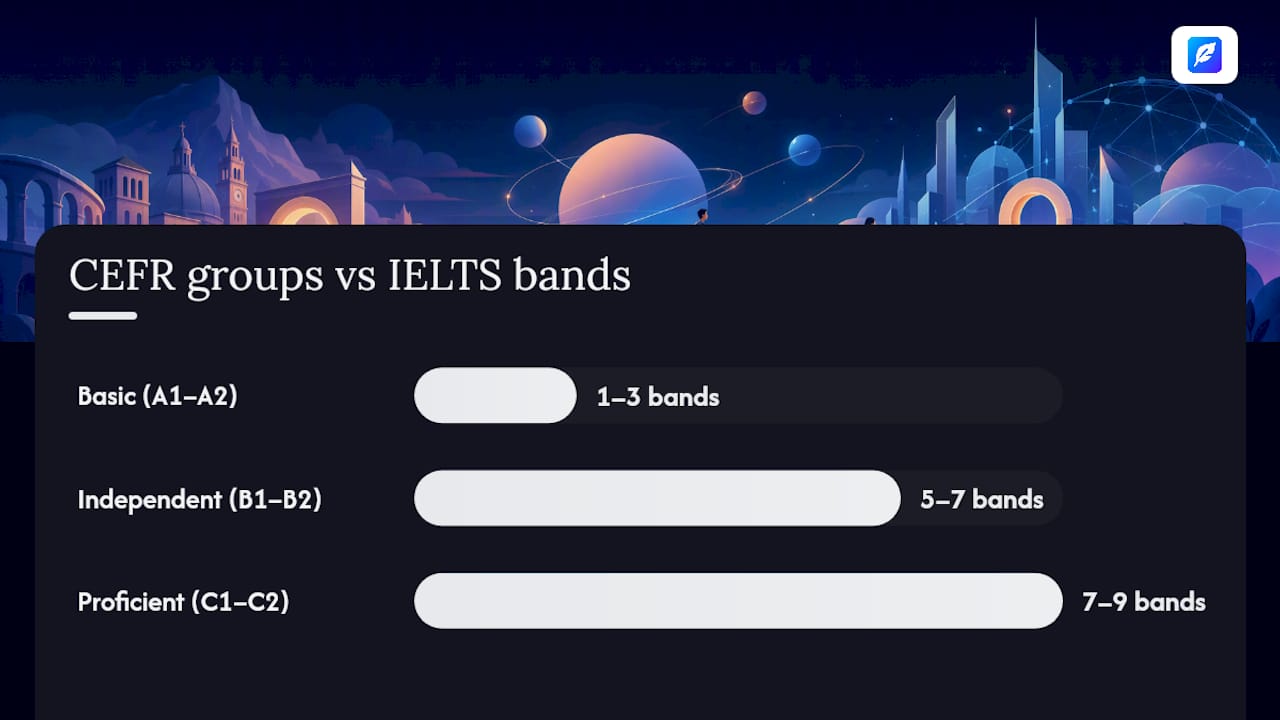
Assessment focus by framework: CEFR and ACTFL are task-based (what the writer can do); ILR emphasises consistency and breadth across contexts; IELTS/Cambridge rate performance on timed, exam-specific tasks. Choosing the right measure depends on your goal: university admission points to IELTS or Cambridge; professional or government language certification points to ILR or ACTFL WPT; classroom progress tracking fits CEFR or ACTFL descriptors.
What raters actually look for when measuring writing
Understanding the criteria raters use is the fastest way to decode scoring language and know exactly what to practise.
The FACT framework
ACTFL organises its writing criteria around four dimensions, commonly abbreviated as FACT:
- Functions/tasks: what the writer can accomplish (listing, describing, narrating, arguing, hypothesising)
- Accuracy: control of grammar, spelling, punctuation, and vocabulary
- Context/content: the topics and situations the writer can handle (familiar, general, abstract, specialised)
- Text type: the length and organisation of the written product (words, sentences, paragraphs, extended discourse)
A rater looks at all four simultaneously. Strong vocabulary alone will not earn a higher rating if text organisation is weak or if the writer cannot handle unfamiliar topics. ACTFL guidelines are explicit: sustained ability across all FACT criteria, including in unpractised situations, is required for a level assignment.
Word, sentence, and text levels
Pedagogical research identifies three instructional targets that map directly onto what raters observe:
- Word level: spelling accuracy, vocabulary range and precision, appropriate register choices
- Sentence level: grammatical control, sentence variety, clause complexity, punctuation
- Text level: paragraph organisation, cohesion devices (pronouns, connectives, reference chains), rhetorical structure, overall coherence
Text-level organisation produces the largest gains in overall writing quality compared with grammar-only work. A writer who fixes every comma but never learns to structure an argument will plateau at B1/Intermediate.
A simplified self-evaluation rubric
| Criterion | Emerging (A1–A2 / Novice) | Developing (B1–B2 / Intermediate–Advanced Low) | Proficient (C1–C2 / Advanced–Distinguished) |
|---|---|---|---|
| Vocabulary | Memorised words; frequent gaps | Adequate for routine topics; some imprecision | Precise, varied; register-appropriate |
| Grammar | Formulaic patterns; many errors | Mostly accurate on familiar structures; errors under pressure | Consistent control; errors rare and minor |
| Organisation | List-like; no clear structure | Topic sentences present; cohesion emerging | Logical, well-signposted; cohesion sustained |
| Task fulfilment | Partial; relies on prompts | Meets basic task requirements | Fully addresses task; adapts to audience |
Pro Tip: Consistency across all four criteria is what moves you up a level. If your organisation is strong but your grammar is shaky, raters will assign the lower of the two — not an average.
What writing looks like at each level
The descriptors below draw on CEFR, ACTFL, and ILR frameworks. Use them to place your own writing or a student's work quickly.
| Level (CEFR / ACTFL / ILR) | Functions and tasks | Typical text types and length | Accuracy and control | Complexity and cohesion | Common errors/limitations |
|---|---|---|---|---|---|
| A1 / Novice Low–Mid / 0–0+ | Fill in forms; copy words; produce isolated labels | Single words, short phrases, simple forms | Heavily formulaic; many spelling errors | No connected text; list-like | Literal translation from L1; invented spellings |
| A2 / Novice High–Intermediate Low / 1 | Write short messages; describe self; simple requests | 2–5 sentences; notes, postcards, simple emails | Mostly accurate on memorised patterns; errors on new structures | Sentences loosely connected; minimal cohesion | Run-on sentences; missing articles; tense confusion |
| B1 / Intermediate Mid–High / 1+ | Narrate events; write personal letters; summarise familiar content | Short paragraphs; informal letters, diary entries | Reasonably accurate on familiar grammar; errors under pressure | Topic sentences emerging; basic connectives (and, but, because) | Overuse of simple connectives; limited paragraph development |
| B2 / Advanced Low–Mid / 2 | Argue a point; write formal emails; produce structured essays | Multi-paragraph texts; reports, essays | Good control of complex grammar; occasional errors | Clear paragraph structure; cohesion devices used consistently | Awkward register shifts; over-reliance on a narrow range of connectives |
| C1 / Advanced High–Superior / 2+–3 | Construct nuanced arguments; write for professional or academic contexts | Extended texts; academic essays, formal reports | Near-consistent accuracy; errors minor and self-correctable | Sophisticated cohesion; varied paragraph structure; clear rhetorical flow | Occasional imprecision in idiomatic expression; minor punctuation slips |
| C2 / Distinguished / 5 | Write for any purpose; adapt style to any audience; handle abstract and specialised topics | Any length; editorials, research summaries, complex correspondence | Near-native accuracy across all structures | Seamless cohesion; discourse-level control; stylistic flexibility | Rare; may over-formalise in casual contexts |
Concrete sample tasks and what they reveal about level
Seeing a short piece of writing annotated is more useful than reading a descriptor in the abstract. The examples below cover four representative levels.
Novice (CEFR A2 / ILR 1): short personal message
Prompt: Write a short message to a friend explaining that you will be late.
What the cues signal: Vocabulary is adequate but minimal. Sentences are complete but very short and unconnected. No cohesion devices. The task is fulfilled at a basic level. This is characteristic A2/Novice High writing: functional for the immediate purpose, but no elaboration and no attempt at explanation.
Intermediate (CEFR B1 / ILR 1+): informal email
Prompt: Email a colleague to explain why you missed a meeting and suggest a new time.
What the cues signal: Task is addressed. Tense error ("I miss" for "I missed") and a spelling/spacing issue ("can not"). Basic connective ("and") used once. Paragraph structure absent. Polite register attempted. Typical B1: communicates the message but with noticeable grammatical errors and limited cohesion.
Advanced (CEFR B2–C1 / ILR 2): structured argument
Prompt: Write a short paragraph arguing for or against remote working.

What the cues signal: Multi-clause sentences with varied connectives ("yet", "however", "therefore"). Argument structured with a concession. Vocabulary precise and register consistent. Minor risk: the phrase "in terms of" is slightly formulaic. This sits comfortably at B2/Advanced Low.
Superior (CEFR C1–C2 / ILR 3): analytical summary
Prompt: Summarise the main arguments for and against a controversial policy in 100 words.
What the cues signal: Abstract vocabulary used accurately. Discourse-level cohesion ("Both positions reflect…", "A balanced assessment requires…"). Hedging language deployed precisely ("remains contested", "varies considerably"). No grammatical errors. Audience awareness evident in the analytical register.
Common learner error and correction:
The corrected version signals B2+ through precise vocabulary, a concessive structure, and a more specific claim.
How to assess your own writing level
A quick self-check is often enough to place yourself within one or two levels before committing to a formal test.
Self-assessment checklist
Work through these statements and note the highest level where you can answer "yes" consistently:
- A1–A2: I can write my name, address, and basic personal information on a form. I can send a very short, simple message.
- B1: I can write a short, connected paragraph about a familiar topic (a recent event, a place I know). I use basic connectives correctly.
- B2: I can write a structured essay or formal email with a clear argument. I rarely make grammar errors on familiar structures.
- C1: I can write extended, well-organised text for academic or professional purposes. My vocabulary is precise and my register is consistent.
- C2: I can write for any purpose, adapt my style to any audience, and handle abstract or specialised topics with near-native fluency.
The British Council's LearnEnglish pages offer free CEFR-aligned self-assessment tools particularly useful for UK learners.
When to use a formal test
Self-assessment is reliable for setting learning goals and tracking progress. Use a formal test when:
- You need a recognised qualification for university admission or a UK visa (IELTS Academic or General Training; Cambridge B2 First, C1 Advanced, or C2 Proficiency).
- Your employer requires a certified language level.
- You want an externally validated rating for professional development (ACTFL WPT, which rates spontaneous writing against ACTFL descriptors).
IELTS writing is scored on a 1–9 band scale across task achievement, coherence and cohesion, lexical resource, and grammatical range and accuracy. Cambridge English exams map directly to CEFR levels and provide a certificate valid for life. The ACTFL WPT is the right choice when you need a proficiency rating (rather than an exam score) for academic research, government employment, or language programme placement.
Exam band tests (IELTS, Cambridge) measure performance on timed, test-specific tasks. Proficiency tests (ACTFL WPT) assess spontaneous ability relative to descriptors. Choose the measure that matches your actual goal.
Evidence-based ways to improve your writing at every level
The most effective improvement targets word, sentence, and text levels simultaneously, but the emphasis shifts depending on where you are now.
Word-level activities
- Keep a vocabulary journal organised by topic and register, noting collocations (not just single words). Aim to record 10 new items per week with example sentences.
- Practise register switching: take one sentence and rewrite it in formal, neutral, and informal registers. This builds the vocabulary range that FACT-based raters look for.
- Use a word frequency list (such as the Academic Word List for academic writing) to identify gaps between your current vocabulary and the level above.
Sentence-level activities
- Sentence combining: take three short, simple sentences and combine them into one complex sentence using subordination and coordination. This directly builds the clause complexity raters expect at B2 and above.
- Error log: after each piece of writing, record your three most frequent error types. Targeting a short list is more effective than trying to fix everything at once. Grammar reference guides can help you understand the rules behind recurring mistakes.
- Punctuation drills: practise semicolons, colons, and relative clauses in isolation before deploying them in full texts.
Text-level activities
Research confirms that text-level organisation produces the largest gains in overall writing quality. Three activities that deliver results:
- Exemplar analysis: take a published text at the level above yours and annotate its cohesion devices, paragraph structure, and rhetorical moves. Then write a parallel text using the same structure.
- Reverse outlining: write a draft, then extract a one-sentence summary of each paragraph. If the summaries do not form a logical sequence, restructure before editing at word or sentence level.
- Purposeful revision cycles: revise one draft three times, each pass targeting a different level (first pass: text structure; second pass: sentence variety; third pass: vocabulary precision).
A 6-week improvement plan template
| Week | Focus | Activity | Checkpoint |
|---|---|---|---|
| 1 | Text level | Exemplar analysis of two texts at your target level | Can you identify all cohesion devices? |
| 2 | Text level | Write one parallel text using the exemplar structure | Does your reverse outline form a logical sequence? |
| 3 | Sentence level | Sentence combining (10 exercises) + error log | Has your top error type reduced? |
| 5 | Sentence level | Write one structured paragraph; revise for clause variety | Count subordinate clauses per 100 words |
| 5 | Word level | Vocabulary journal; register-switching exercise | Can you use new items accurately in context? |
| 6 | Integration | Write a full text; apply all three revision passes | Compare against the self-assessment checklist |
Pro Tip: The most common plateau happens when learners focus exclusively on grammar drills. Targeted revision of text-level organisation, specifically how paragraphs connect and arguments develop, is where the real level jump happens. Spend at least half your practice time at text level.
Instant feedback between drafts shortens the revision cycle considerably, particularly for learners working without a regular teacher.
Why levels are tools, not labels
There is a tendency, among both learners and teachers, to treat a proficiency level as a fixed identity rather than a diagnostic snapshot. A B2 rating does not mean a writer is "a B2 writer" permanently; it means that, at the time of assessment, their sustained performance across FACT criteria placed them in that band. The level is a starting point for targeted work, not a ceiling.
For teachers, the most productive use of a level descriptor is to identify the specific gap between where a student is and what the next level requires, then design tasks that address that gap directly. Combining a level diagnosis with formative feedback on a small set of rubric items (cohesion devices used, clause complexity, task fulfilment) gives clearer evidence of real progress than a long checklist. Tracking two or three metrics over six weeks is more informative than re-running a full assessment every fortnight.
For learners, the practical advice is to set micro-goals tied to rubric items rather than aiming at a level in the abstract. "I will use three different cohesion devices in my next paragraph" is more tractable than "I want to reach C1." The level follows from the accumulated micro-gains.
One further nuance: academic writing proficiency and general writing proficiency are not the same thing. A writer who performs at B2 on a general writing task may struggle at B1 on a formal academic essay because the rhetorical conventions, citation practices, and register expectations are distinct. Similarly, professional writing (reports, proposals, correspondence) carries its own conventions that general proficiency frameworks do not fully capture. Knowing which context you are writing for shapes which descriptors and which practice tasks are most relevant.
Inspirowrite supports your level-based improvement plan
Knowing your level and having a plan is one thing; getting consistent, fast feedback on every draft is another. Inspirowrite gives you instant, privacy-first proofreading that flags grammar errors, cohesion gaps, and register inconsistencies the moment you paste in a draft, without storing your text or using it to train any AI model.
Practically, this means you can run each revision pass from the 6-week plan above through Inspirowrite and get specific suggestions at word, sentence, and text level within seconds. Paste in a paragraph after your exemplar-analysis exercise and ask for cohesion improvements; use the rewrite and rephrase options to test register switches; track your revision history to see how a draft evolves across passes. The tool also supports multiple languages, which is useful for learners writing in English as an additional language.
Automated feedback supplements formative assessment from a teacher; it does not replace it. Use Inspirowrite to accelerate the revision cycle between lessons, not as a substitute for expert human feedback on complex writing tasks. Start with a free plan to see how it fits into your current practice.
Sources
The following official pages give you direct access to level descriptors, rubrics, and test information:
- ACTFL proficiency guidelines overview
- ILR skill level descriptions — writing
- CEFR level descriptions — Council of Europe
- Understand your English level | LearnEnglish
- Assess, interpret and target: Using the levels of language to inform writing instruction
Read the official descriptors alongside a piece of your own writing: find the level that describes most of what you can do, then read the next level up to identify your specific gap.
FAQ
What are the main writing proficiency levels?
The most widely used scales are CEFR (A1–C2), ACTFL (Novice to Distinguished with sublevels), and ILR (0–5). All three describe a continuum from producing isolated words to writing sophisticated, nuanced prose for any audience.
What do A1, A2, B1, B2, C1, and C2 mean in writing?
These are the six CEFR levels: A1–A2 (Basic), B1–B2 (Independent), and C1–C2 (Proficient). At A1 a writer produces simple phrases and forms; at C2 they write with near-native accuracy and stylistic flexibility across all contexts.
What are the five levels of language proficiency in ACTFL?
ACTFL defines five major levels: Novice, Intermediate, Advanced, Superior, and Distinguished. Novice, Intermediate, and Advanced each include Low, Mid, and High sublevels, giving ten distinct bands in total.
How is writing proficiency formally tested in the UK?
IELTS (bands 1–9) and Cambridge English exams (mapped to CEFR) are the standard formal tests for UK university admission and visa purposes. The ACTFL WPT is available for proficiency-based ratings outside the exam context.
How do I move up a writing proficiency level quickly?
Focus on text-level organisation first: practise reverse outlining, exemplar analysis, and purposeful multi-pass revision.