

TL;DR:
- Academic English proficiency involves mastering formal, discipline-specific language needed for university tasks. It predicts academic success, influences confidence, and impacts grading; deliberate practice and targeted testing support skill development. Using tools like Inspirowrite and following structured plans can help students improve efficiently before starting higher education.
Academic English proficiency means the ability to read, write, listen, and speak in English at the level required for university study — not just everyday conversation, but the formal, discipline-specific language of lectures, essays, seminars, and research. For students entering English-medium higher education in the UK, this distinction matters enormously: the CEFR and tests such as IELTS set the benchmarks, and tools like Inspirowrite can support you in closing the gap between where you are and where you need to be.
Table of Contents
- How does academic English differ from everyday English?
- Why does academic English proficiency matter for your grades?
- How do you check your academic English level?
- How to improve your academic English: an 8–12 week plan
- What do UK universities typically expect at each level?
- A quick pre-course readiness checklist
- What does recent research say about academic English proficiency?
- Key takeaways
- The part most students overlook
- Polish your academic writing with Inspirowrite
- Useful sources for UK students
- FAQ
How does academic English differ from everyday English?
The gap between social English and academic English is wider than most students expect, and it shows up in three distinct ways.
Register and tone. Social English is personal, context-dependent, and tolerant of informality. Academic English is impersonal, hedged, and precise. Compare: "I think climate change is a big problem and everyone should care about it" versus "The evidence suggests that anthropogenic climate change poses significant risks to global ecosystems (IPCC, 2023)." Both express a view; only one is acceptable in an essay.
Discipline specificity. Academic English is not a single uniform register. The discourse moves in a mathematics proof differ fundamentally from those in a law essay or a humanities close reading. A maths student needs to follow chains of logical inference and use notation correctly; a history student needs to evaluate historiographical debates and situate sources. Research published in Frontiers in Education highlights that EAP teaching must account for these disciplinary differences — generic academic writing instruction only takes students so far. Understanding why subject matter expertise matters in language use is part of developing genuine academic competence.
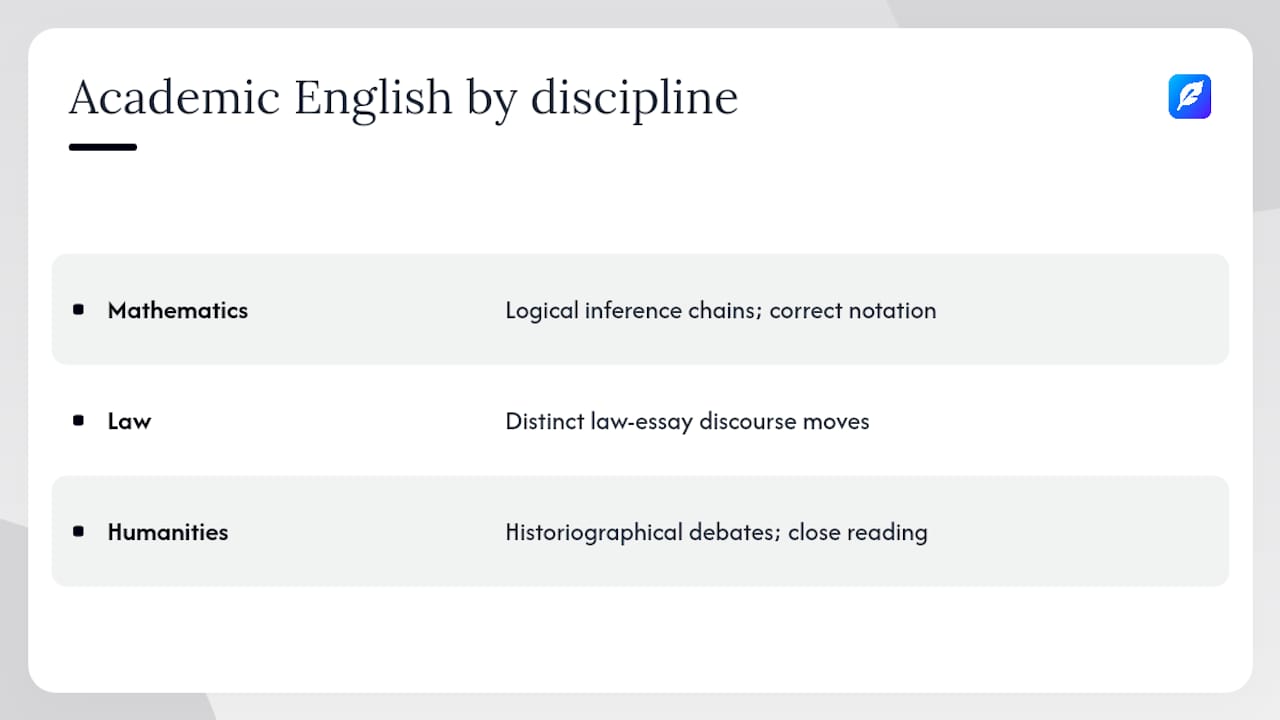
Marking expectations. Tutors in UK universities apply criterion-referenced marking rubrics that explicitly reward academic register, source integration, and structural coherence. A student who writes fluently but informally will lose marks not because their ideas are weak, but because the register signals a misunderstanding of the task. That is a practical consequence of the gap between BICS and CALP — and it catches many students off guard in their first semester.
Why does academic English proficiency matter for your grades?
The evidence is clear. IELTS research identifies English proficiency as a primary predictor of academic achievement in English-medium instruction (EMI) courses. Students with higher standardised English scores report greater confidence, lower stress, and better grades. This is not simply correlation: proficiency affects every academic task simultaneously.
"Students with stronger English proficiency are better equipped to understand course materials, participate in seminars, and produce assessed work that meets academic standards — making language ability one of the most consistent predictors of academic success in EMI settings." IELTS research on English proficiency and academic success
The impact spreads across four areas:
- Stress and confidence: the Open University's guidance notes that academic English is central to working productively with tutors and peers — when it is weak, students often disengage from the very support structures that would help them most
Grammatical control is a particularly underestimated factor. Why grammar matters in essays is not an abstract concern: a single ambiguous sentence in an exam answer can cost marks, not because the idea is wrong, but because the marker cannot be certain what the student meant.
How do you check your academic English level?
Comparing the main tests accepted by UK universities
| Test | Skills covered | CEFR equivalent | UK university acceptance | Format and time |
|---|---|---|---|---|
| IELTS Academic | Reading, writing, listening, speaking | B2–C2 | Universally accepted | Paper or computer; approx. 2 hours |
| Cambridge C1 Advanced / C2 Proficiency | Reading, writing, listening, speaking, use of English | C1 / C2 | Widely accepted | Computer or paper; approx. 3–4 hrs |
| Pearson PTE Academic | Reading, writing, listening, speaking | A1–C2 | Accepted by most UK universities | Computer-based; 2 hrs |
| Duolingo English Test (DET) | Reading, writing, listening, speaking | A1–C2 | Accepted by a growing number of UK institutions | Online, adaptive; approx. 1 hr |
The Duolingo English Test blog notes that academic English includes low-frequency vocabulary and formal grammar that general English tests do not always capture — which is why the Academic version of IELTS, rather than the General Training version, is the standard for university admissions.
When to use an external test versus an institutional diagnostic:
- Use IELTS Academic, Cambridge, or PTE when you need a score for a formal application or visa requirement
- Use a university's own diagnostic (many UK institutions offer these free during induction week) when you want to identify gaps for in-sessional support
- Use the CEFR self-assessment grid for a quick, low-stakes initial check before you decide whether to invest in a full test
How to improve your academic English: an 8–12 week plan
Improvement is systematic, not accidental. The Frontiers in Education review finds that learner-centred, multimodal, and technology-integrated approaches produce the best results in EAP contexts. Here is a realistic plan:
Weeks 1–2: Diagnose and set targets
- Complete the CEFR self-assessment grid and note your weakest skill area
- Read one academic article in your subject and annotate unfamiliar vocabulary
- Identify whether your institution offers a pre-sessional or in-sessional EAP programme and register
Weeks 3–4: Academic reading and vocabulary
- Read one journal article per day; use a vocabulary notebook for AWL items
- Study collocations in academic writing — knowing that "conduct research" is correct and "make research" is not saves marks
- Practise summarising each article in two sentences without looking at the text
Weeks 5–6: Controlled writing
- Write one 300-word essay introduction per week on a topic in your subject
- Focus on thesis statement, signposting, and hedged language
- Submit drafts for feedback — from a tutor, a writing centre, or a tool like Inspirowrite for immediate register and grammar checks
Weeks 7–8: Listening and note-taking
- Watch two recorded university lectures per week (many UK universities post these openly on YouTube)
- Practise Cornell-style note-taking: main ideas, supporting detail, summary
- Review common grammar mistakes non-native speakers make and check your notes for recurring errors
Weeks 9–10: Speaking and seminar participation
- Join a conversation group, language exchange, or university speaking club
- Practise giving a two-minute spoken summary of a reading — record yourself and listen back
- Work on hedging phrases: "It could be argued that…", "The evidence suggests…", "One limitation is…"
Weeks 11–12: Integration and feedback loops
- Write a full practice essay under timed conditions
- Use peer review: swap with another student and apply the marking criteria your department publishes
- Book a tutor feedback session and ask specifically about register, argument structure, and source integration
Resource types to draw on throughout: pre-sessional EAP courses, in-sessional writing workshops, annotated model essays from your department, recorded lectures, academic word lists, and digital proofreading tools for draft checking.
Pro Tip: When asking a tutor for feedback, be specific. Instead of "Can you check my essay?", ask: "Could you comment on whether my argument is clearly signposted and whether my use of sources meets the referencing criteria?" Tutors give better feedback when they know what you are trying to fix.
What do UK universities typically expect at each level?
Expectations vary by institution and programme, but the following ranges reflect common patterns across UK higher education. Always verify with your specific university or department.
- Undergraduate entry: — typically requires IELTS Academic scores broadly corresponding to B2–C1. At this level, students are expected to read textbook chapters and edited academic articles, write structured essays, and participate in seminar discussions
The Open University's guidance on developing academic English frames these expectations clearly: the higher the level of study, the more independently students must interpret assignment questions, construct original arguments, and engage critically with competing scholarly positions.
A quick pre-course readiness checklist
Use this before term starts. For every "no," there is a concrete next step.
- Can you follow a 50-minute lecture and take usable notes? If not: watch two recorded university lectures this week using the Cornell note-taking method
- Can you read a journal article and identify its main argument within 20 minutes? If not: practise with abstracts first, then move to full articles
- Can you write a 500-word essay introduction with a clear thesis and at least two cited sources? If not: attend your university's writing centre or submit a draft to Inspirowrite for instant feedback on structure and register
- Can you use your department's referencing system (Harvard, APA, OSCOLA) without looking it up? If not: download your university's referencing guide and practise with five sources this week
- Can you discuss an academic topic aloud for two minutes without losing your thread? If not: join a language exchange or speaking group, or record yourself and review
- Can you meet a submission deadline while managing three other assignments? If not: build a weekly planner and identify your university's academic skills support
- Do you know how to use academic databases (JSTOR, Scopus, Google Scholar) to find peer-reviewed sources? If not: book a library induction session — most UK universities offer these free in the first two weeks of term
The CEFR self-assessment grid is a useful companion to this checklist: it translates each skill into plain-language descriptors you can match against your own experience.
What does recent research say about academic English proficiency?
Three findings stand out as particularly relevant for UK students:
-
Proficiency predicts achievement across disciplines — IELTS research synthesising multiple studies finds that English proficiency is a primary predictor of academic achievement in EMI courses, with higher scores linked to greater confidence and lower stress. The implication: investing in language before you start a programme pays dividends across every module, not just language-assessed ones.
-
EAP benefits from technology-integrated approaches — The Frontiers in Education narrative review finds that learner-centred, multimodal, and technology-integrated EAP instruction produces better outcomes than traditional grammar-focused teaching. For students, this means that combining formal EAP courses with digital tools, recorded lectures, and corpus-based vocabulary study is more effective than any single method alone.
-
Operationalising academic English matters for fair assessment — The NYSRTI literature review argues that reliable teaching and testing of academic English requires specifying the lexical, grammatical, and discourse features being assessed. Students benefit from knowing exactly what markers are looking for — which is why criterion-referenced rubrics and annotated model essays are so valuable.
"Mastery of academic English supports not only student grades but also the careers of academic staff — enabling researchers to publish internationally, obtain grants, and participate in transnational scholarly networks. Proficiency is a career-long asset, not a one-time admissions hurdle." Teaching academic English in higher education — Frontiers in Education
For further reading, the Council of Europe's CEFR level descriptors remain the most authoritative reference for mapping language ability to academic tasks.
Key takeaways
Academic English proficiency is the single most consistent predictor of success in UK higher education: students who invest in it before term starts perform better, stress less, and engage more fully with their studies.
| Point | Details |
|---|---|
| Academic English is not general English | EAP targets specific genres, registers, and vocabulary that everyday fluency does not cover. |
| CEFR bands guide realistic targets | B2 suits undergraduate entry; C1 is the standard for most UK postgraduate programmes. |
| IELTS Academic is the benchmark | Universally accepted by UK universities; the Academic version tests the skills EMI study actually demands. |
| An 8–12 week plan works | Structured weekly focus on reading, writing, listening, and speaking produces measurable improvement before term. |
| Inspirowrite supports draft feedback | Fast, private AI proofreading helps students check register, grammar, and clarity on academic writing before submission. |
The part most students overlook
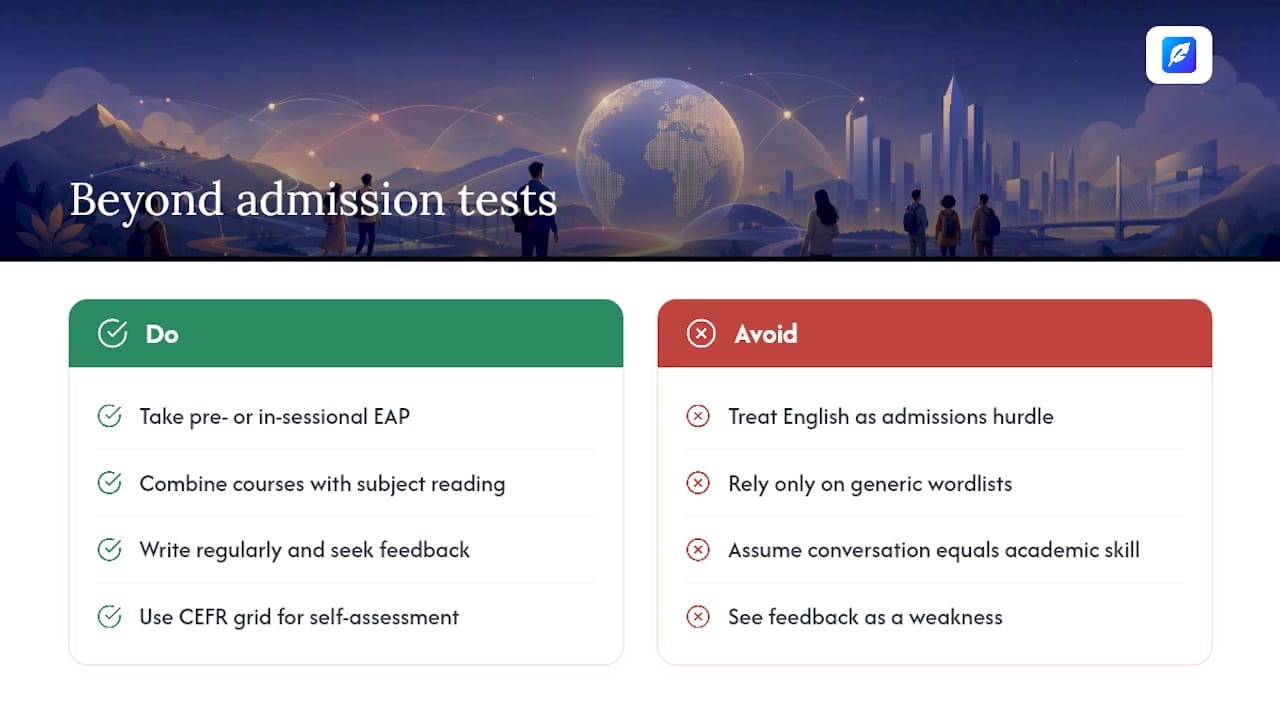
One thing I notice consistently in discussions about academic English is that students treat it as an admissions hurdle rather than a study skill. Pass the IELTS, get the offer, move on. But the research tells a different story: the students who thrive in UK higher education are the ones who keep developing their academic English after they arrive, not just before.
The BICS/CALP distinction is genuinely useful here. You can hold a perfectly fluent conversation in English, navigate a city, make friends, and follow a film without any difficulty — and still find that your first essay comes back with comments about register, argument structure, and source integration. That is not a failure of intelligence. It is a gap between two different kinds of language ability, and it closes with deliberate practice.
What I would push back on is the idea that formal EAP courses are the only route. They are valuable, and if your university offers pre-sessional or in-sessional support, take it. But the students who improve fastest tend to combine formal instruction with high-volume reading in their subject, regular writing with feedback, and honest self-assessment using tools like the CEFR grid. Discipline-specific vocabulary does not come from a generic academic wordlist alone — it comes from reading widely in your field and paying attention to how expert writers construct their arguments.
The other thing worth saying plainly: getting feedback on your writing is not a sign of weakness. It is what professional academics do. Every published paper has been reviewed, revised, and edited. Building that habit as a student puts you ahead of peers who submit first drafts and hope for the best.
Polish your academic writing with Inspirowrite
Writing in academic English is demanding even for confident users of the language. Register slips, grammar errors, and unclear phrasing are easy to miss in your own work — especially when you are writing under deadline pressure.
Inspirowrite gives you fast, private feedback on drafts without storing your content or using it to train AI models. Paste in an essay introduction, a literature review paragraph, or a seminar reflection, and within seconds you get grammar corrections, register suggestions, and rephrasing options that help you sound more precise and more academic. It handles formal rewriting, style adjustment, and clarity checks — the kind of targeted feedback that helps you understand why a sentence does not work, not just that it needs changing.
This is not a replacement for your university's writing centre or your tutor's comments. Think of it as a first-pass check that catches the surface errors before you submit for human feedback, so that feedback can focus on argument and ideas rather than grammar. Your content stays confidential throughout. Try Inspirowrite on your next draft and see the difference a focused register check makes before submission.
Useful sources for UK students
- How important is English language proficiency for academic success? — IELTS
- Teaching academic English in higher education: strategies and challenges — Frontiers in Education
- English language & academic English — Leeds Beckett University library
- The importance of language skills — The Open University
- Level descriptors — Common European Framework of Reference for Languages (CEFR) — Council of Europe
- Table 2 — CEFR self‑assessment grid — Council of Europe
- Literature review: defining and operationalising academic English — NYSRTI / educational research
- What is academic English? — Duolingo English Test blog
FAQ
What does academic proficiency mean?
Academic proficiency means the ability to use language effectively for the specific demands of study: reading complex texts, writing structured arguments, following lectures, and participating in academic discussion. It goes beyond general fluency to include formal register, discipline-specific vocabulary, and genre knowledge.
How do I know my English proficiency level?
The quickest starting point is the CEFR self-assessment grid, which maps your abilities to plain-language descriptors across reading, writing, listening, and speaking. For a formal score, IELTS Academic, Cambridge C1 Advanced, or Pearson PTE Academic each provide a standardised, UK-recognised result.
What is the difference between academic English and general English?
General English covers everyday communication; academic English targets the formal, impersonal, and genre-specific language of university study. The key differences are register (formal versus informal), vocabulary (low-frequency academic and discipline-specific terms), and genre conventions (essays, reports, and literature reviews follow rules that casual writing does not).
What are the five levels of language proficiency?
The CEFR uses six levels: A1 (Beginner), A2 (Elementary), B1 (Intermediate), B2 (Upper Intermediate), C1 (Advanced), and C2 (Mastery). For UK university study, B2 is typically the minimum for undergraduate entry and C1 is the standard for postgraduate programmes.
Does the Duolingo English Test count for UK university applications?
A growing number of UK universities accept the Duolingo English Test (DET), though acceptance varies by institution and programme. IELTS Academic remains the most universally accepted option; always check your specific university's admissions requirements before choosing a test.