

TL;DR:
- Spelling confusion involves the frequent misuse of homophones, look-alike words, and near-synonyms.
- Understanding these categories and applying targeted strategies helps writers catch errors before publishing.
Spelling confusion is defined as the consistent misuse of words that share similar sounds, appearances, or meanings, and it represents one of the most persistent sources of English writing errors. The three core categories, homophones, look-alikes, and near-synonyms, account for the majority of professional writing mistakes. Cambridge Dictionary identifies at least 50 frequently misspelled words that trip up even experienced writers. Resolving these confusions is not about memorising a dictionary. It is about understanding why certain words fool the brain and building habits that catch errors before they reach your reader.
1. What are homophones and why do they cause spelling confusion?

Homophones are words that sound identical but carry different meanings and spellings. They sit at the heart of common spelling confusions in English writing because the ear gives you no warning when you choose the wrong one. "Their," "there," and "they're" are the most cited example, yet writers misuse them daily in professional emails, essays, and published articles.
The critical problem with homophones is that spell-checkers cannot detect them. Both "your" and "you're" are correctly spelled words. Automated tools pass them without comment, leaving the error invisible until a reader notices it. That false security is the real danger.
Three of the most commonly confused homophone pairs are:
- Their / There / They're. "Their" shows possession. "There" refers to a place. "They're" is a contraction of "they are."
- Your / You're. "Your" shows possession. "You're" means "you are." Expand the contraction to test: "you are welcome" works; "you are bag" does not.
- Lose / Loose. "Lose" is a verb meaning to fail to keep something. "Loose" is an adjective meaning not tight. The extra "o" in "loose" makes it longer, just as a loose item has more room.
Pro Tip: Read your sentence aloud and substitute the full meaning of each word. If "they are" sounds wrong in place of "their," you have caught the error before it reaches your reader.
2. How do look-alike words contribute to common spelling errors?
Look-alike words share similar letter patterns but differ in meaning or grammatical function. They cause a distinct type of confusion from homophones because the visual similarity fools the eye rather than the ear. Writers scan text quickly and the brain fills in the expected word, skipping the actual one on the page.
The affect/effect pair is the most frequently confused in this category. The RAVEN mnemonic, which stands for "Remember: Affect = Verb, Effect = Noun," resolves the confusion in the vast majority of cases. "The noise affected her concentration" uses the verb. "The effect was immediate" uses the noun. The mnemonic covers most everyday usage, though exceptions exist when "effect" functions as a verb meaning to bring about a change.
Other look-alike pairs that cause frequent errors include:
- Complement / Compliment. "Complement" means to complete or enhance something. "Compliment" means to praise. The word "complete" shares its opening letters with "complement," which makes the distinction memorable.
- Discreet / Discrete. "Discreet" means careful and tactful. "Discrete" means separate and distinct. The two "e" letters in "discrete" are themselves separate, which mirrors the meaning.
- Stationary / Stationery. "Stationary" means not moving. "Stationery" refers to writing materials. "Stationery" contains "er," just like "paper."
Pro Tip: During proofreading, flag every instance of your highest-risk pairs and check each one individually. Do not rely on a single pass through the full text.
3. Which near-synonyms are commonly confused in English spelling and usage?
Near-synonyms are words with overlapping meanings that writers treat as interchangeable when they are not. The confusion here goes beyond spelling. It affects the accuracy of what you are actually saying. Choosing the wrong near-synonym can change the meaning of a sentence entirely, even when both words are spelled correctly.
The imply/infer pair is a classic example. A speaker or writer implies something by suggesting it indirectly. A reader or listener infers something by drawing a conclusion from what they hear or read. Swapping them reverses the direction of communication. The sentence "She implied that the project was late" means something quite different from "She inferred that the project was late."
Three near-synonym pairs that regularly cause confusion:
- Historic / Historical. "Historic" describes an event of great importance. "Historical" describes anything relating to history or the past. A "historic speech" changed the course of events. A "historical document" simply dates from the past.
- Ensure / Insure. "Ensure" means to make certain something happens. "Insure" relates specifically to financial insurance. You ensure a meeting runs on time. You insure a car.
- Imply / Infer. The speaker implies. The listener infers. The direction of the communication determines the correct word.
When the distinction feels genuinely ambiguous, consult a style guide such as Fowler's Dictionary of Modern English Usage or the Oxford Style Manual. Semantic accuracy matters as much as correct spelling in polished writing.
4. What are the top frequently misspelled words and typical error patterns?
The Cambridge Dictionary's top 50 spelling mistakes reveal clear patterns. Most errors cluster around double letters, silent letters, and unexpected vowel combinations. Understanding the pattern is more useful than memorising each word individually, because one rule can resolve dozens of errors at once.
Silent letters and double consonants in words like "accommodate," "embarrass," and "committee" cause errors even among native speakers. The brain processes familiar words as whole units rather than letter by letter. That shortcut is efficient for reading but dangerous for writing, because it skips the very details that distinguish correct from incorrect spelling.
| Word | Common mistake | Pattern | Memory aid |
|---|---|---|---|
| Accommodate | Acommodate | Double c and double m | Two cots, two mattresses |
| Embarrass | Embarass | Double r and double s | Really Red Skin Showing |
| Occurrence | Occurence | Double r, double c | It occurs with double letters |
| Separate | Seperate | Vowel swap in middle | There is "a rat" in "separate" |
| Necessary | Neccessary | Double c error | One Collar, two Socks (1c, 2s) |
Regional spelling differences add another layer. British English uses "colour," "organise," and "travelling," while American English uses "color," "organize," and "traveling." Writers who read widely across both traditions sometimes mix the two systems without noticing. Choosing one standard and applying it consistently removes this source of error entirely.
Pro Tip: Keep a personal list of the words you misspell most often. Reviewing ten words you personally struggle with beats studying a generic list of one hundred.
5. What strategies and proofreading techniques help avoid spelling confusions?
Reducing spelling mistakes in English requires a system, not just good intentions. Spell-checkers are a starting point, not a finish line. Manual context checks and semantic awareness are necessary for any writing where accuracy matters.
Five practical techniques that work:
- Read aloud. Speaking each word forces you to process the text at a slower pace. Errors that the eye skips over become audible. This technique is particularly effective for catching homophone errors.
- Use mnemonic devices. Personalised mnemonics stick better than generic ones. If "accommodation" trips you up, invent a sentence where the double letters are obvious: "The accommodation has two cats and two mice."
- Proofread in reverse. Reading from the last sentence to the first breaks the narrative flow that causes the brain to predict rather than read. Each sentence stands alone, making errors easier to spot.
- Build a confusable word checklist. List your highest-risk pairs, such as affect/effect, complement/compliment, and discreet/discrete, and search for each one deliberately during every proofread. An essay proofreading checklist formalises this habit.
- Break words into parts. "Dis-creet" and "dis-crete" look identical until you slow down and examine the suffix. Morphological awareness, the understanding of prefixes, roots, and suffixes, resolves many look-alike errors permanently.
Mnemonic tricks help writers resolve common spelling mistakes permanently within a short study period. The key is applying them consistently rather than relying on memory alone during the pressure of writing. Learning to proofread your own writing is a skill that compounds over time.
Key takeaways
Mastering spelling confusions in English requires categorising errors into homophones, look-alikes, and near-synonyms, then applying targeted mnemonics and manual proofreading to each category.
| Point | Details |
|---|---|
| Homophones need context checks | Spell-checkers pass homophones silently; only semantic review catches them. |
| RAVEN resolves affect/effect | The mnemonic covers most cases but requires checking exceptions manually. |
| Double letters are the top error pattern | Words like "accommodate" and "embarrass" require conscious letter-by-letter verification. |
| Near-synonyms change meaning | Swapping "imply" and "infer" reverses the direction of communication entirely. |
| Personal word lists outperform generic ones | Tracking your own recurring errors produces faster improvement than studying broad lists. |
Why I think most writers underestimate spelling confusions
Writers tend to treat spelling as a mechanical problem. Fix the typo, move on. What I have found, after years of working with text across multiple registers, is that the most damaging errors are never the obvious ones. Nobody publishes "teh" in a final draft. The errors that survive are the ones that look right.
The visual-phonetic dissonance in English is genuinely unusual among major languages. The gap between how a word sounds and how it looks is wider in English than in almost any other European language. That gap is not a flaw to work around. It is the central fact you need to accept before you can improve. Once you accept it, you stop trusting your ear and start verifying with your eye.
The writers I have seen improve fastest are not the ones who install the most tools. They are the ones who build a short personal checklist of their own recurring errors and work through it on every draft. Human proofreading remains irreplaceable for confusable words precisely because context is everything. Technology can flag a word. Only a reader can judge whether it means what you intended.
Spelling discipline is not about perfectionism. It is about respecting your reader enough to remove every obstacle between them and your meaning.
— Mike
Inspirowrite: your writing accuracy partner
Catching confusable words and frequently misspelled terms by hand takes time and concentration. Inspirowrite is an AI-powered proofreading tool built to speed up that process without sacrificing accuracy. It reviews your text for grammar, spelling, and style errors in seconds, and it does so without storing your content or using it to train AI models.
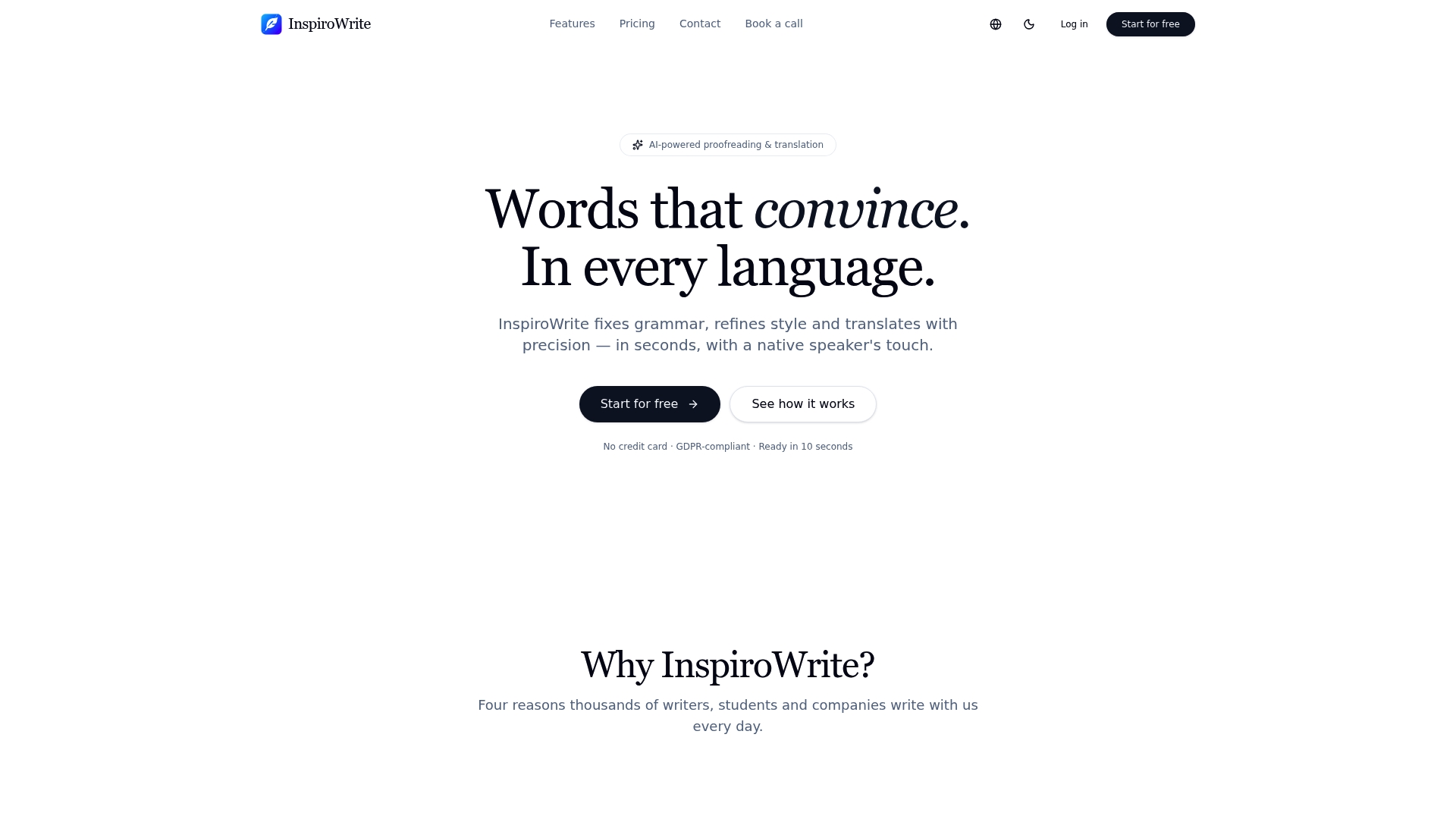
Writers and students who need fast, private feedback on their drafts use Inspirowrite's proofreading tool to catch the errors that spell-checkers miss, including context-dependent confusables like affect/effect and their/there/they're. The result is a cleaner draft in less time, with your content kept entirely confidential.
FAQ
What are the three main categories of spelling confusion?
Spelling confusions fall into homophones (words that sound alike), look-alikes (words with similar spellings), and near-synonyms (words with overlapping meanings). Each category requires a different strategy to resolve.
Why do spell-checkers miss so many confusable word errors?
Automated spell-checkers only verify whether a word exists in their dictionary. When both words in a confusable pair are correctly spelled, the tool passes them without comment, leaving the error for a human reader to catch.
What is the RAVEN mnemonic and when should I use it?
RAVEN stands for "Remember: Affect = Verb, Effect = Noun." It resolves the affect/effect confusion in most cases, though writers should verify exceptions where "effect" functions as a verb meaning to bring about a change.
Which words are most commonly misspelled in English?
Cambridge Dictionary's research identifies "accommodation," "embarrass," "occurrence," and "separate" among the most frequent errors. Double letters and unexpected vowel combinations are the patterns behind most of these mistakes.
How do I stop confusing near-synonyms like "ensure" and "insure"?
Assign a concrete meaning to each word and test it in context. "Ensure" means to make certain. "Insure" relates to financial coverage. If the sentence involves a policy or financial protection, "insure" is correct. In all other cases, use "ensure."