

Context routinely determines which sense of a word is intended. The word "bank" means something entirely different beside a river than inside a financial report, and that shift happens not because the word changed but because the surrounding information did. Understanding the role of context in word meaning is one of the most practical skills a language learner or researcher can develop, because most real-world ambiguity resolves the moment you look beyond the word itself.
- Context includes the words immediately around a target word (co-text), the topic of the conversation or text, the physical situation, and the social relationship between speakers.
- Polysemous words (words with multiple related senses) and homonyms (words that share a form but differ in meaning) both depend on context for disambiguation.
- Indexical expressions such as "I", "here", and "now" have no fixed referent at all without contextual parameters.
Pro Tip: When you meet an unfamiliar or ambiguous word, read the sentence before and after it first, then ask what the broader topic is. Those two steps resolve the majority of everyday ambiguity before you ever reach for a dictionary.
Key takeaways
Context is the primary mechanism by which readers, listeners, and language models assign a specific sense to a word from among its possible meanings.
| Point | Details |
|---|---|
| Context determines sense | Co-text, topic, situation, and cultural knowledge all interact to select the intended word meaning. |
| Brain uses context actively | fMRI evidence shows the PMTG and LIFG respond more strongly to ambiguous words in disambiguating contexts than to unambiguous controls. |
| SCAN method for learners | Surrounding words, Co-topic, Actual situation, and Narrowing hypotheses gives a repeatable disambiguation procedure. |
| Context can mislead | Idioms, sarcasm, cultural mismatches, and under-specified texts produce unreliable contextual signals; expand the context window or ask for clarification. |
| Inspirowrite checks context fit | Inspirowrite's tone and register tools flag word choices that are grammatically correct but contextually mismatched. |
Table of Contents
- What does "context" mean in linguistics?
- What types of context influence word meaning?
- Worked examples: how context resolves ambiguity
- What do the main theories say about context and meaning?
- What does the research evidence show?
- How can learners and teachers use context to infer meaning?
- When does context mislead you?
- Why context awareness matters more than vocabulary size
- Inspirowrite: context-aware proofreading and editing
- Sources
- FAQ
What does "context" mean in linguistics?
Contextual meaning is the meaning a word carries in a specific situation, as opposed to its dictionary definition in isolation. Linguists draw a sharper boundary than everyday usage suggests: context is not simply "the surroundings" but a structured set of parameters that interact to constrain interpretation.
Four main parameters matter most:
- Linguistic co-text: the words, phrases, and sentences that appear before and after the target word in the same text.
- Situational context: the physical setting, the medium (spoken, written, digital), and the time of the utterance.
- Social and cultural context: the relationship between participants, their shared norms, and culturally specific associations.
- Encyclopaedic/background knowledge: what speakers already know about the world, including domain knowledge (medicine, law, sport).
The distinction between semantics (what an expression means as a linguistic unit) and pragmatics (what a speaker means on a particular occasion) sits at the heart of why context matters. Semantics gives you the range of possible senses; pragmatics, guided by context, selects among them.
Indexicals make this concrete. The word "I" has a perfectly stable linguistic meaning: it refers to whoever is speaking. But its actual referent changes with every utterance. "Here" shifts with location; "now" shifts with time. Truth-conditional semantics formalises this by distinguishing expression meaning (the rule for computing reference) from utterance content (the specific proposition expressed on a given occasion). Without contextual parameters, indexicals are uninterpretable.
What types of context influence word meaning?
Researchers working in applied linguistics and cognitive science typically recognise six interacting context types. Each one can shift the sense of a word independently, and they often work together.
- Co-text (local sentential context): the words in the same clause or sentence. "She scored a brilliant century" points to cricket; "he published a century of poems" points to a literary anthology. The adjacent nouns and verbs do most of the work.
- Discourse/topical context: the broader text or conversation. A paragraph about investment strategies primes financial senses of "yield", "return", and "portfolio" for every sentence that follows.
- Situational/physical context: where and how communication takes place. The word "order" in a restaurant differs from "order" in a courtroom, even when the sentence structure is identical.
- Social and cultural context: register, power relationships, and cultural norms. "Wicked" as a compliment is standard in certain British regional dialects; as a moral judgement it carries the opposite charge.
- Encyclopaedic/background knowledge: domain expertise. A cardiologist reading "arrest" in a clinical note activates a different sense than a lawyer reading the same word in a police report.
- Global vs local context: local context (the immediate clause) resolves most ambiguity quickly; global context (the full document or conversation) is needed when local cues are absent or misleading.
Firth's distributional principle captures the co-text dimension neatly: "you shall know a word by the company it keeps." Words that consistently appear near "river", "current", and "flood" are overwhelmingly likely to carry the geographical sense of "bank". Modern word-embedding models such as Word2Vec and GloVe operationalise exactly this insight at scale. Understanding collocations in English writing is one of the most direct ways to exploit this principle in practice.
Worked examples: how context resolves ambiguity
Seeing disambiguation in action is more useful than any abstract taxonomy. The following examples move from simple to complex.
Step-by-step disambiguation method
- Identify local co-text cues. What words immediately surround the target? Verbs, adjectives, and prepositions are especially informative.
- Expand to discourse/topic. What is the text or conversation about? A consistent topic primes a consistent semantic field.
- Apply situational and social information. Who is speaking to whom, and where? Register and relationship narrow the range further.
- Select the most probable sense. Choose the reading that satisfies the most cues simultaneously.
Four worked examples
- "Bowl": "She bowled a perfect line" activates the cricket sense via the verb form and the collocation "line". "Pass me the bowl" activates the container sense via the imperative and the direct-object slot. Local co-text alone is sufficient here.
- "Blue": In "she wore a blue dress", the colour sense is unambiguous. In "he was feeling blue after the news", the emotional sense (sad) is selected by the verb "feeling" and the causal phrase "after the news". Two context types work together: local syntax and situational inference.
- "Leaves": "The tree loses its leaves in autumn" is botanical. "The train leaves at noon" is a departure verb. The subject noun ("tree" vs "train") resolves this in under a second of reading.
- "People are leaving": This sentence carries a pragmatic inference beyond its literal content. Said by a host at a party, it can mean "we should go too"; said by a manager about staff turnover, it is a warning. MIT research on pragmatic inference shows that fluent comprehension depends on integrating social, visual, and topical cues simultaneously, not sequentially.
A case study in the applied linguistics literature argues that context "comes first" in real language use: large portions of interpretation are fixed by contextual parameters before isolated word meanings are even retrieved. This usage-based view has direct classroom implications. Teaching students to read context before looking up a word is not a shortcut; it is closer to how fluent readers actually process text.
What do the main theories say about context and meaning?
Several theoretical traditions offer competing but complementary accounts of how context shapes interpretation.
- Truth-conditional semantics treats meaning as a function from contexts to truth conditions. Expression meaning is stable; utterance content varies with the contextual parameters (speaker, time, location, world). This framework handles indexicals and demonstratives rigorously but is less well suited to metaphor and implicature.
- Distributional/Firthian semantics holds that a word's meaning is constituted by its typical co-occurrence patterns. Modern contextual embeddings, particularly transformer-based models such as BERT, extend this by generating a different vector for each token depending on its context window, capturing polysemy dynamically rather than assigning a single fixed representation.
- Interactive/selectionist neural models propose that context modulates lexical access in the brain. The left inferior frontal gyrus (LIFG) is associated with selection among competing senses; the posterior middle temporal gyrus (PMTG) with contextual integration. These regions interact rather than operate in sequence.
- Computational word-sense disambiguation (WSD) systems use supervised classifiers, knowledge graphs (WordNet), or contextual embeddings to assign senses automatically. LSTM and RNN architectures can model sequential context, though transformer models now outperform them on most benchmarks. A methodological framework using LSTM/RNN models demonstrates how adding contextual variables (speaker background, discourse history) systematically improves prediction of communicative intentions.
| Approach | Core claim | Key strength | Main limitation |
|---|---|---|---|
| Truth-conditional semantics | Meaning is a context-to-truth-condition function | Formal rigour; handles indexicals | Less suited to metaphor and implicature |
| Distributional/Firthian | Meaning derives from co-occurrence patterns | Scalable; empirically grounded | Conflates sense distinctions in sparse data |
| Interactive neural (LIFG/PMTG) | Context modulates activation and selection in the brain | Explains real-time processing | Requires neuroimaging; hard to test pedagogically |
| Computational WSD | Algorithms assign senses from context features | Automatable; measurable accuracy | Struggles with novel or creative usage |
Grammar cues form part of the linguistic context that all four approaches rely on: syntactic structure constrains which senses are even grammatically possible, narrowing the field before semantic and pragmatic processes take over.
What does the research evidence show?
Neuroimaging and behavioural experiments converge on a consistent picture: context does not merely help after a word is identified; it shapes the identification process itself.
- fMRI evidence: A neuroimaging study found that ambiguous words presented in disambiguating contexts elicited greater activation in the PMTG and LIFG than unambiguous controls. This pattern is consistent with interactive models in which context strengthens the context-appropriate sense while suppressing competitors, rather than a simple two-stage "access then select" sequence.
- Behavioural experiments: Classic word-recognition research showed that changing the verbal context between study and test disrupts recognition performance, demonstrating that the context in which a word is encountered becomes part of its memory trace, not merely a retrieval cue.
- Pragmatic inference studies: MIT researchers found that integrating social, visual, and topical context is central to fluent comprehension, and that skill in this integration distinguishes fluent language users from those who rely on literal decoding alone.
Key finding: fMRI studies show that ambiguous words in disambiguating contexts produce measurably greater neural activity in the PMTG and LIFG compared with unambiguous items, suggesting that the brain actively uses context to resolve competition between word senses rather than passively receiving a pre-resolved signal.
The methodological implication for researchers is worth noting. Experimental designs that compare ambiguous items against unambiguous controls, while holding sentence length and frequency constant, isolate the context effect cleanly. Adding or removing contextual variables in LSTM-based models achieves the same isolation computationally.
How can learners and teachers use context to infer meaning?
The research translates into practical methods. The SCAN framework below gives learners a repeatable procedure.
The SCAN method
- S — Surrounding words: Read the clause containing the unknown word. Note the verb, subject, and any modifiers.
- C — Co-topic: Identify the topic of the paragraph or conversation. What semantic field does it belong to?
- A — Actual situation: Consider the setting, medium, and relationship between speakers. Is this formal or informal? Written or spoken?
- N — Narrow hypotheses: Generate two or three candidate senses and test each against all the cues collected. The sense that fits most cues is the most probable.
Classroom activities
- Cloze with escalating context: Begin with a single-sentence gap-fill, then add a paragraph, then a full passage. Students observe how their confidence and accuracy improve as context expands.
- Roleplay with varied situational cues: Give pairs the same sentence but different scenarios (a hospital, a courtroom, a sports commentary). Discuss how the situation shifts interpretation.
- Corpus searches: Use the British National Corpus or COCA to find a target word in 20 authentic sentences. Students categorise the senses and identify which co-text patterns predict each one.
Memory and retention tips
- Write new vocabulary in full sentences that encode the situational context, not just the definition.
- Use spaced repetition software (Anki, for example) with sentence-level flashcards rather than word-definition pairs.
- When reviewing, vary the example sentences so the word is encountered in multiple context types.
Pro Tip: For listening practice, pause after each sentence and predict the next word before hearing it. This trains top-down contextual prediction, the same cognitive process that underlies fluent comprehension.
L2 learners benefit from understanding how language transfer can distort contextual interpretation: a word that carries formal register in a learner's first language may carry neutral or even informal register in English, and that mismatch produces errors that no dictionary lookup will catch.
When does context mislead you?
Context is a powerful guide, but it is not infallible. Several situations produce systematically unreliable contextual signals.
- Idioms: "She kicked the bucket" cannot be interpreted compositionally. The local co-text (a human subject, a physical verb, a concrete object) points entirely in the wrong direction. Learners who apply the SCAN method to idioms without recognising the idiomatic frame will reach the wrong sense every time.
- Sarcasm and irony: The literal content of "Oh, brilliant work" may be positive, but prosody, facial expression, or prior discourse can invert it completely. Written sarcasm is particularly treacherous because prosodic cues are absent.
- Cultural mismatches: A word's social or cultural associations differ across communities. "Quite" in British English often signals mild disapproval ("quite good" = not especially good); in American English it typically intensifies ("quite good" = very good). Applying the wrong cultural frame produces the opposite interpretation.
- Under-specified discourse: Short texts, headlines, and out-of-context quotations strip away the global context that resolves ambiguity. "Hospital sued by seven foot doctors" is genuinely ambiguous without further information.
- Indexicals in reported speech: When "I" or "here" appears in a quotation, the referent shifts from the original speaker to the quoted speaker. Failing to track this shift produces misattribution.
When contextual signals conflict or seem insufficient, the reliable check is to expand the context window: read more of the surrounding text, identify the source and genre, or ask a clarifying question. Interlanguage phenomena in L2 writing often stem from exactly this failure: learners apply contextual norms from their first language to an English text, producing interpretations that are internally consistent but culturally or pragmatically off-target.
Why context awareness matters more than vocabulary size
There is a persistent assumption in language education that vocabulary breadth is the primary driver of reading comprehension. The research suggests a more nuanced picture. A learner who knows 10,000 words but processes them in isolation will consistently misread polysemous items, miss pragmatic inferences, and stumble on culturally loaded expressions. A learner with 6,000 words and strong contextual reasoning will outperform them on authentic texts.
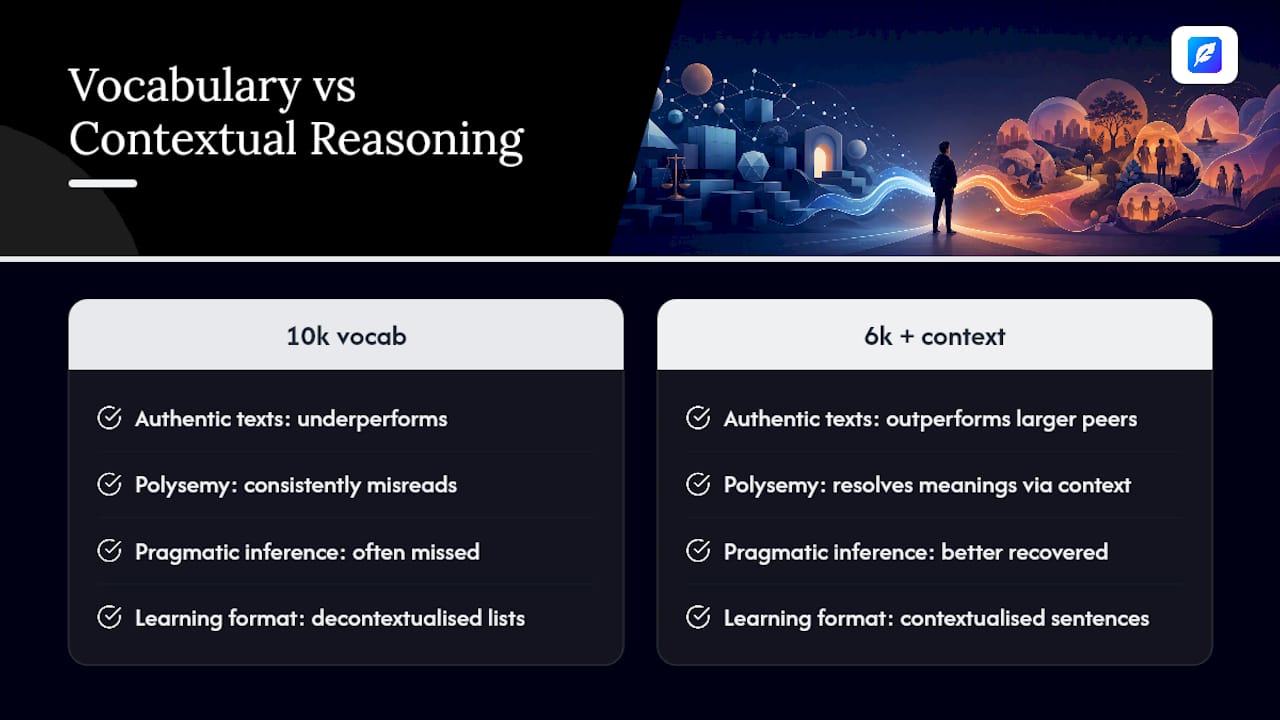
This is not an argument against building vocabulary. It is an argument for building it contextually. The fMRI evidence showing that the brain actively uses context during word recognition, not after it, means that decontextualised learning (word lists, translation equivalents) trains a process that does not match how fluent reading actually works. Every word learned in a rich, situationally specific sentence is a word whose neural representation is already partially integrated with the context types that will later retrieve it.
For translators and editors, the implication is sharper still. A translation that preserves denotation but ignores register, cultural association, and discourse context will read as technically accurate and pragmatically wrong. The same applies to proofreading: a grammatically correct sentence can still carry the wrong sense if the word choice does not match the situational and social context of the document.
Inspirowrite: context-aware proofreading and editing
Getting word choice right in context is harder than it looks, especially for non-native writers or anyone working under time pressure. Inspirowrite gives you instant, privacy-focused feedback on grammar, style, tone, and register, without storing your text or using it to train AI models.
Where context matters most, Inspirowrite's tone and style adjustments flag words that are technically correct but contextually off: too formal for a casual brief, too colloquial for an academic submission, or carrying connotations that clash with the surrounding text. Upload a file, paste a passage, or use the API for team workflows, and receive suggestions in seconds.
- Tone and register adjustment: flags mismatches between word choice and the situational context of your document.
- Rephrasing and expansion: offers alternative phrasings that preserve meaning while fitting the discourse context more precisely.
- Multi-language support: delivers contextual feedback across languages, useful for translators and bilingual writers.
Try Inspirowrite to check that your word choices match the context your readers will bring to them.
Sources
- When it comes to language, context matters | MIT News
- Context-Dependent Interpretation Of Words: Evidence For Interactive Neural Processes - PMC
- Meaning and context (IEP) - Internet Encyclopedia of Philosophy
- Context change and the role of meaning in word recognition (PubMed)
- Contextual | Definition | Cambridge Dictionary
- How context helps us understand the meaning of words | Psychology Today
FAQ
What is the role of context in word meaning?
Context determines which of a word's possible senses is intended in a specific utterance. Without co-text, situational cues, and background knowledge, polysemous words remain ambiguous.
What does "contextual meaning" mean in simple words?
Contextual meaning is the meaning a word takes on from its surroundings, as opposed to its dictionary definition. "Cool" means something different in a weather forecast than in a conversation about music.
What is a better word for "context" in linguistics?
Linguists often use "co-text" for the surrounding words specifically, and "situational parameters" or "discourse context" for the broader setting. "Frame" is used in cognitive linguistics to describe the background knowledge a word activates.
How does context affect word meaning in practice?
Readers use the topic of a text, the words immediately surrounding a target word, and their knowledge of the situation to select the most probable sense. fMRI research shows this process begins during word recognition itself, not after it.
Why do idioms and sarcasm resist normal contextual interpretation?
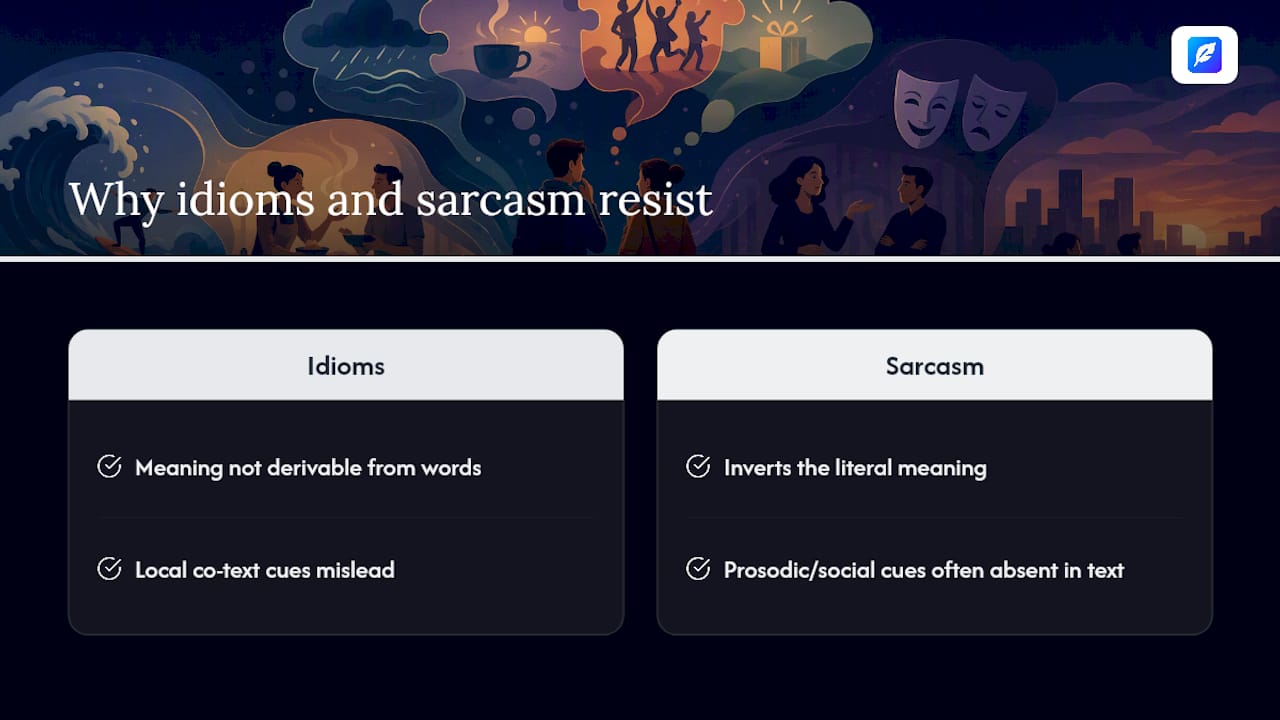
Idioms have meanings that cannot be derived from their component words, so local co-text cues point in the wrong direction. Sarcasm inverts the literal meaning using prosodic or social cues that written text often lacks, making the intended sense invisible to readers who rely solely on linguistic context.