

TL;DR:
- Source text quality influences translation accuracy, error propagation, and overall project cost.
- Focusing on clarifying, standardizing, and correcting source documents improves downstream results significantly.
Source text quality is defined as the degree to which a written document meets established criteria for clarity, accuracy, consistency, and usability before it is translated, proofread, or repurposed. Poor quality at the source level does not stay contained. It multiplies downstream, inflating errors across every language a document is translated into and increasing the cost of correction at every stage. The CRAAP test provides one of the most widely used frameworks for source text evaluation, assessing Currency, Relevance, Authority, Accuracy, and Purpose. Understanding these criteria is the first step to producing text that holds up under scrutiny.
What is source text quality and how is it defined?
Source text quality refers to how well a written document satisfies the criteria required for its intended use, whether that use is translation, academic submission, or professional publication. The term "text quality assessment" is the recognised industry phrase for this process. Both terms describe the same goal: measuring whether a piece of writing is fit for purpose.
The core dimensions of quality text are well established across linguistics and translation studies:
- Clarity: sentences convey one idea at a time, with no ambiguous pronouns or vague references.
- Accuracy: facts, figures, and claims are correct and verifiable.
- Coherence: ideas connect logically from sentence to sentence and paragraph to paragraph.
- Terminological consistency: the same concept uses the same word throughout, with no unexplained synonyms.
- Structural soundness: the document follows a logical order, with clear headings and numbered sections where appropriate.
- Appropriate formality: the register matches the audience and purpose, whether academic, technical, or conversational.
The CRAAP test framework maps directly onto several of these dimensions. Currency checks whether the information is up to date. Authority asks whether the author has the expertise to write on the subject. Purpose examines whether the text has a clear, stated aim.
Pro Tip: Before submitting any document for translation or publication, read each sentence aloud. If you pause or re-read a sentence, that is a signal the sentence needs revision.
How do human evaluators and automated models assess text quality?
Text quality assessment uses two broad approaches: human evaluation and automated scoring. Each has distinct strengths and known weaknesses.

Human evaluation scales
Human assessors typically use one of three scale types:
- Holistic scales: the rater assigns a single overall score based on general impression. These are fast but subjective, and standardisation is difficult across different raters.
- Analytic scales: the rater scores separate dimensions such as grammar, coherence, and vocabulary independently. This produces more detailed feedback but takes longer.
- Primary trait scales: the rater focuses on one specific quality relevant to the task, such as argumentation in an academic essay or terminological precision in a technical manual.
A review of 60 writing assessment studies found that validity of scales is often assumed, not tested. That finding matters because it means many quality scores carry hidden uncertainty.
Automated assessment models
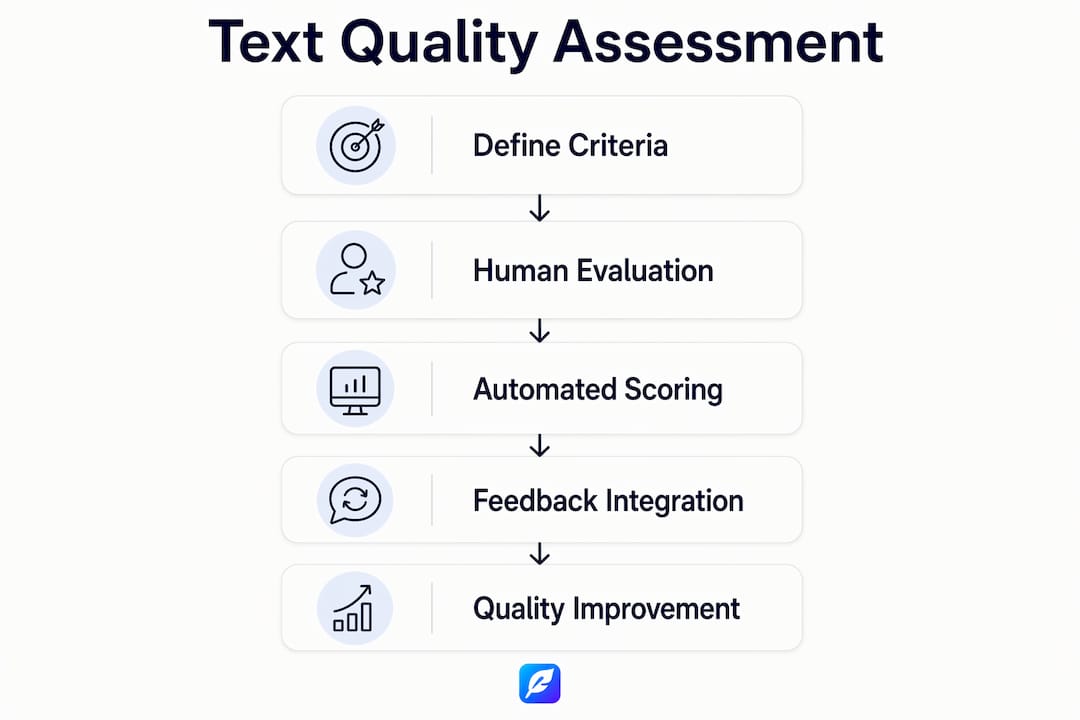
Automated tools now measure properties well beyond grammar. Modern AI models assess Information Density, Compression Ratio, Fluency, and Formality as distinct, measurable properties. This represents a significant advance over earlier tools that checked only spelling and syntax.
The table below summarises the key metrics used in modern automated text quality assessment:
| Metric | What it measures | Why it matters |
|---|---|---|
| Fluency | Grammatical correctness and natural flow | Signals readability and professionalism |
| Information Density | Ratio of content words to total words | Indicates how much meaning each sentence carries |
| Compression Ratio | Length relative to informational content | Flags padding or over-compression |
| Formality | Register appropriateness for audience | Ensures tone matches context |
| Readability | Sentence length and complexity | Predicts how easily a reader processes the text |
One important caveat applies to automated scoring. Transformer-based models rate GPT-generated text 10–20% higher than human-authored text, based on analysis of 18,460 essays. That bias means automated scores for AI-generated content are systematically inflated and should not be taken at face value.
Specialised multilingual models address some of these limitations. MTQ-Eval achieves a correlation of MCC 0.39 across 115 languages, compared to 0.21 for standard fine-tuned models. Better correlation means the model's quality judgements align more closely with human expert judgements.
What challenges affect source text quality across different contexts?
Source text quality is not a fixed standard. Quality criteria shift depending on context: technical manuals require terminological precision, while marketing copy demands cultural adaptability and tone matching. A document that scores well for a technical audience may fail completely for a general readership.
Several specific challenges recur across professional writing contexts:
- Ambiguous references: pronouns without clear antecedents force translators to guess, and different translators will guess differently.
- Inconsistent terminology: using "client," "customer," and "user" interchangeably in a single document creates confusion in translation and in automated processing.
- OCR errors and fragmented sentences: logical reasoning alone cannot resolve OCR flaws or contradictions in scanned documents. These require human correction before any further processing.
- AI-generated text risks: fluent AI text can still be factually wrong. Automated quality metrics measure fluency well but do not detect hallucinations. Source-faithfulness checks are required as a separate step.
- Cultural and register mismatches: a formal legal tone applied to a consumer-facing document creates distance and reduces comprehension.
The economic impact of poor source text is significant. Single source ambiguities replicate across every target language in machine translation post-editing, multiplying errors and cost exponentially. One unclear sentence in an English source document can generate dozens of incorrect translations across a multilingual product release.
Pro Tip: Maintain a project glossary before writing begins. Define every key term once, and enforce that definition throughout the document. This single step reduces terminological inconsistency more than any post-writing revision.
For writers working with multilingual business documents, understanding how quality standards differ by document type is particularly useful.
How to improve source text quality before translation or evaluation
Improving source text quality is a pre-writing and editing discipline, not a last-minute fix. The steps below apply to any document intended for translation, automated processing, or professional publication.
- Simplify complex sentences. Break any sentence with more than two clauses into two separate sentences. Subject-verb-object structure is the most translatable sentence form in any language.
- Clarify all pronoun references. Replace "it," "this," and "they" with the specific noun they refer to, especially at the start of a paragraph.
- Establish and apply a glossary. Define every technical or domain-specific term before writing. Use that term exclusively throughout the document. For technical translation, terminological precision is the single most important quality criterion.
- Correct OCR and formatting errors. Scanned documents frequently contain character substitutions, broken words, and missing punctuation. Correct these before any translation or evaluation step.
- Number pages and sections. Numbered sections allow translators and reviewers to reference specific passages without ambiguity.
- Remove duplicate content. Repeated paragraphs or redundant instructions inflate word count and introduce inconsistency if one instance is updated and another is not.
- Check information density. Sentences that carry very little meaning per word signal padding. Cut or consolidate them. Lexical density is a measurable property that modern tools can score directly.
Pre-editing source texts by simplifying sentences and correcting errors is the most effective way to improve raw machine translation output and reduce the burden on human post-editors. The effort invested before translation consistently reduces total project cost.
The role of proofreading in this process is often underestimated. Proofreading is not just a final check for typos. It is a structured quality gate that catches logical inconsistencies, register shifts, and terminological drift before they cause downstream problems.
Key takeaways
Source text quality determines the accuracy, cost, and usability of every downstream process, from translation to automated evaluation, making it the most important variable a writer controls.
| Point | Details |
|---|---|
| Definition of quality | Source text quality covers clarity, accuracy, coherence, consistency, and appropriate formality. |
| CRAAP test framework | Currency, Relevance, Authority, Accuracy, and Purpose provide a structured evaluation checklist. |
| Automated bias risk | Transformer models score AI-generated text 10–20% higher than human text, so automated scores need scrutiny. |
| Context determines criteria | Technical documents prioritise terminological precision; marketing copy prioritises cultural tone. |
| Pre-editing reduces cost | Simplifying sentences and correcting errors before translation multiplies quality gains across all target languages. |
Why source text quality deserves more attention than it gets
Most writers treat quality as a property of the final draft. After years of working with translated and evaluated documents, I am convinced that view is backwards. Quality is a property of the source, and everything downstream is a consequence.
The most expensive mistakes I have seen in professional writing projects were not translation errors. They were source errors that nobody caught before the document went to a team of translators working across eight languages. One ambiguous sentence in the source became eight different interpretations in the target languages, each of which had to be corrected individually. The cost of fixing that one sentence after translation was roughly forty times what it would have cost to fix it before.
The challenge with automated tools is that they measure what they can measure. Fluency scores are reliable. Hallucination detection is not. A document can score well on every automated metric and still be factually wrong or culturally inappropriate. That gap between measurable fluency and actual grounding is the most underappreciated risk in modern content production.
My view is that the field needs clearer standards, not more metrics. The lack of standardisation in writing quality assessment means that two evaluators using different scales can reach opposite conclusions about the same document. Until that problem is addressed, writers and professionals should treat any single quality score as one data point, not a verdict.
— Mike
How Inspirowrite helps you produce better source texts
Writers and students who want to catch quality issues before they become costly problems have a direct route to improvement.
Inspirowrite provides AI-powered proofreading and translation that checks grammar, style, and consistency in seconds. Unlike general-purpose tools, Inspirowrite keeps your content private and does not use it to train AI models. That matters when you are working with sensitive documents or proprietary content. Whether you are preparing a technical manual for translation or polishing an academic essay, Inspirowrite's proofreading tools give you immediate, specific feedback on the issues that affect source text quality most. Students can also benefit from the essay proofreading checklist to structure their revision process before submission.
FAQ
What is source text quality in simple terms?
Source text quality is how well a written document meets the criteria of clarity, accuracy, consistency, and appropriate style for its intended use. A high-quality source text produces better translations, clearer evaluations, and fewer costly corrections.
What are the main criteria for evaluating source text?
The main criteria are clarity, coherence, accuracy, terminological consistency, structural soundness, and formality. The CRAAP test adds Currency, Relevance, Authority, and Purpose as additional evaluation dimensions.
How does poor source text quality affect translation?
Poor source text multiplies errors across every target language in translation. A single ambiguous sentence in the source can generate multiple incorrect translations, increasing post-editing cost and effort significantly.
Can automated tools fully assess source text quality?
Automated tools measure fluency, information density, formality, and readability reliably. They do not reliably detect factual errors or hallucinations, so human review remains necessary for accuracy and grounding checks.
What is the fastest way to improve source text quality?
Simplify sentences to one idea each, replace vague pronouns with specific nouns, and apply a consistent glossary throughout the document. These three steps address the most common sources of translation and evaluation errors.