

TL;DR:
- Brand voice is a brand's unique personality conveyed consistently across all content and languages.
- Effective cross-cultural branding requires adapting meaning and tone to local cultures while maintaining core traits.
Brand voice is the distinctive personality a brand communicates consistently across every piece of content it produces. Understanding why brand voice crosses languages is not optional for marketers managing global audiences. It is the difference between a brand that resonates worldwide and one that sounds foreign, flat, or even offensive in new markets. 88% of marketers confirm that a defined brand language is critical for connecting with customers, improving engagement, retention, and sales. That figure alone signals how much is at stake when voice gets lost in translation.
Why brand voice crosses languages: the core principle
Brand voice crossing languages means the same personality travels into every market, expressed through culturally appropriate language rather than word-for-word translation. The industry term for this process is brand localisation, and it sits at the intersection of linguistics, cultural psychology, and marketing strategy.

The distinction between brand voice and tone matters here. Brand voice is constant. It is the personality your brand holds regardless of market or medium. Tone is flexible. It shifts depending on context, audience, and channel. A brand that is warm and direct in English can remain warm and direct in Japanese, but the linguistic markers that signal warmth differ completely between those two cultures.
33% of consumers identify a distinct, consistent brand personality as the primary reason a brand stands out in crowded markets. Consistency does not mean uniformity of words. It means uniformity of feeling. A brand that makes customers feel trusted and understood in London must produce that same feeling in São Paulo or Seoul, using the vocabulary and cultural codes that carry that meaning locally.
Pro Tip: Build a brand voice document that separates "what we always are" from "how we express that locally." The first column is fixed. The second column is a living resource updated by local market leads.
| Communication style | English expression | German equivalent |
|---|---|---|
| Warmth | Informal, friendly, first-name terms | Reliable, precise, respectful formality |
| Directness | Short sentences, active voice | Clear structure, logical sequencing |
| Playfulness | Puns, colloquialisms, light humour | Wit grounded in facts, not wordplay |
| Authority | Confident assertions, minimal hedging | Evidence-led claims, formal register |
Why do brand voice challenges arise across cultures?
The most common mistake brands make is treating translation as a word conversion exercise. Distinguishing translation from localisation is the foundational challenge. Translation converts words. Localisation adapts meaning, rhythm, register, and cultural expectation. Brands that impose a single voice template across all markets without calibrating for cultural expression consistently fail to connect.
The problem runs deeper than vocabulary. Voice is conveyed through micro-decisions translators make daily: synonym selection, sentence rhythm, and register. Without brand context, translators default to generic local equivalents. The result is content that reads correctly but sounds like nobody in particular. Brand personality evaporates.
Cultural misfires are the visible symptom of this problem. Spanish warmth expressed informally can read as childish in German markets, where warmth signals reliability and precision rather than friendliness. A brand that sounds approachable and fun in Madrid may sound unprofessional in Munich using the same structural approach. These are not translation errors. They are cultural misreadings.
Fragmented voice across content types compounds the issue further. Consider these common failure points:
- Inconsistent glossaries: Different agencies use different synonyms for core brand terms, producing a patchwork of personalities across markets.
- No brand brief for translators: Translators receive text without persona context, so they write for linguistic correctness rather than brand character.
- Register drift: Marketing copy, customer service scripts, and legal notices each end up in different registers with no unifying voice thread.
- Emoji and visual language mismatches: Positive emojis vary significantly in cultural interpretation, meaning a brand's playfulness signals can land very differently across markets.
- Over-reliance on generic AI translation: Without brand-trained inputs, AI tools produce what amounts to a consistency of mistakes, replicating generic norms rather than brand character.
Pro Tip: Before briefing a translation agency, share three examples of your brand voice done well and three examples of what your brand never sounds like. Examples outperform adjectives every time.
How can brands maintain their voice across languages?
Successful cross-language brand voice management starts with a structured brand brief that separates fixed identity from flexible cultural expression. The fixed layer contains non-negotiable core values: the personality traits, the emotional promise, and the communication principles that define the brand globally. The flexible layer gives local market leads permission to adapt expression while honouring those principles.
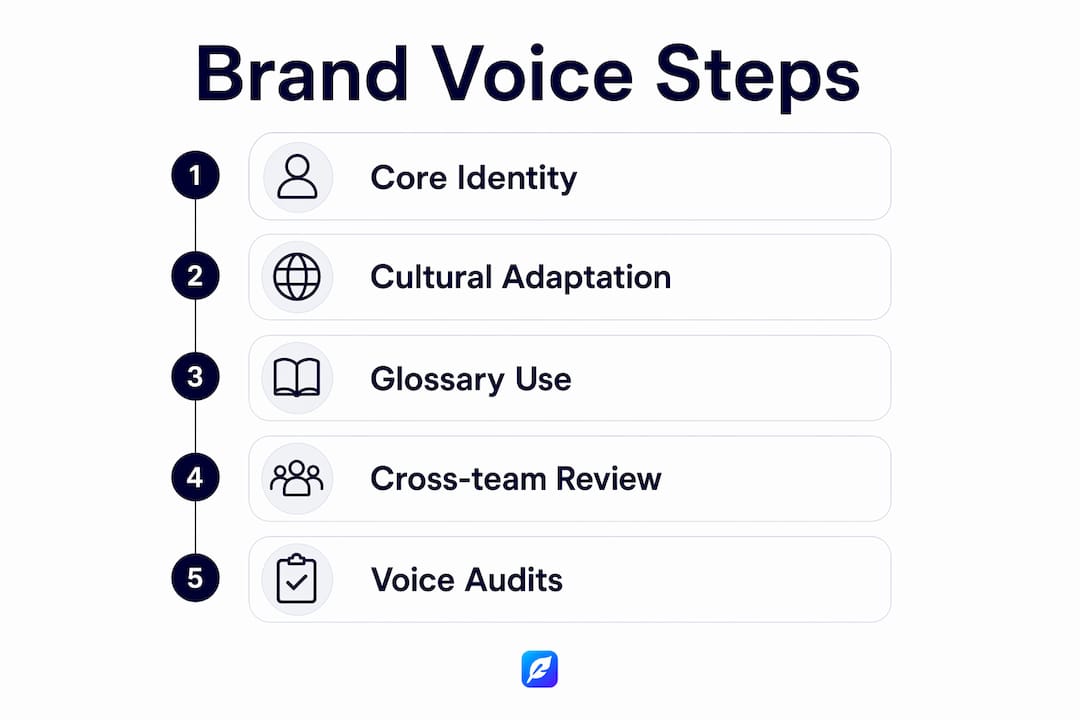
Shifting from command-and-control to flexible brand principles empowers local markets to preserve brand voice while respecting cultural nuances. This model, sometimes called a Flex Zone approach, treats the core identity as non-negotiable and the cultural expression as a space for authorised creativity. Local teams stop feeling policed and start feeling trusted. That trust produces better, more authentic local content.
A practical framework for maintaining brand voice across languages includes these steps:
- Define the fixed core. Write down three to five personality traits with concrete examples of what each trait looks and sounds like in your primary language.
- Build a brand glossary. List approved translations for key brand terms in each target language. Include terms to avoid alongside preferred alternatives.
- Create a translation memory. Store approved translated phrases so every piece of content builds on consistent precedents rather than starting from scratch.
- Involve local leads early. Bring local market managers into messaging development before copy is finalised, not after. They catch cultural misreadings before they become published mistakes.
- Audit for emotional equivalence. Check whether translated content produces the same emotional response as the source, not just the same literal meaning. Use native speaker panels or structured feedback loops.
- Train AI tools with brand context. Generic AI translation defaults to linguistic norms. AI without brand-trained glossaries strips brand-specific voice markers and produces uniform, generic language that erodes personality internationally.
| Framework element | Purpose | Output |
|---|---|---|
| Fixed core identity | Defines non-negotiable brand personality | Personality trait document with examples |
| Cultural expression layer | Allows local adaptation within brand principles | Market-specific tone guidelines |
| Approved glossary | Standardises key terminology per language | Bilingual term lists with context notes |
| Translation memory | Builds consistency across content over time | Reusable approved phrase library |
| Emotional equivalence audit | Measures resonance, not just accuracy | Native speaker review reports |
What tools and processes support cross-language brand voice?
Technology supports brand voice consistency at scale, but only when configured with brand intent. Translation memories store approved phrase pairs so that recurring brand expressions remain consistent across every document, campaign, and channel. Without them, each new piece of content risks introducing new linguistic drift.
Glossaries go further than translation memories by capturing stylistic preferences alongside terminology. A glossary entry for a brand like a financial services firm might specify not just the approved translation of a product name but also the register, the sentence structure, and the contexts where a term should never appear. This level of specificity is what separates a brand-aware glossary from a basic dictionary.
Cross-functional collaboration between marketing, translation, and localisation teams is the organisational practice that makes technology effective. Brands that treat localisation as a downstream task rather than a co-creative process consistently produce fragmented voice. When translators sit in on brand strategy sessions, they absorb the personality context that no brief fully captures.
Regular voice audits focused on emotional impact rather than linguistic accuracy are the final piece. Auditing brand voice across languages requires looking beyond literal correctness to the emotional resonance and cultural fit of messaging. Native speaker panels, structured surveys, and social listening in local languages all provide signals that a word-for-word accuracy check misses entirely. Common business translation errors often go undetected precisely because they are linguistically correct but culturally wrong.
Key takeaways
Brand voice crosses languages successfully only when a fixed core identity is paired with culturally adapted expression, governed by brand-trained glossaries, translation memories, and local market collaboration.
| Point | Details |
|---|---|
| Voice is not words | Brand voice is a personality, not a phrase set. Translate the feeling, not the sentence. |
| Localisation beats translation | Cultural adaptation of meaning, rhythm, and register preserves brand character where word conversion fails. |
| Micro-decisions matter | Synonym choice and sentence rhythm either reinforce or erode brand personality with every translated line. |
| Flexible principles work | Empowering local teams with brand guardrails produces more authentic content than rigid top-down control. |
| Audit emotionally | Measure whether translated content feels the same, not just whether it reads correctly. |
The uncomfortable truth about brand voice and language
Most brands I have observed treat brand voice as a creative asset and localisation as an operational task. That split is the root cause of most cross-cultural brand failures. When voice lives in the creative team and translation lives in procurement, the two never properly meet. The result is a brand that sounds brilliant in its home market and generic everywhere else.
The technology question is more nuanced than most guides admit. AI translation tools have improved dramatically, but without brand-aware inputs, they produce a kind of confident mediocrity. The output is grammatically correct, culturally neutral, and entirely forgettable. That is not a translation failure. It is a brand governance failure. The tool did exactly what it was configured to do.
What I find most brands underestimate is the value of cross-cultural empathy within their own teams. A brand manager who has lived in the target market, or who works closely with someone who has, makes fundamentally better localisation decisions than one who relies entirely on briefs and agency feedback. That human understanding of cultural nuances in branding is not replaceable by process alone.
The brands that get this right treat voice as shared principles rather than a fixed script. They give local teams real creative latitude within a clearly defined identity. They audit for resonance rather than accuracy. And they accept that a brand that sounds slightly different in every market, while feeling exactly the same, is doing precisely what it should.
— Mike
How Inspirowrite supports multilingual brand consistency
Maintaining brand voice across languages requires tools that understand the difference between translation and localisation.
Inspirowrite offers AI-powered proofreading and translation built for writers and brand communicators who need fast, accurate results without sacrificing style or personality. Unlike generic translation tools, Inspirowrite keeps your content confidential and does not use it to train AI models, making it a trustworthy choice for sensitive brand materials. Brand managers can use Inspirowrite to review translated content for stylistic consistency, catching register drift and tone mismatches before they reach the market. Visit Inspirowrite to see how it supports your multilingual brand work.
FAQ
What is brand voice in different languages?
Brand voice in different languages is the same core personality expressed through culturally appropriate language. The identity stays fixed while the linguistic expression adapts to local norms and expectations.
Why does direct translation fail to preserve brand voice?
Direct translation converts words without adapting cultural meaning, rhythm, or register. Voice is carried by micro-decisions in synonym choice and sentence structure, which generic translation ignores.
How does brand voice adapt across cultures?
Brand voice adapts by separating fixed personality traits from flexible cultural expression. Local market leads apply the core identity using the linguistic and cultural codes that carry the same emotional meaning in their market.
What is the role of a glossary in cross-language brand voice?
A brand glossary standardises approved translations for key terms and specifies stylistic preferences per language. It prevents synonym drift and keeps brand personality consistent across agencies and content types.
How do you audit brand voice across languages?
Auditing brand voice across languages means checking for emotional equivalence rather than literal accuracy. Native speaker panels and structured feedback loops reveal whether translated content produces the same feeling as the source.